An air fryer pizza pan is a small, rimmed pan sized to fit inside an air fryer basket or oven-style air fryer, giving a flat surface for dough and toppings while hot air circulates around it. The short answer for choosing one: measure your basket interior, leave visible clearance on every side, confirm accessory and temperature limits in your appliance manual, then follow the manual or recipe for time and temperature because air fryers vary by size and power. For a closer look at pan styles and sizes, see this air fryer baking pans buying guide.
Why a Dedicated Pan Changes the Air Frying Process
Air fryers work as compact convection ovens: food browns and crisps because hot air circulates quickly around it. A pizza pan gives the dough that flat, supported surface so it can be set down, topped and lifted back out without folding or tearing. It also keeps loose toppings such as shredded cheese and sauce inside a rim rather than dropping through the basket.
The trade-off is space. Air fryers generally do not have much room inside, and blocking the airflow defeats the purpose of the appliance. A pan that fills the basket edge to edge can stop air from moving around the food, which is why fit matters as much as material.
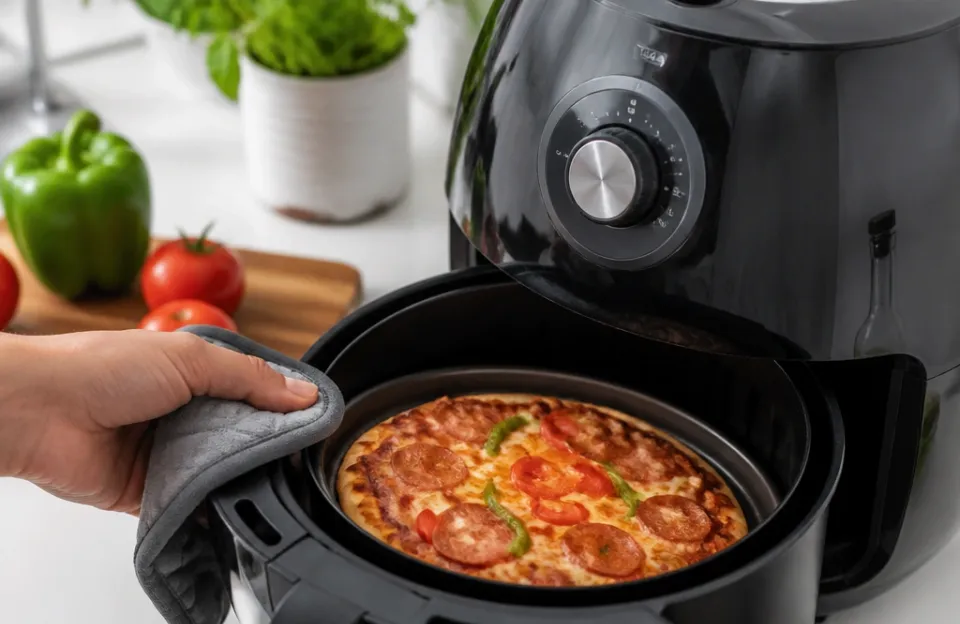
A pan that leaves clearance around the edge lets hot air reach the sides and base of the pizza, which is the same circulation principle that makes an air fryer work for other foods.
Choosing a Material: Coated Aluminum, Stainless Steel or Silicone
Material affects heat transfer, weight, durability and how carefully you must handle the pan. The guidance below describes general material behavior rather than tested performance of a specific product, and manufacturer specifications for any pan you consider should take priority.
| Material | Typical strengths | Typical trade-offs |
|---|---|---|
| Coated aluminum | Lightweight and good heat conduction; nonstick surfaces release pizza easily | Coating can scratch or flake with metal tools or harsh scouring; follow the pan maker’s care instructions |
| Stainless steel | Durable, unbranded surfaces, no coating to peel | Food can stick, so greasing matters; may be heavier for its size |
| Silicone | Flexible, quiet in the basket, easy to turn out dough | Browns the crust less readily than metal; less rigid support for a loaded pizza |
These descriptions are general expectations, not ratings of any individual pan. Do not assume a pan is dishwasher-safe, oven-safe or rated for a particular temperature unless the maker’s label says so. For cookware coating questions, official guidance from the FDA on PFAS and from the CPSC on cookware is a better reference than retailer marketing copy.
Sizing the Pan to Your Air Fryer Basket
Buying a pan without measuring your basket first is the quickest way to waste money. Use this sequence:
- Measure the basket interior across its narrowest point, not just the widest opening, because the basket often tapers.
- Note the usable depth so a rimmed pan does not touch the heating element or sit too close to the top of an oven-style unit.
- Choose a pan that leaves a visible gap on all sides for air to move.
- Read the appliance manual for any accessory clearance rules or restrictions on third-party pans.
- Check that the pan’s handle or rim will still clear the door or drawer as it closes.
If a pizza will not fit on the largest pan your basket can hold, cook in batches instead of forcing a crowded fit. Overcrowding an air fryer can prevent enough air circulation to cook food properly.
Perforated vs Solid Pans: Crust and Cleanup Trade-Offs
Perforated pans have small holes that let hot air reach the base of the dough directly. Solid pans hold the pizza on a continuous surface. The comparison below is a practical one about basket behavior, not a claim of measured crust quality.
- Perforated pans tend to help the base set and dry, which many cooks want for a crisper bottom. They also let crumbs and small bits fall through into the basket, so cleanup can involve the drawer as well as the pan. The air fryer baking pans buying guide covers perforation styles in more detail.
- Solid pans catch sauce and loose cheese, keeping the basket cleaner. They can slow browning underneath because air reaches the base only around the rim.
Whichever you choose, lighten the toppings so the center of the dough can bake through. A heavy load on a small pan is one of the most common causes of a pale, soggy middle.
Baking a Personal Pizza Step by Step
Air fryers can bake, roast and reheat food without it turning soggy. For pizza, the technique matters as much as the pan:
- Stretch or roll the dough to a size that fits inside the pan rim with a little margin for shrinkage.
- Lightly grease the pan, or line it only if the liner is rated for the temperature and approved for air fryer use by its maker.
- If your pan maker or recipe says to preheat the empty metal pan, do so within the appliance’s limits. Do not preheat a coated pan empty unless its instructions allow it.
- Add sauce and cheese sparingly. A thin, even layer browns better than a thick one.
- Set the appliance to the temperature and time in your recipe or manual, not a universal figure, because cooking times vary between air fryers with different sizes and power.
- Check halfway and rotate the pan if your model browns unevenly.
- Lift the pizza out with a spatula rather than tipping the pan, so loose toppings stay in place.
These steps reflect general air fryer practice and the appliance guidance that cooking times vary by model. They are not a substitute for the instructions that came with your pan or air fryer.
For starting points, home air fryer recipes commonly call for temperatures in the range used for general air frying, and foods generally cook in 5 to 25 minutes at 350°F to 400°F. Your pizza’s exact time will depend on dough thickness, topping load and your appliance. Treat these figures as a general range, not a tested recipe for your specific machine.
Troubleshooting Soggy Crust, Burnt Tops, Smoke and Warping
Most problems trace back to airflow, topping load or temperature. Here is a quick diagnostic:
| Problem | Likely cause | Check | Fix |
|---|---|---|---|
| Soggy or pale center | Toppings too heavy, pan too crowded, low heat | Is there clearance around the pan? Is the cheese piled thick? | Reduce toppings, use a smaller pizza or batch, extend baking time slightly |
| Burnt cheese or crust edge | Too close to the heating element, high temperature | Is the pan too tall for the basket? | Lower the pan, reduce temperature, cover loose areas with foil only if the manual allows |
| Smoke from the appliance | Grease or crumbs on the heating element or basket floor | Check below the pan and the element | Clean the basket, empty drips, reduce fatty toppings |
| Warped pan | Pan not rated for the heat, or uneven metal | Check the pan’s temperature rating | Switch to a pan rated for your appliance’s maximum temperature |
These are general diagnostic suggestions based on how air fryers circulate hot air. Where the manual gives specific instructions, follow those instead.
Use a food thermometer for any meat or poultry toppings, and confirm they reach a safe internal temperature. Refrigerate leftover pizza within 2 hours to avoid the temperature danger zone between 40°F and 140°F.
For pans with a nonstick coating, gentler tools and following the maker’s cleaning instructions help maintain the surface. Store stacked pans with a cloth or paper liner between them to prevent scuffs. For coating questions that affect health, prefer the manufacturer’s statement or official guidance over retailer marketing copy.
Cleaning, Care and Storage
Let the pan cool fully before washing unless its instructions say otherwise. For baked-on cheese and flour, soak the pan in warm soapy water first, then use a soft sponge or nylon brush. Avoid metal scrubbers on coated surfaces and harsh scouring on any pan whose finish you want to keep. Check the manufacturer’s guidance for dishwasher suitability rather than assuming it. These are general care suggestions; the pan maker’s instructions take priority.
Store pans flat or nested with protection between surfaces, and keep handles clear of the drawer opening so they do not catch.
When the Bare Basket or a Standard Pan Works Better
A dedicated pizza pan is not always necessary. Reheating a slice, cooking a frozen mini pizza or making a family-size pie in a conventional oven may be simpler without one. The pan earns its place when you are building a personal pizza from fresh dough, want a rim to contain toppings, or need a flat surface to lift the finished pizza out cleanly.
FAQ
Can I use any small pan in my air fryer? Only if it fits with clearance and your appliance manual permits accessories of that size and material. Check the pan’s temperature rating against your appliance’s maximum. If the manual is silent, contact the appliance maker before using a third-party pan.
Should I preheat the pan before adding dough? Follow your recipe or pan instructions. Do not preheat a coated pan empty unless its maker allows it.
Do I need parchment paper under the pizza? Not always, but if you use a liner, confirm it is rated for the temperature and approved for air fryer use by its manufacturer. Parchment can lift and touch the heating element in some baskets, so check your manual. When in doubt, skip the liner and grease the pan instead.
Why is my pizza soggy in the middle? Usually too many toppings, insufficient clearance or too low a temperature. Reduce the load and check airflow around the pan.
Can I bake a pizza in an oven-style air fryer with a rack? Many oven-style models accept small pans on a rack. Confirm the rack position and clearance in your manual before baking. If the manual does not address pan use, contact the manufacturer first.
How do I know the pan’s maximum temperature? The pan’s packaging or maker’s documentation should state it. If it does not, treat the pan as unsuitable for high-heat air frying until you can confirm.