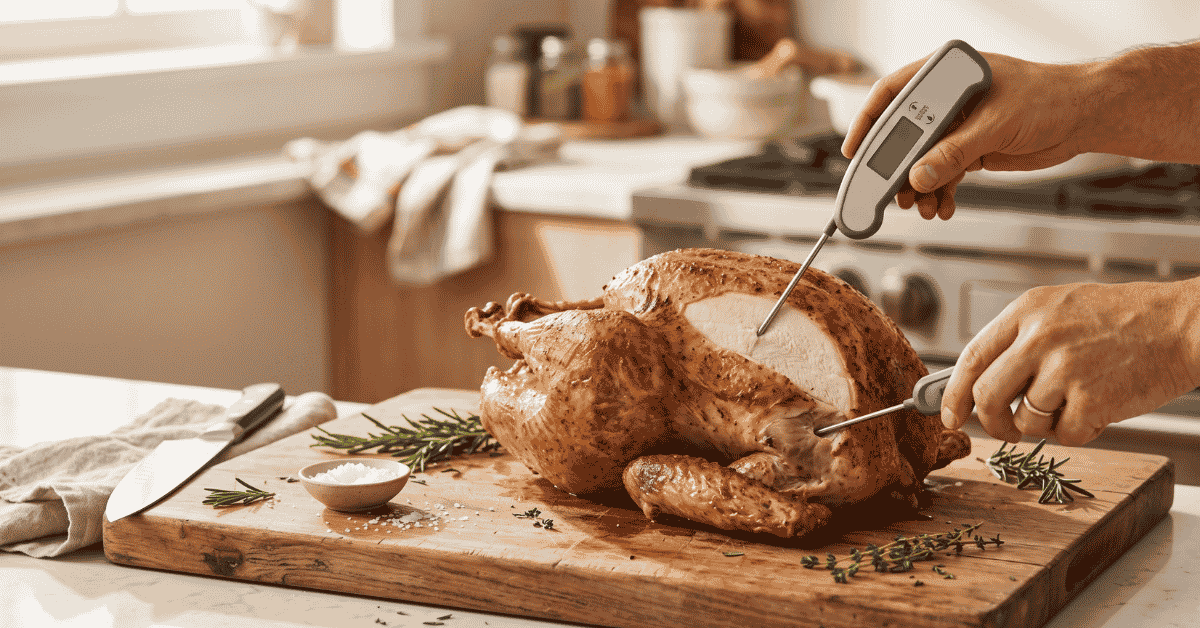
You pull the roasting pan out of the oven, insert your thermometer into the thickest part of the bird, and see two wildly different numbers. The breast is already hitting 160°F, but the thigh is barely at 155°F. If you wait for the thigh to catch up, the white meat may turn dry and stringy. If you pull it now, the dark meat may stay chewy.
Quick Answer: Turkey breast and turkey thigh need different target temperatures because they are different muscle types. The USDA sets a safe minimum of 165°F for all poultry, including every part of the turkey. Breast meat is lean and dries out quickly, so it is best pulled near that minimum and allowed to rest. Thigh meat contains more connective tissue, which softens into gelatin with sustained heat, so many cooks prefer it cooked to a higher internal temperature for better texture. The higher thigh temperature is a matter of eating quality, not a safety requirement.
The 165°F Safety Baseline
Before discussing texture, establish the rule that does not change. A whole turkey is safe when it reaches a minimum internal temperature of 165°F, measured with a food thermometer. That same safe minimum applies to poultry parts, including breasts, legs, thighs, wings, ground poultry, giblets and stuffing.
The USDA advises checking the temperature in the innermost part of the thigh and wing and the thickest part of the breast. If your turkey came with a pop-up indicator, the USDA recommends also checking those three locations with a food thermometer rather than relying on the indicator alone.
The USDA also notes that consumers may choose to cook food to higher temperatures than the safe minimum for personal preference. That allowance is the space where thigh texture preferences live.
White Meat vs. Dark Meat: What Changes in the Oven
The two parts of the same bird behave differently because they are built for different work. Breast meat comes from fast-twitch muscles used for brief bursts of activity. It is pale and lean, with little fat or connective tissue to protect it from heat.
Thighs and legs are slow-twitch working muscles used for standing and walking. They contain more myoglobin, the protein that gives dark meat its color, along with more fat and connective tissue. Hard-working muscles contain more collagen, while tender cuts have much less connective tissue.
That difference in connective tissue is the main reason the two parts respond differently to the same oven temperature.
The Collagen Factor in Turkey Thighs
Collagen is the tough protein that holds muscle fibers together. When collagen is heated in the presence of water, its triple-helix structure begins to unravel around 60°C (140°F), and with sustained heat it converts to gelatin. The conversion is gradual and requires continued cooking at or above that temperature to complete.
That is why thigh meat tolerates, and often benefits from, more heat than the breast. A thigh pulled at exactly 165°F is safe, but the collagen may not have had enough time and heat to soften fully, so the meat can still feel firm or chewy. Holding the thigh at a somewhat higher internal temperature gives the collagen more opportunity to convert.
Elastin, another connective tissue protein, is more heat-stable and only starts to break down above 80°C (176°F). Elastin is a minor component compared with collagen, but it helps explain why very tough cuts need generous heat.
The texture targets many cooks use for thigh meat, roughly 175°F, are personal preference rather than an official rule. There is no USDA requirement to take thigh meat above 165°F. If you prefer firmer dark meat, 165°F is safe and acceptable.
Managing Carryover Cooking at the Breast
Carryover cooking is the continued rise in internal temperature after the bird leaves the oven, as heat moves from the outer layers toward the center. The exact rise depends on bird size, oven temperature, pan and resting conditions. No fixed number of degrees applies to every turkey.
That matters for the breast. Pulling the whole bird below 165°F in the breast depends on carryover lifting it to the safe minimum, and that is not guaranteed. A cautious approach is to confirm the breast has reached 165°F before or during the rest, checking again with the thermometer if you pulled it slightly early.
The USDA advises letting a roasted turkey stand 20 minutes before carving so juices set and the bird carves more easily. Use that rest to confirm the breast and thigh temperatures, and return the bird to the oven if any measured spot is still below 165°F.
How to Measure Breast and Thigh Temperature
Use a digital instant-read thermometer and check the locations the USDA specifies: the innermost part of the thigh, the innermost part of the wing, and the thickest part of the breast.
- Breast: Insert the probe into the thickest part of the breast, away from the bone and the body cavity. Bone heats faster than meat and can give a false high reading.
- Thigh: Aim for the center of the thigh muscle, avoiding the bone. The thigh is usually the slowest part to reach temperature.
- Wing: Check the innermost part of the wing as well, since the USDA includes it among the required locations.
- Pop-up indicators: If present, do not rely on them alone; check all three locations with a food thermometer.
Start checking earlier than you expect the bird to finish. The exact timing varies with bird size, whether the turkey is stuffed, oven performance and pan type, and the USDA notes that many variables affect roasting time. A practical habit is to begin checking about 45 minutes before your estimated finish and then recheck every 15 to 20 minutes. That cadence is a suggestion for convenience, not official guidance.
Techniques to Finish Breast and Thigh Closer Together
The breast sits high and exposed, while the thighs are tucked against the carcass. In a standard oven, that geometry often leaves the breast ahead. Several supported techniques help close the gap.
Use a rack and a shallow pan. The USDA describes placing the turkey breast-side up on a flat wire rack in a shallow roasting pan 2 to 2½ inches deep. A rack lifts the bird so heat circulates underneath. The depth and size of the pan can reduce heat circulation to all areas of the turkey.
Tent the breast with foil early. A loose aluminum foil tent may be placed over the breast for the first 1 to 1½ hours, then removed for browning. Keeping a foil tent over the turkey for the entire roasting time can slow cooking, so remove it as directed. Alternatively, a tent may be placed over the turkey after it has reached the desired golden brown color.
Start breast-side down, if you choose. Some cooks begin with the bird breast-side down so the breast sits lower in the pan, then flip it. This is a technique preference, not an official USDA step, and flipping a hot bird requires care.
Consider spatchcocking. Removing the backbone and flattening the bird puts the thighs and breast on a similar level, which can help them finish closer together. The USDA’s whole-bird guidance does not specifically address spatchcocked turkey, so treat timing as something to monitor with the thermometer rather than a fixed schedule.
Set the oven no lower than 325°F. The USDA recommends an oven temperature no lower than 325°F when roasting turkey.
What to Do If the Breast Is Done First
If the breast reaches 165°F while the thigh is still below it, you have options that keep both parts safe and palatable.
- Confirm the reading. Recheck the breast in the thickest part away from bone, and recheck the thigh in its center. A probe touching bone can read high.
- Shield the breast. Cover the breast loosely with foil to slow further heat gain while the thigh continues cooking.
- Separate the legs if needed. Carve the legs and thighs from the bird and return them to the oven on a separate tray or in a skillet. This lets the breast rest while the dark meat finishes. The USDA’s whole-bird guidance does not cover this recovery step specifically, so keep checking the separated pieces with the thermometer until they reach 165°F.
- Never serve below 165°F. Whatever the texture goal, every part of the turkey should reach the safe minimum before serving.
Stuffing, Edge Cases and Leftovers
Stuffing. For optimal safety and uniform doneness, the USDA advises cooking stuffing separately rather than inside the turkey. If you do stuff the bird, the center of the stuffing must reach a safe minimum internal temperature of 165°F. Even when the turkey meat reaches 165°F, stuffing inside the bird may not have reached a temperature high enough to destroy bacteria. A stuffed turkey also takes longer to cook than an unstuffed one. Remove all stuffing from the cavities after the bird rests and before carving.
Frozen and pre-stuffed birds. A turkey can be safely cooked from the frozen state. Frozen pre-stuffed turkeys should not be thawed before cooking and should be cooked from frozen following package directions. The USDA recommends buying only frozen pre-stuffed turkeys that display the USDA or State mark of inspection.
Thawing. Be sure the turkey is completely thawed before roasting, with roasting times based on a refrigerator temperature of 40°F or below.
Wild turkey. Wild birds are generally leaner than commercial broad-breasted turkeys. Because the available guidance does not specifically address wild turkey, monitor both the breast and thigh closely with a thermometer and do not assume the same timing as a store-bought bird.
Leftovers. Refrigerate cooked turkey and stuffing within 2 hours, place leftovers in shallow containers, and use them within 3 to 4 days. Reheat leftovers to a safe minimum internal temperature of 165°F.
Temperature Reference and Troubleshooting
| Turkey Part | Safe Minimum | Texture Preference | Why |
|---|---|---|---|
| Breast | 165°F | Pull near 165°F, confirm after rest | Lean meat dries out above the minimum |
| Thigh | 165°F | Higher than 165°F for firmer-to-softer preference | More collagen softens with sustained heat |
| Drumstick | 165°F | Often cooked higher for texture | Heavily exercised muscle with connective tissue |
| Wings | 165°F | Often cooked higher for texture | High skin-to-meat ratio; connective tissue |
The texture preference column reflects cook’s choice, not an official requirement.
Frequently Asked Questions
Why Is My Turkey Thigh Still Pink If the Thermometer Says 175°F?
Pink color in cooked poultry does not by itself mean the meat is undercooked. Myoglobin and other pigments can keep meat looking pink even after it reaches a safe temperature. If your thermometer reads at least 165°F in the innermost part of the thigh, away from bone, the meat has met the USDA safe minimum. Verify your thermometer is working correctly and that the probe is not touching bone.
Can I Cook a Turkey Breast to 180°F Just to Be Safe?
You can, but you probably will not enjoy the result. The safe minimum for the breast is 165°F, and taking lean white meat well beyond that point drives out moisture. There is no safety benefit to pushing the breast to 180°F once it has reached 165°F.
Is It Better to Measure Temperature in the Wing or the Thigh?
The USDA advises checking all three: the innermost part of the thigh, the innermost part of the wing, and the thickest part of the breast. The thigh is usually the slowest to reach temperature and is a key safety check, but do not rely on a single location.
How Do I Fix a Bird Where the Breast Is Done but the Thigh Is Only 150°F?
Shield the breast with foil and continue roasting until the thigh reaches 165°F. If the breast is at risk of overcooking, carve off the legs and thighs and finish them on a separate tray, checking with a thermometer until they reach the safe minimum.
Can I Cook a Turkey from Frozen or Use a Frozen Pre-Stuffed Turkey?
Yes. A turkey can be safely cooked from the frozen state. Frozen pre-stuffed turkeys should not be thawed before cooking and should be cooked from frozen following package directions. Buy only frozen pre-stuffed turkeys that display the USDA or State mark of inspection.
Worth Remembering
The breast and thigh need different treatment because they are different muscles with different jobs. The breast is lean and quick to dry out, so it should be pulled near the 165°F safe minimum and confirmed after resting. The thigh has more connective tissue, so many cooks prefer it cooked somewhat higher for better texture, while remembering that 165°F is the safety floor for every part. Check the breast, thigh and wing with a food thermometer, shield the breast if it runs ahead, and never serve any part below 165°F.