If you want total control over your coffee and don’t mind a learning curve, buy a traditional espresso machine. If you want a fast, consistent shot every morning with zero fuss, buy a Nespresso. The choice between an espresso machine vs Nespresso comes down to how much effort you want to spend before your first sip.
Espresso Machine vs Nespresso: Quick Comparison
| Factor | Traditional Espresso Machine | Nespresso Machine |
|---|---|---|
| Typical price | $300 to $2,000+ | $150 to $300 |
| Coffee format | Freshly ground beans or pre-ground | Sealed aluminum capsules |
| Prep time | 2 to 5 minutes per drink | Under 60 seconds |
| Skill required | Moderate to high | None |
| Milk frothing | Built-in steam wand (manual) | Separate Aeroccino or built-in automatic |
| Drink variety | Unlimited (any bean, any recipe) | Limited to available capsule flavors |
| Cleanup | Knock box, rinse portafilter, wipe wand | Eject capsule into bin |
| Long-term cost | Lower (buying whole beans) | Higher (buying capsules daily) |
How the Two Systems Actually Work
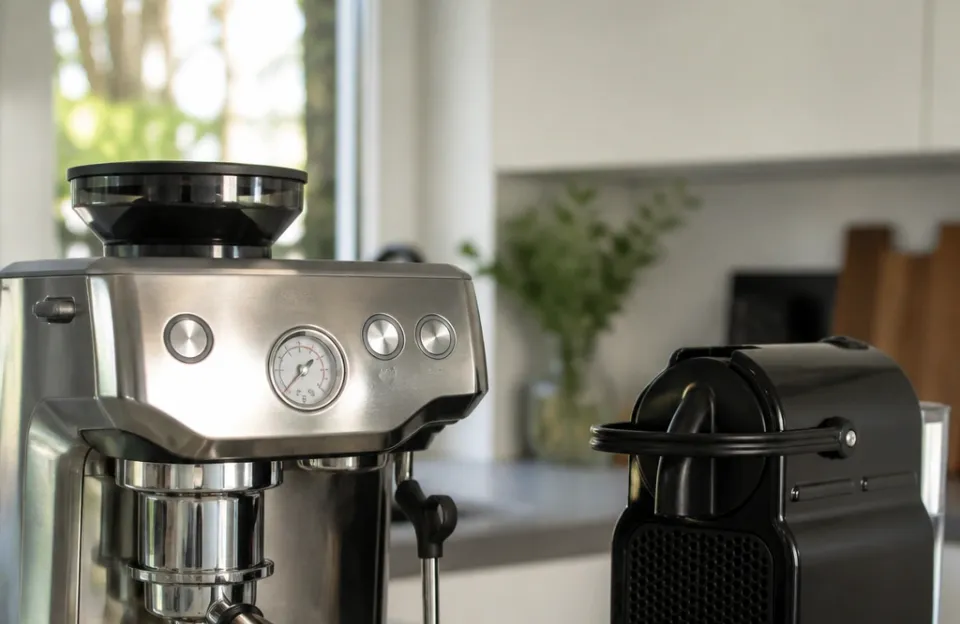
A traditional espresso machine forces hot water through finely ground coffee at about nine bars of pressure. You grind the beans, dose them into a metal basket called a portafilter, tamp them flat, lock the handle in place, and start the pump. The water pushes through the packed coffee bed and drips into your cup as a thick, syrupy liquid topped with crema.
That crema is the golden foam created when pressure emulsifies the natural oils in fresh coffee.
Nespresso does something similar but removes all the manual steps. You drop a sealed aluminum capsule into the slot and press a button. The machine pierces the foil, heats the water, and pushes it through the pre-measured, pre-tamped coffee inside.
The system uses either centrifugal force (Vertuo line) or high pressure (Original line) to extract the coffee. You get a clean shot in under a minute. There is no grinding, no tamping, and no loose grounds to sweep off the counter.
The core difference is where the work happens. With a traditional machine, you do the work. With a Nespresso, the factory did the work months ago when they sealed the capsule.
Price and Long-Term Cost
The upfront cost of a traditional espresso setup is higher. A reliable entry-level machine from Breville or Gaggia starts around $300 to $500. If you need a separate burr grinder, add another $150 to $300.
Serious setups with dual boilers and PID temperature controllers run well past $1,500.
Nespresso machines are cheaper to buy. An Original line model like the Essenza Mini often sells for under $150. A Vertuo model usually sits between $150 and $250.
You don’t need a grinder because the coffee is already processed inside the pod.
But the math flips after a few months. A bag of good specialty coffee beans costs $18 to $25 and makes about 30 double shots. That works out to roughly 75 cents per drink.
A sleeve of ten Nespresso capsules costs $10 to $14 depending on the line and where you buy them. That means you pay $1.00 to $1.40 per cup. If you drink two coffees a day, that extra 50 cents per cup adds up to over $300 a year.
Over three years, a Nespresso habit costs more than buying a nice traditional machine and a quality grinder.
We compared specs, materials, warranty terms, and the complaints that come up most often for this type of product. One frequent complaint about Nespresso is the shock buyers feel when they calculate their annual capsule spending. It pays to run the numbers before you commit.
Taste and Coffee Quality
Freshness dictates flavor. Coffee beans start losing volatile aromatics within weeks of roasting, and once ground, they stale in minutes. A traditional espresso machine lets you use beans roasted last week and grind them seconds before brewing.
This produces a complex, rich shot with distinct tasting notes like dark chocolate, bright citrus, or toasted nuts.
Nespresso capsules are flushed with nitrogen and sealed in aluminum to slow down staling. They taste remarkably consistent, which is their biggest strength. But they cannot match the depth of freshly ground specialty coffee.
The flavor profile is engineered to be pleasant and balanced rather than distinct.
If you drink your espresso with milk, the gap narrows. Once you add steamed milk and flavored syrups, the subtle differences between a fresh artisanal shot and a Nespresso pod become hard to detect. But if you drink straight espresso or Americanos, the traditional route tastes noticeably better.
Convenience and Morning Speed
This is where Nespresso wins without trying. You wake up, press a button, wait 30 seconds for the machine to heat, insert a pod, and press brew. Your coffee is ready in under a minute.
You eject the used pod into the attached bin and walk away.
A traditional machine demands a routine. You turn it on and wait for the boiler to reach temperature, which takes anywhere from one minute on a thermocoil model to twenty minutes on a heavy brass boiler. You weigh your beans, grind them, distribute the grounds evenly in the portafilter, tamp with firm pressure, flush the group head, lock the portafilter in, and pull the shot.
Then you steam your milk, pour your drink, knock the spent puck into the trash, and rinse everything.
For someone who needs caffeine immediately while getting kids ready for school, the traditional process feels like a chore. For someone who enjoys a quiet morning ritual, it feels like a craft. Neither approach is wrong, but you have to know which morning person you are.
Milk Frothing and Drink Options
Most traditional espresso machines in the $400-plus range include a steam wand. You submerge the tip in cold milk, open the valve, and introduce air until the milk doubles in volume and reaches about 150°F. This creates true microfoam, the wet-paint texture needed for latte art.
Learning to steam milk properly takes practice. We’ve seen many beginners struggle with large bubbles or scalded milk during their first week. Keeping your gear spotless matters just as much here as preventing residue buildup does with other countertop appliances.
Nespresso handles milk in two ways. Some models come bundled with an Aeroccino, a standalone electric whisk that heats and froths milk automatically. You pour milk in, press a button, and wait.
It produces decent foam, though it lacks the silky density of hand-steamed milk. Higher-end Nespresso models, like the Lattissima series, have built-in milk carousels that draw milk directly into the coffee stream. These are incredibly convenient but harder to deep clean.
If you only drink lattes and cappuccinos, both systems work. If you want to pour rosettas or tulips in your cup, you need a traditional machine with a real steam wand.
Counter Space and Kitchen Fit
Traditional espresso machines are heavy and wide. Even compact models take up significant space, especially when you add a grinder next to them. You need room to maneuver the portafilter and clear the steam wand.
Before buying, measure your counter space carefully, much like you would check the interior dimensions of any new appliance to confirm it actually fits where you plan to put it.
Nespresso machines are designed for small footprints. The Essenza Mini is barely wider than a coffee mug. Vertuo models are taller due to the spinning mechanism but still occupy less width than a standard drip brewer.
If your kitchen is tight, Nespresso has a clear physical advantage.
Maintenance and Daily Cleanup
Espresso machines require regular attention. After every shot, you rinse the portafilter. At the end of the day, you backflush the group head with a blind basket and cleaning powder to remove coffee oils.
You wipe the steam wand immediately after frothing so milk doesn’t bake onto the metal. Every few months, you run a descaling solution through the boiler to remove mineral deposits left by tap water. Skipping these steps leads to bitter coffee and broken parts.
Nespresso maintenance is minimal. You empty the capsule bin when it gets full. You run a water-only cycle occasionally to rinse the spout.
Descaling is still required every three to six months, but the process is automated. The machine blinks a specific pattern, you add the descaling kit to the water tank, and press a button. Just make sure you match the right supplies and cleaning agents recommended for your specific model’s tank size.
Environmental Impact
This topic causes a lot of debate. Traditional espresso produces organic waste: spent coffee pucks. You can toss them in the garden compost or the trash.
Paper filters aren’t needed for espresso, and bulk coffee bags generate very little packaging waste per cup.
Nespresso capsules are made of aluminum. Aluminum is infinitely recyclable, but only if it actually reaches a recycling facility. You cannot throw Nespresso pods into standard US curbside recycling bins because they are too small and fall through the sorting screens.
You must collect them and mail them back using prepaid bags provided by Nespresso, or drop them off at a Nespresso boutique. According to the Environmental Protection Agency, proper sorting and routing of specialized materials is critical for actual recovery rates. If you rely on your city’s single-stream bin, those pods end up in a landfill.
If environmental impact is your primary concern, a traditional machine using locally roasted beans in compostable bags leaves a smaller footprint than a pod system.
Which Nespresso Line Fits Your Cup Size
Nespresso currently sells two distinct systems in the US, and they do not share capsules. Understanding the difference prevents a frustrating purchase.
The Original line uses small, thimble-shaped capsules. It relies on 19 bars of pressure to extract coffee. It excels at traditional espresso shots, ristrettos, and lungos (long espressos).
Third-party brands like Peet’s, Starbucks, and Lavazza make compatible pods for this system, giving you more flavor choices and lower prices.
The Vertuo line uses dome-shaped capsules of varying sizes. It reads a barcode printed on the rim of each pod to adjust water volume, spin speed, and brew time automatically. It can brew everything from a single espresso to a 14-ounce travel mug.
However, the barcode system is patented. Only Nespresso manufactures Vertuo capsules, meaning you have zero third-party options and pay a premium for larger cup sizes.
If you only drink small, strong espresso drinks, the Original line is cheaper and more flexible. If you want large mugs of coffee alongside your espresso, you need a Vertuo.
Recommended Traditional Machines
Breville Bambino Plus
This is the best starting point for most home baristas. It heats up in three seconds thanks to a thermojet system. It includes an automatic steam wand that textures milk without requiring you to learn manual stretching techniques.
The footprint is surprisingly small for a machine with a 54mm portafilter. Its main limit is the lack of a built-in grinder, so you must buy one separately.

Gaggia Classic Pro
A long-standing favorite for people who want to learn the craft. It uses a commercial-style 58mm portafilter and a standard boiler. It requires more skill to operate than the Bambino because the steam wand is fully manual and the temperature fluctuates slightly without modification.
It is built like a tank and easily lasts a decade with basic care. Skip this if you want push-button simplicity.
Recommended Nespresso Machines
Nespresso Vertuo Plus
The standard choice for US households that drink large coffees. It brews five different cup sizes automatically based on the pod you insert. The water tank moves to the side or back to fit different counter layouts.
The limitation is strict reliance on Nespresso-branded capsules, which locks you into their pricing and flavor catalog.
Nespresso Essenza Mini (Original Line)
The smallest option available. It pulls excellent espresso shots and takes up almost no space. It pairs well with a separate Aeroccino frother if you want milk drinks.
Because it uses the Original line, you can buy cheaper third-party pods at most grocery stores. It lacks programmable volume settings out of the box, though you can manually program them by holding the buttons.
Pick A if / Pick B if Rules
Choosing between an espresso machine vs Nespresso doesn’t require a flowchart. Use these direct rules.
Pick a traditional espresso machine if:
- You buy whole beans from local roasters.
- You enjoy tinkering with grind size and brew ratios.
- You want to pour latte art.
- You drink multiple cups a day and want to keep the cost per cup low.
- You have counter space for a machine and a grinder.
Pick a Nespresso if:
- You need coffee ready in under 60 seconds.
- Multiple people in your house want different flavors without brewing separate pots.
- You hate cleaning up loose coffee grounds.
- You live in a small apartment with limited counter space.
- You mostly drink milk-based drinks where subtle coffee nuances get masked anyway.
Neither system fits if you primarily drink standard drip coffee. If you just want a full 12-ounce mug of black coffee without intensity, neither a pressurized espresso shot nor a concentrated Nespresso pod will satisfy you. Buy a standard drip brewer instead.
Frequently Asked Questions
Does Nespresso count as real espresso?
Technically, yes. It uses pressure to force hot water through coffee, which meets the mechanical definition. However, coffee professionals note that the crema on a Vertuo is artificially generated by high-speed spinning rather than natural oil emulsification.
It tastes close enough for most people, but purists will notice the difference in texture and body.
Can I use my own coffee in a Nespresso?
Only on the Original line, and only if you buy reusable stainless steel capsules from third-party sellers. You fill them with your own fine grounds and insert them like a normal pod. The results are inconsistent because dialing in the exact grind size for a tiny reusable basket is difficult.
You cannot use your own coffee in Vertuo machines due to the barcode requirement.
How long do these machines last?
A well-maintained traditional espresso machine from a reputable brand lasts 10 to 15 years. Parts like gaskets and shower screens are easily replaceable. Nespresso machines typically last 5 to 7 years.
Because they contain more proprietary electronics and plastic components, they are rarely worth repairing once the internal pump fails.
Is the coffee from a Nespresso weaker?
It depends on the pod. Nespresso prints an intensity scale on every box, ranging from 1 to 13. A low-intensity pod will taste mild and floral.
A high-intensity pod delivers a heavy, bitter, dark-roasted punch. However, even the strongest Nespresso pod lacks the heavy mouthfeel of a freshly pulled double shot from 18 grams of finely ground specialty beans.
Do I really need a separate grinder for a traditional machine?
Yes. Pre-ground coffee from the supermarket loses its aromatic compounds quickly and is rarely ground fine enough for espresso. A burr grinder allows you to adjust the particle size by tiny increments.
Dialing in that grind size is the single most important factor in pulling a good shot. Skipping the grinder guarantees mediocre results regardless of how expensive your machine is.
The right choice depends entirely on what you value more on a Tuesday morning: the ritual of crafting a perfect cup, or the speed of pressing a button and walking away. Both paths lead to good coffee.
As an Amazon Associate, we earn from qualifying purchases.