The two labels overlap so much that neither one reliably tells you which design you are buying. What matters is whether the appliance has genuinely separate baskets with independent heating and controls, because that decides whether you can cook two different foods at once. If you regularly cook a main and a side that need different temperatures, look for independent zones and a sync-finish feature. If you mostly cook one thing at a time, or counter space decides it, you will not miss the extra complexity.
What “Dual Zone” and “Dual Basket” Actually Mean Across Brands
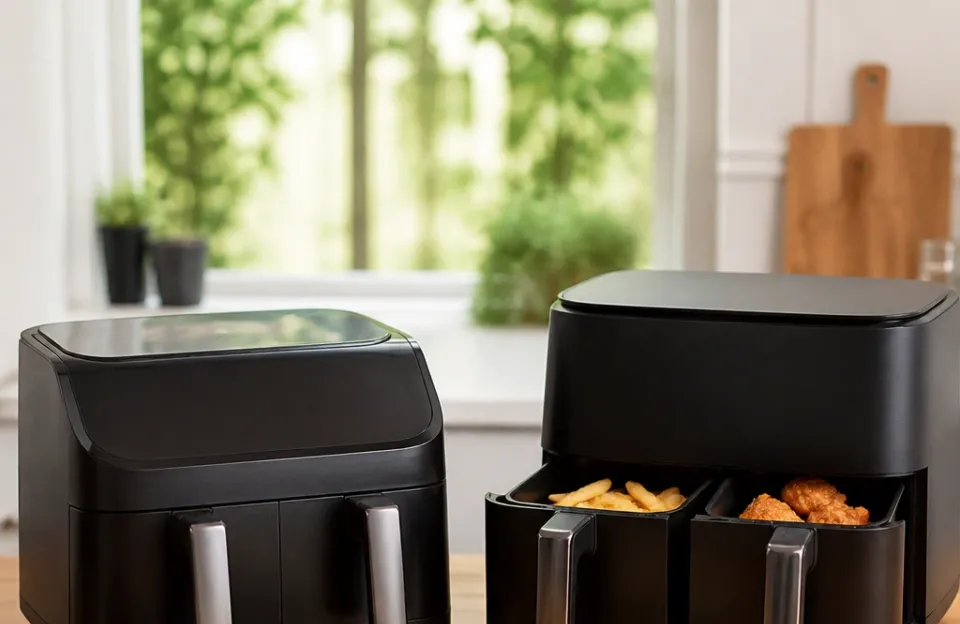
Brands use both phrases loosely, and the sources behind this comparison do not settle on one shared definition. Treat the label as a starting point, not a specification.
Air fryer marketing does not have a single accepted definition for either phrase. Some two-basket models let you set temperature and time for each side separately, but the label alone does not guarantee that. Retailers and review sites do not treat the terms as interchangeable specifications.
The practical check is mechanical. Ask whether the model has separate heating elements and separate temperature controls, or a single divided basket. The two behave quite differently in daily use, and a box label showing two drawers can still describe the second arrangement. For background on how these countertop ovens evolved and why manufacturers began splitting the cooking chamber, the history explains the shift.
Independent Temperature Control and Heat Distribution
Independent controls let you set a temperature and time for each basket. On a model such as the Ninja Foodi DualZone XL, both 5-quart baskets can be programmed to heat independently or at the same temperature for the same period. Other two-basket models can run different temperatures and times on each side. Confirm the exact model’s specification sheet, because the label alone does not guarantee this.
This is where the category earns its keep. A mixed meal, such as chicken in one basket and vegetables in another, does not force you to pick a single compromise temperature. A divided single basket cannot replicate that, whatever its label says.
Sync Finish and Match Cook Features
The reason most buyers want two baskets is to plate everything together. Smart Finish addresses that by timing the two baskets so both finish cooking at once, even when the foods are different. The feature is documented on the Ninja Foodi DualZone XL and the Ninja DZ201, which couples the timing function with Match Cook for cooking both sides identically.
The feature is not limited to high-end models. The Chefman dual basket air fryer includes Smart Sync Finish, so both sides can finish cooking at the same time even when the temperatures differ. The Chefman TurboFry Touch also lets you adjust time mid-cook and includes a shake reminder and auto shut-off. Check the product page for the exact model, since feature sets change between versions.
How to Read Sync-Finish Claims
Manufacturers use several names: Smart Finish, Smart Sync Finish, and finish-together timing. The function works the same way. You confirm the feature exists on the exact model before purchase rather than assuming that two baskets imply it.
Feature names and behavior vary by brand, so read the product page for the model you are considering.
Cooking Performance and Food Texture
Design does not settle cooking quality. Business Insider’s tests of the Ninja Foodi DualZone XL, a two-basket unit, found moist and evenly heated food and fast heating, but frozen fries cooked slowly. That is one model in one test, not a verdict on the whole format. For a practical example of preparing poultry for weekly lunches, the same caveat applies: judge the model, not the label.
One test of one model cannot rank the whole category, so weigh model-specific reviews for the foods you cook most.
Business Insider describes dual baskets as offering the most flexibility and versatility among air fryer designs. That is a statement about options, not about crisping ability. For texture, judge the individual model, its wattage, and its fan design, not the zone label.
Treat versatility claims as a description of menu options rather than proof of cooking performance.
Capacity Limits and Batch Sizes
Total capacity means little if one basket is too small for a main dish. Compare both figures.
| Model | Baskets | Notes |
|---|---|---|
| Ninja two-basket model | Two baskets | Separate baskets with Smart Finish |
| Ninja Foodi DualZone XL | Two baskets | Independent or matched heating |
| Chefman TurboFry Touch | Two baskets | Sync finish across both sides |
| Chefman dual basket air fryer | Two baskets | Smaller each side |
| Philips two-drawer model | Two differently sized drawers | Larger drawer for main dishes |
Capacity figures vary by model and by how the brand measures usable space, so check the per-basket figure on the exact product page rather than relying on a total quart rating.
Equal baskets suit households that cook the same food on both sides, like two portions of wings. Unequal drawers suit a main-plus-side dinner, where the larger compartment carries the protein. Check the per-basket figure against your usual portion sizes, and confirm the usable floor area rather than the total quart rating alone.
Counter Space and Kitchen Footprint
Two-basket designs are noticeably bigger than standard single-basket fryers, so measure counter space and cabinet clearance before buying. The Ninja DZ201 occupies real counter space and is not a compact appliance. Business Insider also describes the Ninja Foodi DualZone XL as heavy and space-consuming. If counter width is your main constraint, a compact slim design is worth considering.
Vertical stacking trades width for height. The Ninja DoubleStack XL stacks two baskets vertically to keep the footprint close to a single air fryer, but it is tall and needs clearance under cabinets. Other stacked models use two vertically arranged baskets for a more compact footprint in kitchens with limited counter room. Measure the height under your cabinets before choosing a stacked model.
Cleaning, Maintenance and Flavor Transfer
Separate baskets simplify cleanup and keep foods apart. Buyer-facing guides describe the Ninja two-basket model’s crisper plates as dishwasher safe and say its separate baskets keep flavors from crossing over. The Chefman TurboFry Touch is described as handling proteins and vegetables together without flavors mixing. These are design expectations from buyer-facing guides, not controlled test results.
Those flavor claims come from buyer-facing guides rather than controlled testing, so treat them as design expectations. The physical separation is real; the practical absence of aroma transfer depends on ventilation and handling in each model. Check the manual for which parts are dishwasher safe, since that varies.
Dishwasher-safe claims should be confirmed against the manufacturer’s manual for the exact model, not the marketing copy.
Power Draw and Electrical Needs
The sources behind this comparison do not include verified wattage or amperage figures for dual-zone versus dual-basket models, so this article cannot quote specific numbers. Two separate heating elements may place different demands on a kitchen circuit than a single element, but you should confirm the rating on the exact model you are considering.
Wattage and circuit requirements vary by model and region, so treat any general figure as a prompt to check the label rather than a specification.
Before ordering, check the appliance’s rated wattage, as stated on the manufacturer’s specification sheet and the label on the unit. Then consider what else shares that circuit. If your kitchen outlets share a circuit with other high-draw appliances, plan the outlet you will use rather than assuming any free socket will do. Confirm that the voltage and plug type match your region, since regional configurations differ.
Which Setup Fits Your Cooking Routine: A Decision Framework
Use this sequence to decide.
- Check for independent heating and controls. Confirm separate elements and separate temperature settings for the exact model. If it is a divided single basket, the rest of this comparison does not apply.
- Match capacity to your usual batch size. Add up what you cook in a normal meal, not a holiday. Compare per-basket capacity on the exact model pages for the Ninja two-basket model, the Chefman dual basket air fryer, and the Chefman TurboFry Touch.
- Confirm a sync-finish feature if you cook two different foods. It is what makes two baskets genuinely useful rather than merely bigger.
- Measure the counter and the cabinet clearance. Side-by-side units take more width; stacked units such as the DoubleStack XL take height and need overhead room.
- Check the cleaning instructions for the parts you will wash daily, and confirm dishwasher-safe claims in the manual rather than in marketing copy.
Pick a dual-zone model with independent controls and sync finish if you cook complete meals with components that need different temperatures and want them ready together. Pick a dual-basket model with equal baskets if you batch-cook one food, such as wings or fries, in quantity. Pick a stacked or unequal-drawer design if your counter is narrow or your meals center on one main dish with a smaller side. When timing a thicker item such as a two-pound meatloaf, the extra horizontal space in a wide basket helps.
These are starting points, not rules. Confirm the features on the exact model before you buy.
Avoid choosing on the label. The terminology varies, the evidence base for cooking performance is thin, and the features you actually use are independence, timing, capacity, and fit.
Frequently Asked Questions
Is Dual Zone the Same as Dual Basket?
Not reliably. Brands use both phrases loosely, and the meaningful distinction is separate heating elements and controls versus a divided single basket. Verify the specification for the model.
The label alone is not a reliable guide, so check the product page or manual.
Do Dual Basket Air Fryers Always Have Independent Temperature Control?
No. Some do, such as the Ninja two-basket model and Chefman TurboFry Touch, but the label does not guarantee it. Check the product specification for the exact model.
Can Both Baskets Finish Cooking at the Same Time?
On models with a sync-finish feature, yes. The Ninja Foodi DualZone XL, the Ninja two-basket model, and the Chefman dual basket air fryer all document this function. Confirm it on the exact model page before buying.
Is a Stacked Design Better for a Small Kitchen?
It can be, provided you have vertical clearance. The Ninja DoubleStack XL and other stacked models reduce footprint by stacking, but the taller body needs room under cabinets. Measure the height under your cabinets first.
Which Type Is Better for Cooking Frozen Foods Straight from the Freezer?
Neither format decides it. In testing, a two-basket Ninja model heated fast and produced moist food, but frozen fries cooked slowly. Check model-specific reviews for the foods you cook most, and see the timing right for frozen fries for a practical starting point.
One test of one model does not settle the format, so weigh reviews for the foods you cook most.
Do Two Baskets Prevent Flavor Transfer?
The baskets are physically separate, and buyer guides say flavors do not cross over on the Ninja two-basket model and Chefman TurboFry Touch. That rests on design rather than controlled testing, so expect limits with strongly aromatic foods.