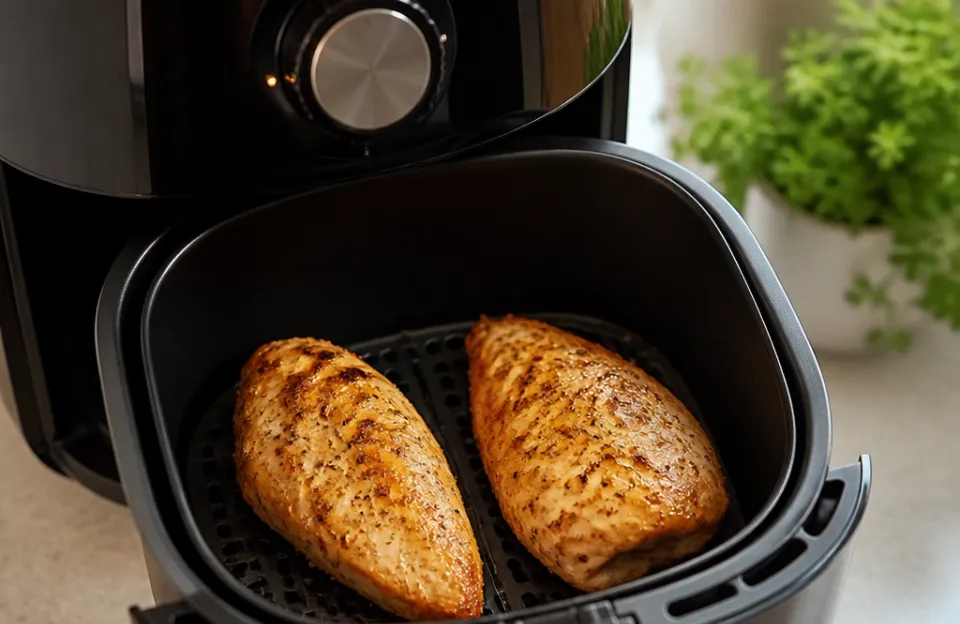
Most air fryers use between 1,400 and 1,800 watts. A standard 4-quart model typically draws about 1,500 watts, while larger dual-basket units or oven-style machines often pull 1,700 to 1,800 watts. Compact models designed for one or two people usually sit around 1,200 watts.
Knowing how many watts does an air fryer use matters if you share circuits in an older kitchen, run a generator during power outages, or just want to track your electricity bill. The wattage determines how fast the heating element reaches cooking temperature and how much electrical load the appliance places on your home wiring. This article breaks down the numbers by size, explains what that wattage costs to run, and covers the electrical limits you need to watch out for.
Where the Power Goes Inside Your Air Fryer
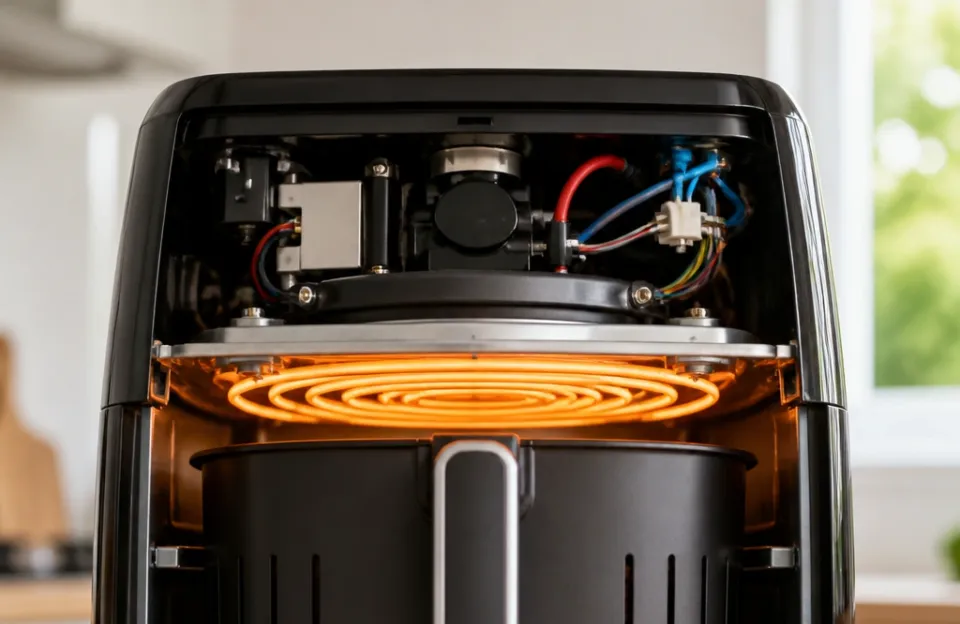
An air fryer is a small, high-powered convection oven. Almost all the electricity it pulls from the wall goes straight to two components: a coiled heating element and a high-speed fan. When you set the machine to 400°F, the heating element converts electrical current into heat.
The fan then pushes that hot air rapidly around the food basket.
The wattage rating printed on the back of the machine represents the maximum power draw. That number tells you how much electricity the appliance uses when both the heater and the fan are running at full capacity. A 1,500-watt air fryer pulls 1,500 watts continuously only while the element is actively heating.
Once the internal chamber hits your target temperature, a thermostat cycles the heating element off. The fan keeps spinning, drawing far less power, until the temperature drops and the element kicks back on.
Because of this cycling, an air fryer doesn't pull its maximum rated wattage every single second of a cook time. Still, you must size your electrical circuit for that peak draw. If you try making crispy chicken wings in a 1,700-watt machine plugged into an overloaded circuit, the breaker will trip long before the skin gets crunchy.
Heating Element Size Dictates the Draw
The physical size of the heating element determines the baseline wattage. Larger baskets require more heat to maintain a stable cooking temperature because there is more air volume inside the chamber. A compact 2-quart air fryer can get away with a smaller coil and a 1,200-watt rating.
A 6-quart machine needs a thicker, longer coil to push enough heat into that bigger space, which pushes the rating closer to 1,700 watts.
This is why you can't judge cooking speed purely by the wattage number alone. A 1,500-watt compact air fryer will heat up faster than a 1,500-watt large air fryer because the smaller unit has less empty space to fill with hot air. Matching the wattage to the basket size is how manufacturers balance speed and power consumption.
Fan Motors Add a Small Amount
The fan motor uses a fraction of the total wattage. Most air fryer fans draw between 30 and 50 watts. While that seems minor compared to a 1,500-watt heating element, the fan runs constantly during the entire cooking cycle.
The heating element cycles on and off, but the fan never stops. Over a 30-minute cook, that steady motor draw adds up slightly to your total energy use.
Wattage Ranges by Basket Capacity
Air fryer sizes have expanded well beyond the original egg-shaped countertop models. As the physical footprint grows, so does the electrical demand. Here is how the power draw generally lines up across different capacities.
| Basket Capacity | Typical Wattage Range | Common Use Case |
|---|---|---|
| 1.5 to 2 quarts | 900W to 1,200W | Single servings, dorm rooms, reheating |
| 3 to 4 quarts | 1,400W to 1,500W | Two people, standard side dishes |
| 5 to 6 quarts | 1,500W to 1,700W | Families of three or four |
| 7 to 10 quarts | 1,700W to 1,800W | Large families, whole chickens |
| Dual basket (8-10 qt) | 1,700W to 1,800W | Cooking two foods at once |
| Oven style (countertop) | 1,500W to 1,800W | Replacing a toaster oven |
Small personal models under 2 quarts sometimes drop below 1,000 watts. These are common in travel setups or RVs where electrical capacity is limited. They take longer to preheat and struggle to crisp dense foods like root vegetables.
If you follow a specific guide for cooking potatoes evenly, a sub-1,000-watt machine will likely require extra time compared to what the recipe suggests.
Mid-range 3-to-4-quart models hit the sweet spot for most kitchens. They draw about 1,500 watts, which fits safely on any standard US kitchen outlet without stressing the wiring. They recover heat quickly when you open the basket to shake your food.
Large capacity and dual-basket models push right up against the 1,800-watt ceiling. Manufacturers rarely go higher than 1,800 watts because of standard household electrical limits, which we'll cover shortly. To fit more cooking space into that electrical limit, brands like Ninja or Cuisinart rely on better insulation and highly efficient airflow designs rather than just adding more raw power.
Checking the specs on a specific model, such as the Ninja AF101, shows exactly how a brand balances a 4-quart capacity with a 1,550-watt draw.
Oven-style air fryers with multiple racks also max out around 1,800 watts. Because they have a wider, flatter shape, the fan has to push air further horizontally. They often take slightly longer to preheat than a basket-style machine of the exact same wattage.
How Much Electricity an Air Fryer Actually Uses
Watts measure the rate of power draw. To figure out what that means for your electric bill, you have to convert watts into kilowatt-hours (kWh). Utility companies charge you per kWh.
One kilowatt-hour equals running a 1,000-watt appliance for one full hour.
The math is simple. Take the wattage of your air fryer, divide by 1,000, and multiply by the hours you run it.
A 1,500-watt air fryer used for 30 minutes (0.5 hours) consumes 0.75 kWh.
A 1,700-watt air fryer used for 45 minutes (0.75 hours) consumes 1.275 kWh.
According to the US Energy Information Administration, the average residential electricity rate in the US hovers around 16 to 17 cents per kWh. Using 16 cents as a baseline, running a 1,500-watt air fryer for half an hour costs about 12 cents. Even if you use it every single day for a month, you're looking at roughly $3.60 added to your bill.
Compare that to a traditional full-size electric oven. A standard wall oven often draws between 2,000 and 5,000 watts, and it requires heating a massive metal cavity. Preheating a conventional oven takes 10 to 15 minutes of continuous high-wattage draw before you even put the food inside.
An air fryer preheats in 3 minutes or skips preheating entirely. For short cooks, like getting bacon perfectly crisp, the air fryer uses significantly less total energy than firing up the big oven.
Standby Power and Digital Displays
Many modern air fryers have digital touchscreens and Wi-Fi connectivity. These displays draw a tiny amount of power even when the machine is turned off but still plugged in. This standby draw is usually between 1 and 3 watts.
It won't noticeably impact your bill, but if you are strictly managing power usage in an off-grid cabin or RV, unplugging the machine when not in use stops that trickle completely.
Circuit Limits and Why Breakers Trip
In North America, standard kitchen outlets run on 120-volt circuits. Most kitchen circuits are rated for either 15 amps or 20 amps. You calculate the maximum safe wattage by multiplying volts by amps.
A 15-amp circuit handles a maximum of 1,800 watts (120V x 15A).
A 20-amp circuit handles a maximum of 2,400 watts (120V x 20A).
Electrical codes recommend keeping continuous loads under 80% of a circuit's maximum capacity to prevent overheating wires. For a 15-amp circuit, that safe continuous limit is 1,440 watts. For a 20-amp circuit, it's 1,920 watts.
Here is where people run into trouble. If you plug a 1,700-watt air fryer into a 15-amp circuit, you are already near the absolute maximum limit. If someone else turns on a blender (typically 500 to 1,000 watts) or a coffee maker (900 to 1,200 watts) on that same circuit while you are cooking, the total draw exceeds 1,800 watts.
The breaker trips immediately.
This is why understanding how many watts does an air fryer use is a safety issue, especially in older homes built with mostly 15-amp wiring. If you buy a large 8-quart dual-basket model pulling 1,800 watts, you need to plug it into a dedicated 20-amp outlet. Don't use extension cords or cheap power strips.
High-wattage heating appliances require direct wall connections to handle the electrical current safely. The National Fire Protection Association provides extensive guidelines on preventing electrical fires caused by overloaded household circuits.
If you frequently trip breakers while cooking, map out your kitchen outlets. Outlets next to each other often share the same circuit. Moving the air fryer to an outlet on a different breaker solves the problem instantly.
Does Higher Wattage Mean Faster Cooking?

More watts generally mean faster preheating and quicker temperature recovery, but raw power isn't the only factor in cooking speed. Airflow design plays an equally large role.
A 1,700-watt air fryer with poor fan circulation will cook slower and less evenly than a 1,500-watt model with a highly engineered exhaust system. The heating element generates the heat, but the fan distributes it. If the hot air pools at the top of the basket, the bottom of your food stays soggy regardless of how much power the machine pulls.
When shopping, don't just chase the highest wattage number. Look at how the brand designs the basket perforations and the fan placement. Some premium models use lower wattages paired with superior insulation to trap heat more effectively.
A well-insulated 1,500-watt unit might hold a steady 400°F better than a poorly insulated 1,800-watt unit that leaks heat through thin plastic walls.
Higher wattage does give you an advantage when cooking frozen foods. Dropping a pound of frozen chicken drumsticks into a basket causes a massive temperature drop. A 1,800-watt element recovers that lost heat faster than a 1,200-watt element.
If you regularly cook from frozen, a higher-wattage machine saves you time. Just check a reliable guide on timing for frozen drumsticks to adjust your expectations based on your specific machine's power output.
Running an Air Fryer on Generators and Inverters
If you live in an area prone to power outages, or if you use an air fryer in an RV or boat, the wattage rating becomes your primary constraint. You cannot guess with generators.
Generators list two wattage ratings: running watts and starting (or surge) watts. Resistive heating elements, like the coil in an air fryer, don't have a massive startup surge the way a refrigerator compressor does. An air fryer's starting wattage is usually very close to its running wattage.
If your air fryer is rated at 1,500 watts, you need a generator capable of supplying at least 1,500 continuous running watts.
However, you must account for everything else plugged into that generator. If you are running lights, a fan, and a phone charger totaling 300 watts, your generator needs to supply 1,800 watts total to handle the air fryer safely. Running a heating appliance near a generator's maximum capacity causes voltage drops.
Low voltage forces the air fryer to pull more amps to compensate, which can overheat the generator or damage the air fryer's control board.
For RV owners using battery inverters, a 1,500-watt air fryer will drain a standard 12-volt battery bank incredibly fast. To run a 1,500-watt appliance on a 12-volt system, the inverter must pull about 125 amps from the batteries (1,500W / 12V = 125A). That level of draw requires thick, specialized cabling and a robust lithium battery setup.
Lead-acid batteries will sag under that load and trigger low-voltage shutoffs almost immediately. Many RV owners opt for lower-wattage 900-watt travel models specifically to avoid draining their house batteries.
Misconceptions About Air Fryer Power Consumption
People often make assumptions about appliance power that don't match the physics of how these machines operate. A few misconceptions lead to bad buying decisions or unnecessary worry about electrical bills.
- Assuming it runs at max wattage the entire time. As mentioned earlier, the thermostat cycles the heating element. A 1,500-watt machine might only draw peak power for 60% of the total cook time, resting during the remaining 40%. Your actual energy use is always slightly lower than the raw math suggests.
- Thinking a lower-wattage model saves significant money. The difference between a 1,200-watt and a 1,500-watt model running for 20 minutes is fractions of a penny. However, the 1,200-watt model might take 30 minutes to achieve the same crispness, negating the energy savings entirely.
- Believing all air fryers require special 220V outlets. Standard air fryers run on regular 120V household current. Only massive commercial deep fryers or full-size double-wall ovens require 220V/240V circuits. You don't need an electrician to install a new outlet for a standard countertop model.
- Confusing wattage with heat output quality. A high-wattage machine with a failing fan will burn food on top and leave it raw underneath. Wattage measures electrical consumption, not cooking performance. Maintenance, like clearing grease buildup from the fan intake, keeps the airflow matching the power draw.
- Assuming "eco" modes drastically reduce peak wattage. Some digital models have eco settings. These usually just shorten the automatic keep-warm phase or dim the display. They rarely throttle the main heating element's peak draw, because doing so would ruin the cooking performance.
What to Check Before Plugging It In
Before you unbox a new air fryer, take two minutes to verify your kitchen's electrical setup. Skipping this step is the most common reason people experience tripped breakers or damaged outlets.
- Read the sticker on the back. Every air fryer has a manufacturer label listing the voltage and wattage. Don't rely solely on the box marketing; read the actual appliance sticker.
- Identify your circuit amperage. Go to your breaker panel and find the switch labeled for your kitchen outlets. Note whether it says 15A or 20A.
- Do the math. Multiply your circuit amps by 120 volts. Ensure the air fryer's wattage leaves room for other devices. If you have a 15-amp circuit (1,800W max) and a 1,700W air fryer, nothing else can run on those outlets simultaneously.
- Inspect the outlet. High-wattage appliances can wear out old receptacles. If the plug feels loose or falls out easily, the internal contacts are worn. Loose contacts create electrical resistance, which generates dangerous heat. Replace the outlet before using the air fryer.
- Ditch the extension cords. If the cord doesn't reach the wall, move the appliance. Extension cords introduce resistance and voltage drop. For a heating element pulling 15 amps, a standard household extension cord can melt or start a fire.
Taking these steps guarantees your machine operates safely. It also helps you understand why certain recipes behave differently depending on your equipment. If you switch from a 1,200-watt dorm model to a 1,700-watt family model, you'll notice immediate differences in browning and timing.
Adjusting your technique based on your machine's specific power output is the key to consistent results, whether you're baking a dense meatloaf or roasting delicate vegetables.
Keeping Your Kitchen Wiring Safe
The wattage rating on your air fryer is a fixed specification. You can't change it, and you shouldn't try to bypass it. Understanding how many watts does an air fryer use gives you the information needed to manage your kitchen's electrical load properly.
Stick to dedicated 20-amp circuits for large models, avoid sharing outlets with other heavy appliances, and skip the extension cords. A 1,500-watt appliance is incredibly cheap to run daily, provided the wiring behind the wall is ready to handle the peak draw safely.