Air fryers generally come in three capacity ranges: small (1 to 3 quarts), medium (4 to 6 quarts), and large or extra-large (7 to 12+ quarts). The right size depends entirely on how many people you cook for and what you plan to make. A 2-quart model works fine for one person reheating leftovers, while a family of four needs at least 5 quarts to cook a full meal without doing multiple batches.
This air fryer size guide breaks down exactly what fits inside each capacity tier. We'll look at real food volumes, counter space tradeoffs, and the specific situations where buying bigger or smaller makes sense. Picking the wrong capacity means either wasting money on a massive appliance you rarely fill, or standing over the counter cooking three separate batches of chicken just to feed your household.
How Manufacturers Measure Air Fryer Capacity
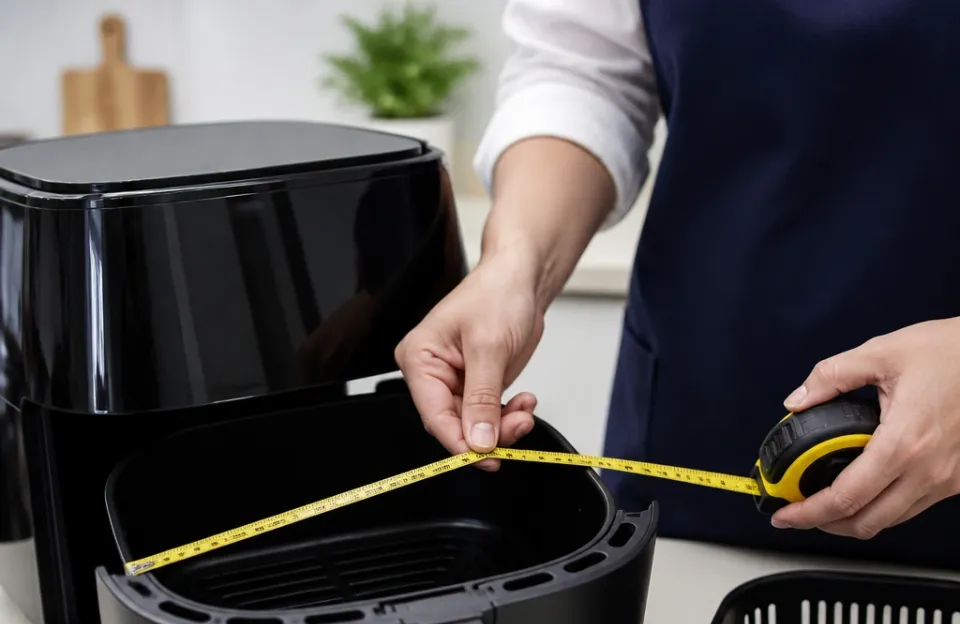
Capacity is listed in quarts or liters. That number refers to the total volume of the cooking chamber or basket. It does not tell you how much food you can actually cook at once.
A 4-quart air fryer cannot hold 4 quarts of solid food. You need empty space above and around the ingredients so hot air can circulate. If you pack the basket completely full, the food steams instead of crisping.
In practice, you should only fill an air fryer basket about halfway to two-thirds full for most foods. For items that need serious browning, like getting wings perfectly crisp, keeping them in a single layer with gaps between pieces gives the best result. That means a 4-quart unit realistically holds about 2 quarts of actual food.
Manufacturers sometimes measure differently depending on the design. Basket-style models list the volume of the removable drawer. Oven-style air fryers, which look like miniature toaster ovens, often list the interior cubic volume.
A 10-quart oven-style unit might have racks that hold more surface area than a 10-quart deep basket, even if the total volume number matches. Always check whether the listed capacity applies to a single basket or a multi-rack interior.
Small Baskets for One or Two People (1 to 3 Quarts)
Small air fryers range from 1 to 3 quarts. These are built for solo diners, couples who eat small portions, or dorm rooms. They take up very little counter space, usually under 10 inches wide.
A 2-quart basket comfortably holds one large chicken breast, a couple of pork chops, or a single serving of roasted vegetables. You can fit a standard portion of fries in there, though you'll need to shake the basket frequently to get even browning. If you want to know how long potatoes take in a compact unit, expect slightly longer times than larger models because the food sits closer together.
The main limitation is batch cooking. You cannot roast a whole chicken or cook dinner for guests in a 2-quart machine. It also struggles with bulky items.
A large sweet potato might not fit through the opening, and bagel halves might touch the top heating element. These units are strictly for side dishes, snacks, or single-portion meals. They're also lighter, making them easy to store in a cabinet when not in use.
The Sweet Spot for Most Kitchens (4 to 6 Quarts)
Medium air fryers sit between 4 and 6 quarts. This is the most popular category, and for good reason. A 5-quart model handles meals for two to four people without requiring constant reloading.
Inside a 5-quart basket, you can fit four to six chicken thighs in a single layer. You can roast enough broccoli to serve a family of four as a side dish. If you're prepping chicken for weekly lunches, this size lets you process a reasonable amount in just two batches rather than five or six.
A 6-quart unit pushes into territory where you can cook a small whole chicken, usually up to 3 or 4 pounds. You can also fit a standard 8-inch baking pan inside many 6-quart baskets, which opens up options for cakes, casseroles, or baked eggs. The footprint grows here.
Expect a 5- or 6-quart machine to be roughly 12 to 14 inches wide and just as deep. You will need dedicated counter space or a sturdy shelf to store it.
For households of three or four, a 5.5-quart or 6-quart model prevents frustration. You have enough room to leave gaps between pieces for airflow, which is the entire point of convection cooking. Overcrowding a 4-quart basket to feed four people defeats the purpose of the appliance.
Large and Extra-Large Units for Families (7 to 12+ Quarts)
Large air fryers start at 7 quarts and go up to 12 quarts or more. Some dual-basket models advertise 10 quarts total, meaning two 5-quart baskets side by side. Others use a single massive drawer or an oven-style door.
A single-basket 8-quart model fits a 5-pound whole chicken easily. You can roast an entire bag of frozen french fries at once, or cook enough salmon fillets for six people in one go. When timing a thicker cut of fish, having that extra horizontal space means you don't have to stack delicate fillets on top of each other.
Oven-style air fryers in the 10-to-12-quart range use wire racks instead of a deep basket. This changes what you can cook. You can slide in a 9×13 baking dish, toast six slices of bread simultaneously, or dehydrate fruit across three levels.
The tradeoff is cleaning. Racks collect drips, and the wider interior takes longer to wipe down than a nonstick basket.
Dual-zone models solve a specific problem: cooking a protein and a side dish at different temperatures at the same time. A 10-quart dual-basket unit gives you two independent 5-quart drawers. You can roast vegetables at 400°F in one while cooking sausages at 375°F in the other.
Some brands, like the Chefman 8-quart powerhouse, combine large single capacities with multiple cooking functions, blurring the line between air fryer and countertop oven.
The downside to anything over 7 quarts is physical size. These machines are heavy and bulky. A 10-quart oven-style unit can be 16 inches wide, 15 inches deep, and 14 inches tall.
Measure your cabinets before buying. Many people end up leaving them on the counter permanently because moving them daily is exhausting.
| Capacity Range | Best For | Realistic Food Volume | Approximate Footprint |
|---|---|---|---|
| 1 to 3 quarts | 1 person, snacks, sides | 1 to 2 servings | Under 10 x 10 inches |
| 4 to 6 quarts | 2 to 4 people, daily meals | 3 to 5 servings | 12 x 12 to 14 x 14 inches |
| 7 to 9 quarts | 4 to 6 people, whole chickens | 6 to 8 servings | 14 x 14 to 16 x 15 inches |
| 10+ quarts | Large families, oven replacement | 8+ servings or multi-rack | 16 x 15 inches or larger |
Dual-Zone vs Single-Basket Designs
Capacity numbers mean different things depending on the internal layout. A 6-quart single basket gives you one large square or round cooking zone. A 6-quart dual-basket unit splits that space into two 3-quart drawers.
If you buy a 6-quart dual model thinking you can fit a whole chicken in it, you will be disappointed. Neither 3-quart drawer is big enough for a whole bird. Dual zones excel at cooking two different foods that finish at the same time.
They are terrible at cooking one large item.
Single baskets handle bulk better. If your goal is roasting large batches of root vegetables or cooking oversized proteins, stick to a single-drawer design. If your goal is making complete meals with a starch and a protein simultaneously, dual drawers save time.
Brands like Ninja offer both configurations, and reviewing a specific Ninja model's layout helps clarify whether its basket shape suits your typical recipes.
Wattage scales with size. A 2-quart air fryer might pull 800 watts, while a 10-quart oven draws 1700 to 1800 watts. Larger units heat up faster despite their size because they have more powerful elements, but they consume more electricity per cycle.
Matching the Capacity to What You Actually Cook

Don't buy based solely on household size. Buy based on your recipes. Two people who mostly reheat pizza and cook frozen nuggets need less space than two people who meal-prep roasted vegetables every Sunday.
Think about your largest common ingredient. If you regularly cook bacon, consider how many strips you need at once. Fitting enough bacon for breakfast usually requires laying strips flat without overlapping.
In a 3-quart basket, you might fit four strips. In a 6-quart basket, you can fit ten. If you're feeding two hungry people, the 3-quart model forces you to cook twice.
Consider meatloaf. A standard 2-pound meatloaf requires a pan or a foil sling that fits inside the basket with at least an inch of clearance on all sides for airflow. Checking the dimensions needed for a full-sized loaf reveals that anything under 5 quarts simply won't accommodate the pan.
Even a 1-pound loaf needs a 4-quart minimum to avoid touching the heating coil.
Vegetables shrink significantly during cooking. Zucchini loses water and reduces in volume. You can pile raw zucchini spears higher than raw potatoes because they will collapse as they roast.
Still, starting with too much volume blocks the fan. Knowing roughly how long zucchini needs helps you gauge whether your basket size supports the quantity you're dropping in.
Baking is another factor. If you want to bake muffins, brownies, or small cakes, you need an air fryer large enough to hold a baking pan. Most standard 6-inch round pans fit in 4-quart models.
An 8-inch pan requires at least 5.5 quarts. Square 8×8 pans usually need a 6-quart or larger oven-style unit.
Counter Space and Storage Reality
Physical dimensions matter as much as quart capacity. A 6-quart air fryer is a permanent fixture on most counters. It weighs between 12 and 18 pounds.
Lifting it in and out of a lower cabinet every day gets old fast.
Measure your available space before choosing a size. Leave at least 5 inches of clearance behind the unit for the exhaust vent. Air fryers blow very hot air out the back.
Pushing a large model flush against a wall or underneath low cabinets can damage paint, melt plastics, or create a fire hazard. The US Consumer Product Safety Commission (CPSC) maintains safety guidelines for countertop appliances that stress proper ventilation clearance to prevent overheating.
Height is the hidden constraint. Many basket-style air fryers are taller than they are wide. A 5-quart model might be 14 inches tall.
If you plan to store it under upper kitchen cabinets, which typically hang 18 inches above the counter, you have 4 inches to spare. That's enough to slide it in, but pulling the basket out requires angling the whole machine forward.
Some brands design specifically for tight spaces. Looking at models engineered with a slimmer physical profile shows how manufacturers maintain a 6-quart capacity while reducing the depth or width. If your kitchen is small, prioritize exterior dimensions alongside interior volume.
Oven-style units are wider but shorter. They slide under cabinets easier than bucket-style fryers, but they eat up horizontal counter space. Decide which dimension you have more of: width or height.
Why Bigger Isn't Always Better
Buying the largest air fryer you can afford sounds logical, but it causes problems for small tasks. Heating a massive 10-quart chamber to cook two chicken tenders wastes energy and time. The preheating phase takes longer because there is more air volume to heat.
Food placement becomes tricky in oversized baskets. If you put a small handful of fries in the corner of an 8-quart drawer, the fan blows them around. Lightweight items like kale chips or shredded coconut can fly up into the heating element in a large, empty basket.
You need enough food to anchor itself, or you have to use a rack to weigh it down.
Cleaning a giant basket in a standard kitchen sink is awkward. A 2-quart drawer rinses out in seconds. A 10-quart oven tray might not fit under your faucet without hitting the opposite side of the basin.
Nonstick coatings also degrade faster if you're constantly scrubbing a massive surface area.
There is also the noise factor. Larger fans move more air and generate more sound. A compact 3-quart unit hums quietly.
A dual-zone 10-quart machine running both fans sounds like a hair dryer on low. If you have an open-concept living space, the acoustic difference matters.
Wattage, Power Draw, and Circuit Limits
Most standard home kitchens have 15-amp or 20-amp circuits operating at 120 volts. A 15-amp circuit handles 1800 watts maximum. Large air fryers rated at 1700 or 1800 watts consume nearly the entire capacity of that circuit.
If you plug an 1800-watt air fryer into the same circuit as a running microwave or coffee maker, you will trip the breaker. Medium 4-to-6-quart models typically draw 1400 to 1500 watts, leaving headroom for other devices. Small 2-quart models draw 800 to 1000 watts.
Check the wattage rating before buying a large unit, especially if you live in an older home or an apartment with shared kitchen circuits. Running a high-wattage appliance safely means understanding your electrical limits. The National Fire Protection Association (NFPA) provides electrical safety standards that outline load limits for residential circuits.
Higher wattage does mean faster cooking. A 1700-watt 6-quart model recovers heat faster after you open the basket than a 1400-watt model of the same size. But that speed comes with the electrical tradeoff mentioned above.
Common Sizing Mistakes Buyers Make
People routinely misjudge what they need. Here are the most frequent errors when picking a capacity.
- Confusing total volume with usable cooking space. A 6-quart oven-style unit has 6 quarts of total interior space. Once you insert the racks and leave room for airflow, you might only fit 3 quarts of actual food per rack level.
- Buying for a fantasy lifestyle. Purchasing a 10-quart dual-zone machine because you "plan to host parties" when you currently cook for one results in a giant appliance collecting dust. Buy for your Tuesday night reality, not your hypothetical Saturday dinner party.
- Ignoring the basket shape. A 5-quart square basket holds more usable food than a 5-quart round basket. Corners allow you to align rectangular items like chicken breasts or fish fillets without wasted edge space.
- Assuming a bigger unit cooks faster automatically. While higher wattage helps, stuffing a large basket to the brim slows cooking down drastically compared to a half-full smaller basket. Airflow dictates speed.
- Forgetting about accessories. If you plan to use silicone liners, baking pans, or crisper plates, those take up interior volume. A 4-quart basket shrinks to a 3-quart effective space once a thick silicone liner is installed.
Getting the Fit Right Before You Buy
Choosing the correct capacity comes down to measuring your habits, not just guessing a number. Count the people you feed daily. Think about the largest single item you cook weekly.
Measure the physical space on your counter where the machine will live.
If you live alone and mostly cook fresh vegetables, reheated meals, or single proteins, a 3-quart model keeps your counter clear and your electric bill low. If you have a partner or a roommate and cook real dinners together, jump to 5 or 6 quarts. The slight increase in footprint pays off every time you don't have to wait for a second batch to finish.
Families of four or more, or anyone who wants to roast whole birds, should look at the 7-to-10-quart range. Just verify your cabinet depth and electrical circuit first. Dual-basket designs are ideal if you want to cook a main and a side simultaneously without buying two separate appliances.
The right size disappears into your routine. You drop the food in, set the dial, and everything fits. The wrong size reminds you of its flaws every single night, either by forcing you to cook in shifts or by dominating your kitchen visually and physically.
Match the quart count to your actual plate count, and the appliance does exactly what it was built to do.