Wireless vs Bluetooth vs Wi-Fi Thermometers: Which Connection Fits Your Kitchen?
A wireless thermometer is any cooking probe that sends temperature data without a physical cord. The real difference between wireless vs Bluetooth vs Wi-Fi thermometers comes down to how far you can walk away and whether you need your home network involved. Bluetooth connects directly to your phone within about 100 to 165 feet.
Wi-Fi models connect through your router, letting you monitor food from anywhere with cell service. Generic "wireless" units often use a dedicated radio frequency to talk to a separate base station sitting on your counter.
If you stay close to the grill or stove, Bluetooth works fine. If you want to run errands while a brisket smokes for twelve hours, you need Wi-Fi. If you hate dealing with app updates or pairing issues, a dedicated RF base station might be your best bet.
We'll break down exactly how each signal type behaves in a real kitchen so you can pick the right one.
How Each Signal Actually Reaches You
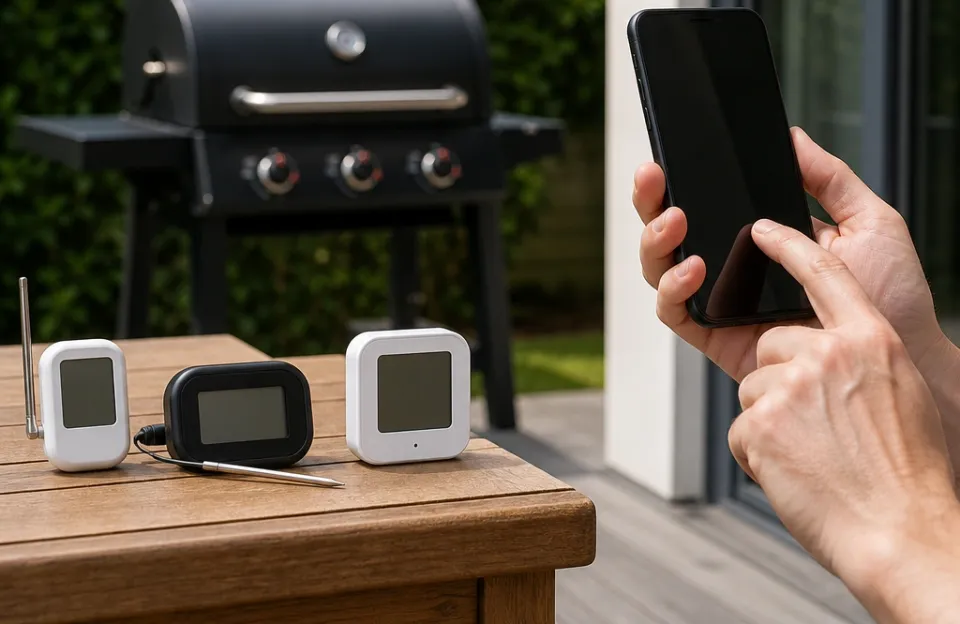
Bluetooth thermometers skip your home network entirely. The probe or transmitter talks straight to your smartphone using short-range radio waves. This keeps setup fast.
You turn it on, open the app, and pair. The tradeoff is distance. Walls, metal siding, and even a closed oven door eat into that range quickly.
If you step out to the garage, you'll likely lose the signal. I've seen plenty of cooks deal with dropped signals near thick brick walls, which is why fixing connection drops usually starts with checking what's physically between the probe and the phone.
Wi-Fi thermometers connect to your home router first. Once they're on the network, your phone can pull the temperature data from the cloud. You could be at the grocery store three miles away and still see that your pork shoulder hit 203°F.
The catch is dependency. If your internet goes out, or your router reboots, you lose monitoring until it reconnects. You also have to trust the manufacturer's app servers to stay online.
Dedicated wireless models using RF frequencies operate differently. They come with their own receiver. The probe sends a signal to that specific box, not to your phone or your router.
This means zero reliance on internet infrastructure. The range usually sits between 300 and 500 feet, which covers most backyards comfortably. You just carry the receiver with you instead of your phone.
Range Limits That Matter While Cooking
Stated ranges on packaging assume a clear line of sight. Real kitchens don't work that way. A Bluetooth thermometer rated for 165 feet might only give you 50 feet once the signal passes through a stainless steel fridge and two drywall partitions.
If you cook mostly indoors or on a small patio, this rarely matters. But if you have a smoker parked at the far edge of a large yard, you'll spend your afternoon hovering near the back door.
Wi-Fi removes the physical boundary completely. As long as the thermometer stays connected to your router, your location doesn't matter. This makes Wi-Fi the standard choice for competition barbecue teams or anyone doing overnight cooks where sleeping inside the house is non-negotiable.
RF base stations split the difference. They offer much better penetration through walls than Bluetooth because they often use lower frequencies like 433 MHz or 915 MHz. You can leave the receiver on the kitchen table while you work in the basement.
Just remember that the receiver needs charged batteries too.
| Attribute | Bluetooth | Wi-Fi | Dedicated RF Wireless |
|---|---|---|---|
| Typical Range | 100 to 165 feet | Unlimited (via internet) | 300 to 500 feet |
| Requires Router | No | Yes | No |
| Uses Smartphone | Yes | Yes | Optional |
| Setup Speed | Fast | Slower (network config) | Instant |
| Best For | Quick grilling, indoor roasting | Long smokes, remote monitoring | Large yards, no-internet areas |
App Dependence and Daily Usability
Bluetooth and Wi-Fi thermometers both live and die by their companion apps. You need a compatible phone, available storage space, and a willingness to run software updates. Some apps are polished.
Others crash when you switch screens or drain your battery because they constantly poll the sensor in the background. If you prefer a simple workflow, relying on a phone screen adds friction. Checking your readings quickly requires pulling out a device, unlocking it, and waiting for the app to sync.
Using a fast-reading digital tool for spot checks avoids this entirely when you don't need continuous logging.
Dedicated RF units sidestep app fatigue. The base station has a physical screen. It beeps when the target temperature hits.
There's nothing to update, no passwords to remember, and no Bluetooth pairing dance every time you cook. For older users or anyone who just wants to look down and see a number, this simplicity wins.
Wi-Fi apps do offer one massive advantage over both: historical data stored in the cloud. You can review past cooks, share graphs with friends, or track exactly when the stall happened on your last brisket. Bluetooth apps store data locally, meaning if you lose your phone, you lose your cook logs.
Power Draw and Battery Life
Transmitting data costs energy. Wi-Fi radios consume significantly more power than Bluetooth Low Energy chips. Because of this, Wi-Fi probes tend to be slightly thicker to house larger batteries, or they require more frequent charging.
If you leave a Wi-Fi probe running for a 16-hour smoke, you need confidence in its battery life. Picking hardware built for extended heavy use prevents mid-cook failures.
Bluetooth probes generally last longer per charge cycle because the transmission protocol uses less juice. However, if your phone is far away and the probe keeps searching for the signal, battery drain spikes.
Base station models shift the power burden. The probe itself might use a tiny watch battery that lasts months, while the heavy lifting of displaying data happens on the rechargeable receiver sitting on your counter.
Safety Standards Across All Types

No matter which signal type you choose, the probe must read temperatures accurately. The USDA states that all poultry needs to reach a safe minimum internal temperature of 165°F to destroy harmful bacteria. Ground meats require 160°F.
A dropped Bluetooth signal doesn't change the fact that your chicken is undercooked. You can verify these targets through official food safety guidelines before setting your alarms.
The connection type only dictates how you receive the alert. It doesn't change the physics of heat transfer. Always verify critical temperatures manually if your wireless unit loses connection during a cook.
Keeping a basic backup probe nearby takes seconds and prevents ruined meals. A reliable dual-probe setup gives you redundancy if your main wireless transmitter fails halfway through dinner.
Matching the Connection to Your Cooking Style
Choosing between wireless vs Bluetooth vs Wi-Fi thermometers comes down to your physical space and patience for technology.
Pick Bluetooth if you cook quick meals, stay within 50 feet of the food, and want a cheap entry point. It pairs fast and handles weeknight dinners easily. You won't need to configure network settings every time you fire up the stove.
Many compact options handle this well, including rechargeable everyday models that keep the footprint small.
Pick Wi-Fi if you smoke meat low and slow, travel while cooking, or want cloud-based cook logs. It demands a stable home network and a good app. The freedom to leave the house while monitoring a twelve-hour pork butt makes the setup hassle worthwhile.
Pick a dedicated RF wireless unit if you have a large property, spotty internet, or despise smartphone apps. It offers the best raw range without needing a router. You carry the screen with you.
It's the most reliable option for pure distance and simplicity.
Frequently Asked Questions
Can I use a Bluetooth thermometer through a brick wall?
Brick severely weakens Bluetooth signals. You might get a reading if you're close, but expect frequent dropouts. Metal studs and foil-backed insulation cause similar interference.
For thick exterior walls, Wi-Fi or a dedicated RF base station performs much better.
Do Wi-Fi thermometers work if my internet goes down?
Most Wi-Fi thermometers lose remote monitoring capabilities if the internet drops. Some models will still communicate locally with your phone if they support a fallback Bluetooth mode, but pure Wi-Fi units rely on the router to function.
Is there a delay in temperature readings on wireless models?
Yes. Wireless probes typically update every few seconds to save battery. A wired instant-read thermometer reacts faster.
For smoking or roasting, a five-second delay doesn't affect the outcome. For searing a steak, you might prefer a direct-contact tool.
Which connection type drains the probe battery fastest?
Wi-Fi consumes the most power due to constant network communication. Bluetooth Low Energy uses significantly less. Dedicated RF probes vary, but those using simple transmitters to a base station often achieve the longest battery life since they don't process complex network protocols.
Are wireless probes safe to leave inside a closed oven?
Most modern wireless probes are designed for oven use, but you must check the manufacturer's maximum ambient temperature rating. The internal electronics can fail if exposed to direct flame or extreme broiler heat. Always route the probe wire away from heating elements.
Before You Buy Your Next Probe
The signal type dictates your freedom of movement. Bluetooth keeps you tethered to the yard. Wi-Fi untethers you completely but ties you to your router.
Dedicated wireless splits the difference with raw distance and zero app requirements. Look at where you actually stand when you cook, not where you wish you were standing. Match the range to your routine, and the rest falls into place.