Is Your Air Fryer Temperature Accurate?
Most air fryers run 10 to 25 degrees hotter or cooler than the number on the dial. If you set your machine to 400°F, the actual cooking temperature inside the basket might be 375°F or 425°F. This gap is normal for countertop convection appliances, and it happens because budget thermostats cycle the heating element on and off rather than holding a steady heat.
Knowing whether your air fryer temperature is accurate changes how you follow recipes. A 25-degree swing means chicken skin burns before the meat cooks through, or roasted potatoes stay pale and soggy. You can find out exactly what your machine does with a cheap oven thermometer and a few minutes of testing.
Once you know the offset, you just adjust the dial. The rest of this article covers why these machines drift, how to test yours, and what to do when the numbers are way off.
Why Countertop Convection Ovens Drift From Their Dial Settings
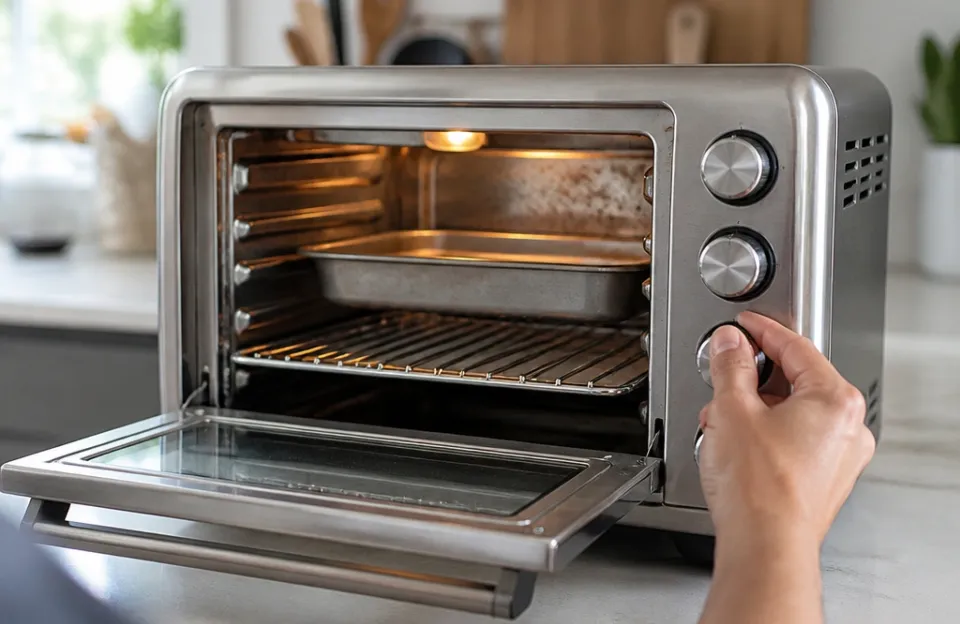
Air fryers are small convection ovens. They use a heating element near the top and a fan to push hot air down around the food. Because the cooking chamber is so small, usually between two and six quarts, the temperature spikes fast and drops fast.
The thermostat tries to manage this by turning the element on and off.
When the element is on, the air gets much hotter than your target setting. When it turns off, the air cools quickly as the fan keeps spinning. The number on the display or dial is an average, or sometimes just the point where the thermostat triggers the shutoff.
It rarely reflects the exact heat hitting your food at any given second.
Manufacturers also use inexpensive bimetallic strip thermostats or basic digital sensors in most models. These parts have a tolerance range. A sensor rated for 400°F might actually trigger anywhere between 385°F and 415°F straight from the factory.
Over time, repeated heating cycles cause that sensor to degrade, widening the gap. Grease buildup on the sensor itself acts as insulation, making it read the heat slower than the air is actually warming up.
How Heating Element Placement Changes the Heat Inside the Basket
The distance between the heating coil and your food matters more in an air fryer than in a full-sized oven. In a basket-style model, the element sits directly above the food, sometimes only two inches away. That top layer gets blasted with radiant heat while the fan circulates the ambient air.
If you put an oven thermometer right under the element, it will read significantly higher than if you place it at the bottom of the basket. The air at the top might hit 420°F while the bottom sits at 380°F, even though the dial says 400°F. Drawer-style or toaster-oven-style air fryers spread the heat out more, but they still have hot zones directly under the top elements.
This uneven distribution means a single temperature reading doesn't tell the whole story. The food is cooking in a gradient. Recipes that work perfectly in one brand might burn in another simply because the element is half an inch closer to the basket.
The Role of Fan Speed in Temperature Swings
The fan in an air fryer runs constantly, or it pulses depending on the model. Its job is to move air past the heating element and over the food. Fast-moving air transfers heat more efficiently than still air.
That's why air frying cooks faster than standard baking.
But that same fast air pulls heat away from the thermostat sensor quickly. If the sensor is located near the exhaust vent rather than near the food, it reads the cooling air leaving the chamber, not the hot air cooking the meal. The machine then keeps the element on longer than necessary, driving the internal temperature well past your target.
Older units or heavily used ones often have fans clogged with grease or dust. A sluggish fan moves less air, creating stagnant hot pockets near the element and cooler spots near the basket walls. The thermostat gets confused by these mixed signals, leading to wider swings.
Testing Whether Your Air Fryer Temperature Is Accurate
You don't need special equipment to figure out if your machine runs hot or cold. An inexpensive standalone oven thermometer is all you need. Avoid using infrared thermometer guns for this specific test.
IR guns measure surface temperature, not the ambient air temperature that actually cooks the food. The metal basket will always read differently than the air circulating through it.
Place the oven thermometer in the center of the basket. If your thermometer has a hook, hang it from the basket grate so it sits in the middle of the airspace, away from the direct blast of the top element. Set the air fryer to 400°F.
Let it run empty for five minutes to reach its peak cycle. Open the drawer quickly, read the thermometer, and close it. Wait another three minutes and read it again.
Do this three times.
Write down the numbers. If your dial says 400°F and the thermometer reads 415°F, 420°F, and 410°F, your machine runs about 15 degrees hot. If it reads 375°F consistently, it runs cool.
Most machines settle into a predictable pattern once you test them.
| Thermometer Reading | Machine Status | Required Adjustment |
|---|---|---|
| 10°F to 25°F below dial | Runs cool | Add 10-25°F to recipe settings |
| Within 5°F of dial | Accurate | Follow recipes as written |
| 10°F to 25°F above dial | Runs hot | Subtract 10-25°F from recipe settings |
| 50°F+ difference | Sensor failure | Requires repair or replacement |
Preheating Changes the Starting Point for Every Recipe
Many people skip preheating their air fryer, tossing food into a cold basket and pressing start. This throws off the timing entirely. A cold basket absorbs a massive amount of thermal energy during the first few minutes.
The air temperature drops sharply when you add cold food to a cold machine, and the thermostat struggles to catch up.
Preheating for three to five minutes stabilizes the chamber. The metal walls, the basket, and the air all reach the target zone before the food arrives. When you drop a piece of chicken into a preheated basket, the sear starts immediately.
Without preheating, the food steams in the slowly rising heat until the element finally catches up.
If you are testing your machine's accuracy, you must preheat it first. Testing a cold machine tells you nothing about how it performs while cooking. For foods where precise timing matters, like getting perfectly cooked salmon, starting with a fully heated chamber removes the biggest variable.
Checking Multiple Spots Inside the Cooking Chamber
One reading in the center gives you a baseline, but checking the edges shows you the hot and cold zones. Move the thermometer to the back corner near the exhaust vent. Then move it to the front edge near the handle.
In many basket models, the back corner runs 15 to 20 degrees hotter than the front edge. The fan pushes air down the back wall and sweeps it forward along the bottom. Food placed at the back browns faster.
If you're cooking something sensitive, like getting bacon evenly browned, knowing where the hot spot sits prevents burnt edges on one side and floppy strips on the other.
Map your basket mentally. Put dense items that need more heat in the hot zones. Put delicate items in the cooler spots.
Shaking the basket halfway through cooking redistributes the food through these different temperature zones, which is why almost every air fryer recipe tells you to flip or shake.
What Happens When the Heat Is Off By Twenty Degrees
A 20-degree error sounds small. In a slow-roasting scenario, it barely matters. In high-heat air frying, it ruins the texture.
The Maillard reaction, the chemical process that creates browning and flavor on the surface of meat and vegetables, accelerates rapidly above 300°F. At 400°F, it happens fast. At 420°F, it crosses the line into burning within minutes.
If your machine runs 25 degrees hot, a recipe calling for 400°F for 12 minutes will likely scorch the outside by minute 9 while the inside stays raw. This is especially obvious with thick cuts. If you follow a guide for cooking thick chicken pieces without adjusting for a hot-running machine, the skin chars before the bone joint reaches a safe temperature.
Conversely, a machine running 25 degrees cool fails to crisp. Moisture evaporates too slowly. Instead of blistering and drying out to form a crust, the surface of the food stays damp.
Potatoes turn out leathery instead of crunchy. Breaded items absorb oil rather than frying in the hot air stream. Knowing your machine's offset lets you compensate before the food goes in.
Baking and Reheating Require Tighter Margins Than Roasting
Roasting vegetables or cooking raw meat forgives some temperature slop. Baking does not. If you use your air fryer to bake muffins, cookies, or small cakes, a 20-degree variance changes the rise, the crumb structure, and the spread of the dough.
Baking relies on precise chemical reactions triggered at specific heat thresholds. Leavening agents activate too fast in a hot oven, causing the center to collapse.
Reheating leftovers also suffers from bad calibration. When you want to warm up leftover slices without drying them out, a machine running hot scorches the cheese and hardens the crust before the center thaws. Dropping the dial by 25 degrees to match your machine's true output fixes this instantly.
Dense items like a thick meatloaf portion need low, accurate heat to cook through without burning the exterior glaze. If your thermostat lies to you, the outside turns to charcoal while the center remains pink. Always lower the dial if you suspect your unit runs hot when cooking anything thicker than an inch.
Adjusting Your Cooking Times When the Thermostat Lies
Once you know your offset, you have two choices. Change the temperature dial, or change the cooking time. Changing the dial is easier and safer for food quality.
If your machine runs 20 degrees hot, and a recipe says 400°F, set your dial to 380°F. The internal air will hit roughly 400°F. You keep the original cooking time.
This works best for digital air fryers that let you select exact temperatures in 5-degree increments.
If you have an analog dial with no numbers between 350°F and 400°F, you can't easily dial in 380°F. In that case, you must adjust the time. Leave the dial at 400°F, but check the food earlier.
Reduce the total cook time by 10 to 15 percent. Instead of 20 minutes, check at 17.
For starchy sides where texture is everything, like crisping up potato chunks, dropping the temperature slightly and adding a minute or two yields better results than blasting them at an uncalibrated high heat. High heat burns the starch before the interior fluffs up. A slightly lower, verified temperature allows the moisture to escape evenly.
Using a Meat Thermometer to Compensate for Bad Calibration
An oven thermometer tells you the air temperature. A meat thermometer tells you the food temperature. When your air fryer temperature isn't accurate, relying on visual cues or recipe times becomes risky.
You need to measure the internal heat of the protein directly.
The USDA recommends cooking all poultry to a minimum internal temperature of 165°F. Ground meats need to hit 160°F. Whole cuts of beef, pork, and lamb require 145°F followed by a three-minute rest.
These safety standards don't care what your air fryer dial says. If your machine runs cold, it takes longer to reach 165°F. If it runs hot, the outside hits 200°F while the inside lags at 130°F.
Keep an instant-read thermometer next to the appliance. Pull the basket out, check the thickest part of the meat, and put it back if needed. This habit eliminates the guesswork caused by a drifting thermostat.
It's the only reliable way to guarantee safety when the appliance's own numbers are wrong.
Does the Age of the Appliance Affect Temperature Accuracy?
Yes. Brand new air fryers often run slightly different than they will after a month of use. The heating element and the thermostat go through a break-in period.
Factory calibration settles after the first dozen heavy uses. If you test a brand-new machine, retest it after two weeks of regular cooking.
As the appliance ages, grease accumulates. Even with diligent cleaning, vaporized oil coats the heating element and the temperature sensor. This carbon buildup acts as an insulator.
The sensor takes longer to feel the heat, so it leaves the element on longer. The machine gradually runs hotter over its lifespan. A unit that was accurate two years ago might run 15 degrees hot today.
Heating elements also degrade. The electrical resistance in the coil changes as the metal expands and contracts thousands of times. It draws power differently, altering how much heat it produces per second.
Combined with a dirty sensor, an older machine loses its precision. If your trusted appliance suddenly starts burning things that used to cook perfectly, the calibration has shifted.
Differences Between Digital Displays and Analog Dials
Digital air fryers use electronic thermistors to read the heat. These sensors are generally more precise than the mechanical springs found in analog dials. A digital display might show you exactly 395°F, while an analog dial just points somewhere between the 350 and 400 marks.
However, digital displays create a false sense of security. Seeing "400" glowing on a screen makes you trust it completely. But the screen only shows what the sensor reports.
If the sensor is coated in grease or poorly placed, the digital number is confidently wrong. Analog dials force you to pay attention to the food because you never really knew the exact temperature to begin with.
Some premium brands, like those reviewed in comparisons of high-end glass-basket models, use dual sensors or PID controllers that pulse the element rapidly to maintain a tighter range. Budget models just bang the element fully on and fully off. The wider the swing between the on and off states, the less accurate the average temperature feels to your food.
Common Mistakes People Make When Guessing the Heat
Assuming the dial is correct is the first mistake. People buy a new appliance, follow a recipe exactly, get a burnt result, and blame the recipe. The recipe was likely tested in a different machine with a different offset.
Always assume your machine needs testing until proven otherwise.
Crowding the basket is the second mistake. Even if your air fryer temperature is accurate, stuffing the basket full of cold food crashes the internal heat. The fan can't circulate air through a solid wall of potatoes.
The thermostat reads the cold mass of food and leaves the heater on constantly, but the center of the pile never gets hot. Cook in batches to maintain the air gap that makes the machine work.
Ignoring altitude and humidity is a third issue. Water boils at a lower temperature at high altitudes, and moist air holds heat differently than dry air. While these factors don't change the thermostat's mechanical reading, they drastically change how the heat transfers to the food.
A recipe developed in humid Florida behaves differently in dry Colorado, even if both air fryers hold exactly 400°F.
Opening the drawer too often kills the heat. Every time you pull the basket out to check the food or give it a shake, the superheated air escapes instantly. The chamber drops 50 degrees or more in seconds.
The element has to fire hard to recover. Frequent checking creates wild temperature swings that ruin the average. Shake once at the halfway mark, not every two minutes.
Frequently asked questions
Can I calibrate my air fryer if it runs hot or cold?
Most consumer air fryers do not have a user-accessible calibration screw or software setting. You cannot recalibrate the internal thermostat like you can on some commercial ovens. The practical fix is to map the offset with a thermometer and manually adjust the dial up or down every time you cook.
Why does my food burn on top but stay raw underneath?
This happens because the heating element is very close to the top of the food, radiating intense direct heat while the air circulation hasn't penetrated the bottom yet. Lowering the temperature by 25 degrees and extending the cook time allows the convective air to cook the center before the radiant heat chars the surface. Flipping the food halfway through also solves this.
Do air fryer recipes online account for temperature differences?
No. Recipe developers test in their own kitchens using their specific machines. A recipe tested in a unit that runs 15 degrees cool will instruct you to cook at 400°F for 20 minutes.
If your machine runs 15 degrees hot, following that exact instruction will burn the food. Treat all online cooking times and temperatures as starting estimates, not absolute rules.
Is an infrared thermometer gun good for checking air fryer heat?
Infrared thermometers measure the surface temperature of solid objects, not the temperature of moving air. If you point an IR gun into an empty air fryer, it reads the floor of the basket or the heating element, giving you useless data for cooking purposes. You need a physical probe thermometer or a hanging oven thermometer designed to measure ambient air.
Does preheating make the temperature more accurate?
Preheating doesn't change the machine's calibration, but it stabilizes the environment. A fully preheated chamber has reached its maximum cycling equilibrium. The swings between the element turning on and off become predictable.
Adding food to a stable, preheated environment yields far more consistent results than adding food to a cold chamber that is still trying to find its baseline.
Getting Consistent Results Despite the Dial
Every countertop appliance has quirks. Finding out if your air fryer temperature is accurate takes ten minutes and a basic oven thermometer. Once you know your machine runs 20 degrees hot or 15 degrees cool, you stop fighting the appliance.
You adjust the dial, trust the math, and get the same results every time.
Don't rely blindly on the glowing numbers or the printed marks. Test the airspace where your food actually sits. Map the hot spots.
Buy a fast instant-read thermometer for your proteins. The dial on the front of the machine is just a suggestion. The thermometer inside the basket tells you the truth.
Learn your specific unit's habits, adjust your approach, and the recipes will finally work the way they should.