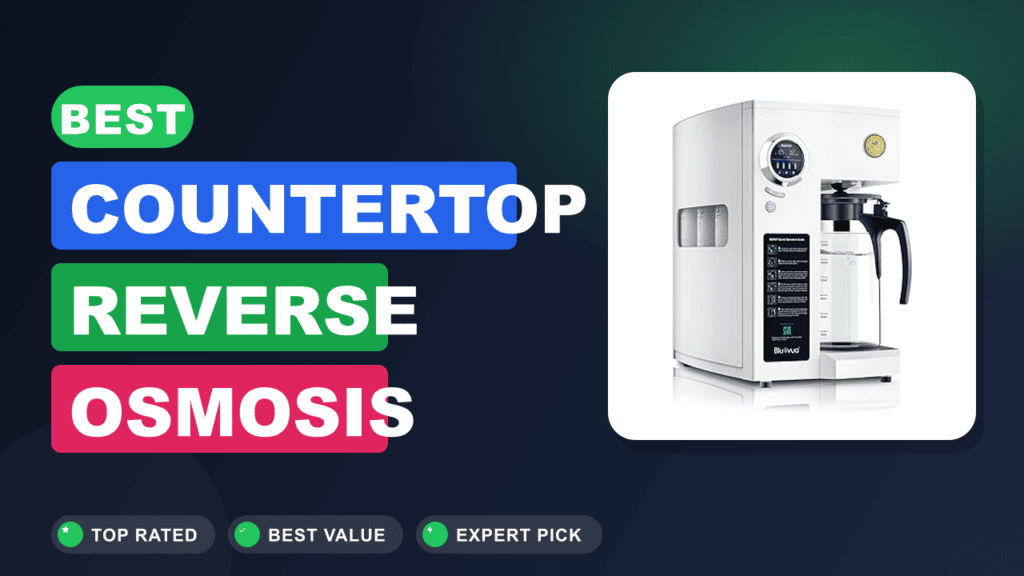
Countertop reverse osmosis systems promise cleaner-tasting water without cutting into your cabinets or hiring a plumber. The trade-off is that these units sit on your counter, need refilling and filter changes, and their performance claims come mostly from manufacturer listings rather than independent lab reports. That makes documented installation needs, capacity, and maintenance details the most reliable way to compare them.
Two picks lead for different reasons. The Bluevua RO100ROPOT stands out for its six-stage design with UV and remineralization plus a glass carafe.
This comparison uses verified product records and the shared criteria of filtration technology, documented reduction claims, installation needs, capacity, and maintenance. No hands-on testing was performed, and contaminant-reduction figures remain manufacturer listing claims unless a certification is named.
1. For UV polishing and remineralization: Bluevua RO100ROPOT Countertop Reverse Osmosis Water Filter System
The Bluevua's six stages include a 0.0001 μm RO membrane, UV light, and a remineralization filter, which is the most layered treatment setup among these picks. It needs no plumbing and simply plugs in, so renters and anyone avoiding faucet adapters can use it. The glass carafe is a real differentiator for buyers who dislike plastic water containers.
The listing describes a 2:1 pure-to-drain ratio and says leftover cycle water can serve household purposes rather than going to waste. Certification covers lead-free materials under NSF/ANSI/CAN 372, not removal performance.
Best For:
Readers buying for a 2:1 pure-to-drain ratio.
Pros:
- The RO100ROPOT-UV uses a six-stage filtration system with a 0.0001 μm RO membrane, UV light, and a remineralization filter.
- The water container is high borosilicate glass rather than plastic, matching a preference for a glass carafe.
Considerations:
- The countertop RO system requires no plumbing or installation and only needs to be plugged into a power source. The system automatically enters a power-saving standby mode when not in use.
2. compact 3L with autofill pitcher: DREO DR-KWF002
Its special features list a built-in TDS meter, a filter change indicator, and touch control, which gives you a read on water quality without separate test strips.
If your household drinks more than a few liters a day, the 5L version is the better-matched sibling.
Best For:
Readers who want include a built-in TDS meter, a change filter indicator, TDS reduction and touch control.
Pros:
- Special features include a built-in TDS meter, a change filter indicator, TDS reduction and touch control.
3. compact dispenser with Aquaporin: PHILIPS Reverse Osmosis Water Filter Countertop
Philips builds this around Aquaporin Inside technology, which the listing says was tested with NASA and ESA for astronaut water access, plus five-stage RO filtration down to 0.0001 micron. At 5 by 13 by 14 inches it is the smallest unit here and is pitched for counters, RVs, dorms, apartments, and offices. Each press dispenses 16.9 ounces, and the 9-cup reservoir detaches for refilling.
The listing claims reduction of TDS, lead, calcium, and chromium III. Its NSF/ANSI/CAN 372 certification covers lead-free materials only, not removal performance. Philips includes a clear safety warning: do not filter microbiologically unsafe or unknown-quality water without adequate disinfection. The filter is listed as lasting up to 12 months.
Best For:
For a small apartment, dorm, RV, or office user who wants a compact plug-and-play RO dispenser with a detachable reservoir and no plumbing.
Pros:
- The filter measures 5 by 13 by 14 inches and is described as slim and compact for countertop, RV, dormitory, apartment, or office use.
- Plug-and-play operation needs no plumbing, and each press dispenses 16.9 ounces.
- The system is NSF/ANSI/CAN 372 certified for lead-free material.
Considerations:
- The listing warns not to filter microbiologically unsafe water or water of unknown quality without adequate disinfection. The unit is corded electric.
4. For 3–4 person households: DREO DR-KWF003
The 5L DREO pairs its larger tank with two 1.1L autofill pitchers, a setup the listing describes as ideal for three to four people drinking daily. Its pitcher and tank are stated to be BPA-free. Real-time TDS readings for both raw and purified water plus filter change reminders make upkeep largely self-monitoring.
Replacement uses a twist-to-install design.
Best For:
For readers whose requirements match this specification: The 5L tank plus two 1.1L pitchers are listed as ideal for daily use by 3–4 people.
Pros:
- The 5L tank plus two 1.1L pitchers are listed as ideal for daily use by 3–4 people.
- The ABS water filter pitcher and water tank of this water filter are made from BPA-free materials.
- The system checks raw water and pure water TDS in real time and gives timely filter change reminders.
5. faucet-connected four-stage: Express Water Countertop Reverse Osmosis Water Filtration System
Express Water takes a different approach: it connects to your faucet rather than a refill tank. Four stages cover sediment, granular carbon, RO membrane, and post activated carbon. The listing claims 99.99% removal of major contaminants. Quick-connect cartridges keep changes simple, and the unit carries a one-year limited warranty.
The compatibility catch matters most here. It works only with faucets that have a threaded removable aerator and will not fit sprayer faucets. It comes preassembled, but you should check connections and the RO membrane cap for tightness to prevent leaks.
Output is listed at 0.5 to 1 gallon per hour, and the pure-to-drain ratio is 1:3. If your tap lacks a threaded aerator, skip this one.
Best For:
Readers buying for an easy four-point installation that fits most standard faucet types.
Pros:
- Four-stage filtration includes sediment, granular carbon, RO membrane, and post activated carbon.
- The listing states 99.99% removal of major contaminants from drinking water.
Compatibility note:
- Only works with faucets that use a threaded removable aerator; not compatible with sprayer faucets.
Considerations:
- The countertop reverse osmosis system requires only minutes to install. The product is backed by a one-year limited warranty.
6. non-electric emergency-ready: GLACIER FRESH PC04 Gravity-Fed Countertop Water Filtration System
That makes it the practical choice for outages, storms, or off-grid situations where powered RO units stop working. It holds 2.25 gallons in a stainless steel body.
The listing says it reduces heavy metals, PFOA, and PFOS and meets SGS standards, though the certification scope is not shown. Plan to flush the system with 2 gallons before first use. Independent test data for the reduction claims was not available.
Best For:
Readers who want drinking water during power outages, snowstorms, or floods.
Pros:
- Completely non-electric operation provides drinking water during power outages, snowstorms, or floods.
- The system has a 2.25-gallon capacity and is made of stainless steel. The product is a gravity-fed countertop water filter.
- Elarisey electrosorption is described as attracting negatively charged submicron contaminants and reducing heavy metals and impurities.
Which Option Should You Choose?
- Want UV treatment and remineralized water with a glass carafe: the Bluevua RO100ROPOT.
- Need the smallest footprint for an apartment, RV, dorm, or office: the Philips Aquaporin dispenser.
- Have a threaded aerator faucet and prefer faucet-fed filtration: the Express Water four-stage.
Code-Checked Calculations
- DREO Reverse Osmosis Water Filter Countertop System, RO Water Filter 113 5L: 265 gallons = 1003.1341 liter.
Affiliate disclosure: This post contains affiliate links. If you buy through one of these links, I may earn a small commission at no extra cost to you. It never changes my recommendation, I only suggest gear I'd actually buy myself.