Most home espresso machines last roughly 5 to 15 years when they are descaled, backflushed where appropriate, and used with reasonable water. That range is an informal estimate drawn from independent industry sources rather than a manufacturer service-life specification, and it is wide because lifespan depends far more on machine type, water quality, and maintenance than on price alone. Entry-level thermoblock machines typically last about 3 to 6 years, mid-range semi-automatics with quality boilers commonly last 5 to 10 years or longer, and super-automatic machines usually last about 5 to 8 years because they contain more motorized parts and failure points. Manual lever machines, which have few electronics to fail, often last 15 to 20 years or more. These figures assume light to moderate home use; heavy daily use shortens them, while occasional use can extend them.
What Actually Breaks First
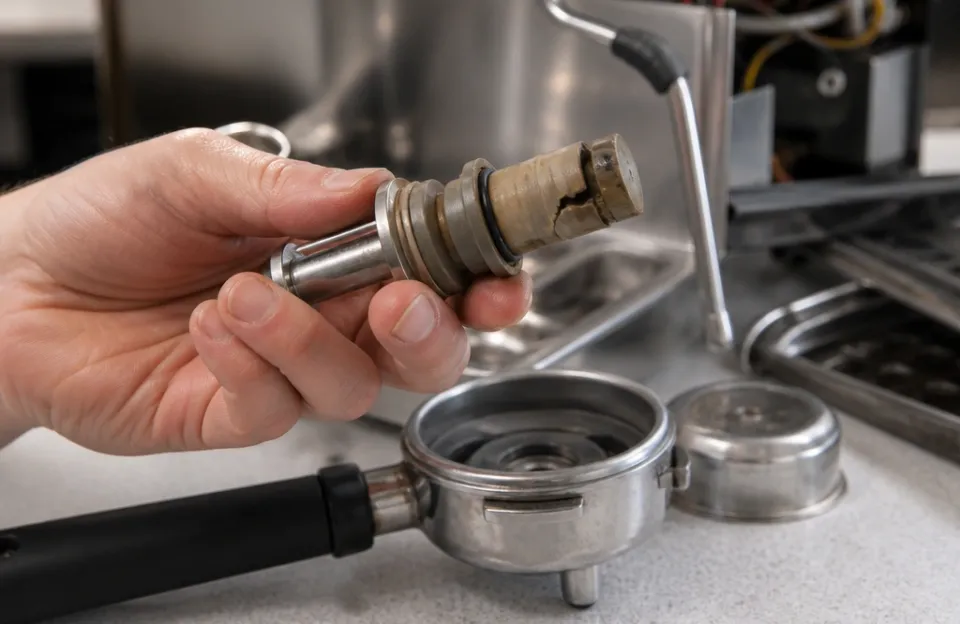
Scale buildup is the leading cause of home espresso machine failure, restricting flow, damaging solenoid valves, and eventually damaging heating elements. Before any major component fails, the group-head gasket and shower screen are usually the first parts to need replacement; the rubber seal at the group head hardens and loses its seal over time, and best practice is replacing it roughly once a year.
The pump is the next common failure point. Vibratory pumps are used in most home espresso machines and are simple, cheap, and replaceable on machines built with standard parts. Solenoid valve clogs from mineral deposits and coffee oils cause weak flow or leaking and are usually fixable with cleaning or a low-cost replacement on serviceable machines. Electronics or PCB failure is the rarest cause of machine death but often the most terminal, especially when the control board is not sold as a standalone part.
Lifespan by Machine Type
Different machine architectures carry different lifespans and different failure risks. The table below summarizes typical expectations across the main home categories.
| Machine Type | Typical Lifespan (independent estimates) | Main Risk |
|---|---|---|
| Entry-level thermoblock | 3 to 6 years | Scale, pump wear |
| Semi-automatic with quality boiler | 5 to 10+ years | Gaskets, scale |
| Automatic | 5 to 10 years | Electronics, pump |
| Super-automatic | 5 to 8 years | Motorized parts, grinder |
| Manual lever | 15 to 20+ years | Seals only |
| Pod or capsule | 5 to 10 years | Pump, heating element |
These ranges come from independent industry sources, not manufacturer service-life documentation, and they assume light to moderate home use. Heavy daily use shortens them; occasional use can extend them.
Prosumer boiler machines with quality parts can exceed 10 to 15 years, and a well-maintained $800 single boiler often outlasts a neglected $2,000 dual boiler, because price predicts component quality while habits predict calendar years.
Water Quality Decides Everything
Hard water scales the boiler, which insulates the heating element, slows heat-up, and eventually kills it, while filtered water within the guidance range greatly reduces scale risk. A premium machine on hard water with no maintenance can fail before a budget machine on filtered water that is cared for.
Lifespan is best understood as a product of design quality, water quality, and maintenance, so two identical machines can have very different lives. The Specialty Coffee Association publishes water standards for coffee brewing, and machine manufacturers generally identify a preferred water hardness range in their manuals. Treat those figures as the authoritative reference for your specific model rather than a general number.
Daily Habits That Extend Life
Descaling a home espresso machine is commonly recommended roughly every 1 to 3 months, closer to monthly on hard water and closer to every three months on soft or filtered water, using a proper espresso descaling solution rather than vinegar, followed by a heavy fresh-water rinse. Manufacturer manuals take priority over any general interval, so check your model’s instructions for the approved product and frequency.
Beyond descaling, the maintenance habits that most reliably extend machine life are:
- Backflush the group head according to your manual, when your machine supports it.
- Replace the group-head gasket roughly once a year or when it stops sealing cleanly.
- Use filtered or softened water within the manufacturer’s recommended range to reduce scale.
- Address small leaks promptly, since water near internal wiring is a risk to the machine’s electronics.
If you are still choosing a machine, understanding how the main types of espresso machines differ will help you match the build to the way you actually brew.
Repairability Matters More Than Price
Repairability, meaning whether a machine uses standard serviceable parts or a sealed proprietary design, is a stronger lifespan predictor than price. A machine built with standard gaskets, pumps, and valves can be kept running through individual part swaps, while a sealed unit with an integrated brew group may be effectively disposable once a key component fails.
The practical implication is that the most durable home machine is not necessarily the most expensive one. It is the one whose parts are still sold years after purchase, and whose design allows a home technician or local repair shop to open it up without destroying the housing.
Repair or Replace? A Simple Rule
Replacement is a financial decision, not an emotional one: compare the repair cost to the machine’s remaining value and the cost of a new machine. A $50 gasket on a ten-year-old machine is an easy repair, while a $400 boiler on the same machine is a conversation. Use the same logic for labor: if a repair requires shipping the machine and paying a technician, factor that into the comparison.
A few questions sharpen the call:
- Is the failing part still sold, or has it been discontinued?
- Is the machine under warranty, and does the failure fall under coverage?
- How old is the machine relative to the typical range for its type?
- Would the same money buy a machine with better parts availability today?
Warranty Expectations and What They Do Not Cover
Home espresso machine warranties commonly run 1 to 2 years, though terms vary by brand, model, region, and date. Breville covers most of its home espresso machines with a one-year limited warranty in the US market, and some higher-tier models carry a two-year warranty. For Breville US, the warranty covers manufacturing defects in materials and workmanship but does not cover damage from scale buildup, failure to descale, unauthorized cleaning products, or normal wear on consumable parts such as group seals and portafilter baskets. Other brands set their own terms, so check the warranty document for your specific model.
That distinction matters when estimating lifespan, because it means the warranty period is not a statement about how long the machine will last. A machine can be well out of warranty and still have a decade of reliable service ahead of it, provided water quality and maintenance are managed.
Signs Your Machine Is Nearing the End
A machine that is failing usually shows warning signs before it stops working outright:
- Weak or inconsistent flow. This often points to scale or a clogged solenoid valve.
- Leaking around the group head. A hardened gasket is the most common cause.
- Slow heat-up or unstable temperature. Scale on the heating element is a frequent culprit.
- Unusual pump noise or pressure loss. A failing vibratory pump is the likely cause on machines with standard parts.
- No response to controls. This suggests electronics or PCB failure, which is often terminal on machines without a standalone control board.
Addressing the first four signs early can prevent further damage, though the outcome depends on the underlying fault, the model, and the quality of the repair. The fifth sign, a failure to respond to controls, often triggers the repair-versus-replace decision.
Picking a Machine Built to Last
When longevity is the priority, the deciding features are the ones that support repair and resist scale. Standard serviceable parts, replaceable gaskets, and an accessible brew group matter more than the specific heating technology. A machine that accepts a standard portafilter and uses a vibratory or rotary pump with widely available spares is generally easier to keep running than a sealed design, because individual parts can be swapped instead of replacing the whole unit.
Frequently Asked Questions
How often should I descale my espresso machine?
Common guidance is roughly every 1 to 3 months, closer to monthly on hard water and closer to every three months on soft or filtered water, using a proper espresso descaling solution. Your machine manual overrides any general interval, and you should follow the manufacturer’s specific instructions for your model, including the approved descaling product and the recommended frequency for your water hardness.
Can I use vinegar to descale my espresso machine?
General guidance favors a dedicated espresso descaling solution over household vinegar, followed by a heavy fresh-water rinse. Because formulations vary, confirm the approved descaling method in your machine manual before running any solution through the boiler.
Why do hard-water machines fail sooner?
Hard water scales the boiler, which insulates the heating element, slows heat-up, and eventually kills it. A premium machine on hard water without maintenance can fail before a budget machine on filtered water that is cared for.
Does a longer warranty mean a longer-lasting machine?
No. Most home espresso machine warranties run 1 to 2 years regardless of class or price, and standard warranty terms exclude scale damage and normal wear on consumable parts like group seals.
Conclusion
A typical home espresso machine lasts roughly 5 to 15 years, with the range set by machine type, water quality, and maintenance habits rather than price. Scale is the single biggest controllable threat, and repairability is the strongest structural predictor of long service life. If a repair is cheap relative to the machine’s remaining value, repair it; if the failing part is discontinued or the cost approaches a replacement, the same math points the other way. Keep the water within spec, replace consumable gaskets on schedule, and descale per the manual, and a well-maintained machine can serve well beyond its warranty.