The choice between an espresso machine and a coffee maker comes down to four factors: the drinks you actually want, your total budget including accessories, your counter space, and how much daily effort you will tolerate. If you drink lattes, cappuccinos, or straight shots and you are willing to grind, tamp, and clean every day, buy an espresso machine. If you want a full mug of coffee with minimal fuss, a drip coffee maker is the practical choice. Neither category is universally better. They brew differently, cost differently, and demand different routines.
Espresso Machine vs Coffee Maker: the Short Verdict
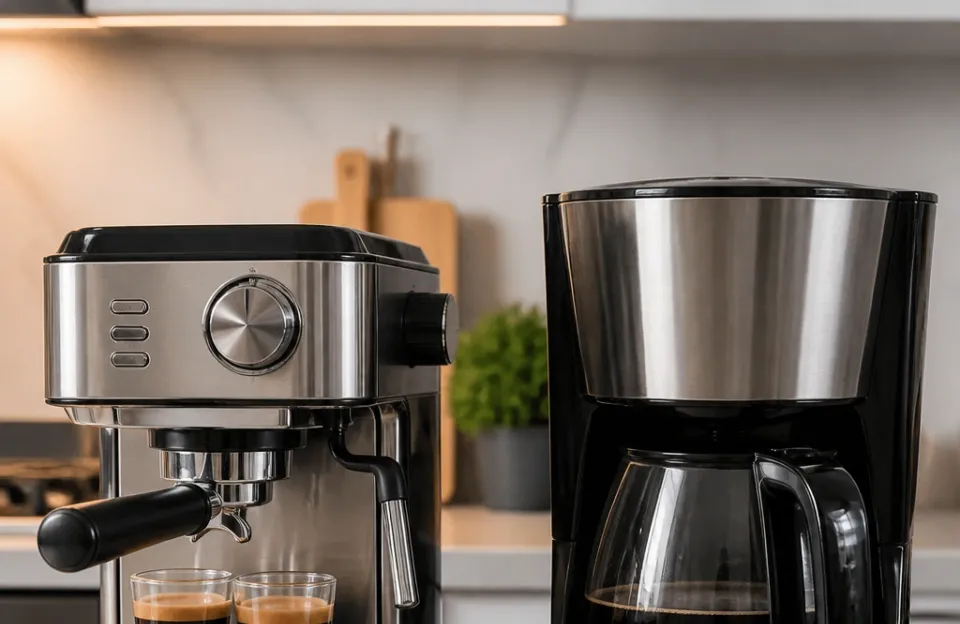
Drip coffee makers heat water and run it through grounds into a pot or carafe. Automatic-drip machines are the most popular type: you fill a chamber with water, load coffee into a filter basket, and flip a switch. The result is a batch of brewed coffee you can drink immediately or keep warm.
Espresso machines force water through finely ground coffee under pressure to produce a concentrated shot. DeLonghi’s product categories list automatic espresso machines, manual espresso machines, and steam coffee machines as distinct types. The category includes machines that handle most of the work and machines that require hands-on control.
The practical difference is what ends up in your cup. Drip gives you volume. Espresso gives you intensity and the base for milk drinks. The Specialty Coffee Association publishes standards for home coffee brewers, home coffee grinders, and semi-automatic and automatic espresso machines, though the documents themselves require SCA membership to view.
How Pressure and Grind Change What Ends Up in Your Cup
Drip brewing relies on gravity. Hot water passes through medium-ground coffee at atmospheric pressure. The grind is forgiving, the process is simple, and the result is a consistent cup that scales to a full pot.
Espresso brewing relies on pressure. Water is forced through a compacted bed of fine grounds, producing a small, concentrated shot. This pressure requirement is why espresso machines cost more, why the grind matters more, and why the learning curve is steeper.
If you want the full technical parameters for what counts as espresso under industry standards, the Specialty Coffee Association maintains published specifications for semi-automatic and automatic espresso machines. Those standards are behind a member login, so the exact numbers are not publicly readable from the SCA page alone.
What Each Category Actually Costs: Price Tiers and Required Extras
Price tiers for both categories change frequently and depend on the specific model. The retrieved manufacturer pages confirm product categories and manual availability but do not list current retail prices. What you can plan for is the structure of the cost.
Drip coffee maker costs. A basic drip machine makes at least a decent cup. Spending more buys conveniences such as programmability, a thermal carafe to keep coffee hot longer, and settings that adjust brew strength. There is no mandatory accessory purchase beyond coffee and filters unless you choose a model that requires specific filter types.
Espresso machine costs. A pump espresso machine is the entry point for true espresso. But the machine is not the full cost. You will likely need a grinder capable of producing consistent fine grounds, a scale for dosing, and a tamper if your machine does not include one. These accessories are not optional if you want repeatable results. The retrieved retailer evidence does not include current prices for these items.
Before buying any specific model, verify that replacement parts and accessories are available for your machine. The same principle applies to any kitchen appliance: checking that parts fit your specific model before purchase saves frustration later.
Size, Setup, and Daily Friction
Counter space is a real constraint. Drip machines with glass carafes and warming plates tend to be narrower but taller. Espresso machines with built-in grinders and milk systems take up more depth. A dual coffee maker combines drip and single-serve brewing in one machine, which suits people who want both options but adds footprint.
Setup differs too. A drip machine needs water, a filter, and grounds. An espresso machine needs water, finely ground coffee, a portafilter, and often a puck-prep routine that includes leveling and tamping. The daily friction of espresso is higher, and that friction is the most common reason people stop using a machine they bought.
If your mornings are rushed and you want coffee with zero decisions, drip wins. If you enjoy the ritual and the result justifies the effort, espresso earns its place.
Grinders Matter More Than You Think
Espresso demands a grinder that can produce consistent, fine particles. Drip is more forgiving of grind inconsistency. This is the single biggest hidden cost difference between the two categories.
The SCA publishes a standard for home coffee grinders. The specifics are behind the member login, but the existence of a dedicated standard signals that grinder performance is treated as a serious variable, not an afterthought.
If you choose espresso, budget for a grinder that can handle fine settings and adjust in small increments. If you choose drip, a mid-range burr grinder will serve you well for years. Blade grinders produce uneven particles that make espresso extraction unpredictable. For drip, the consequences of an uneven grind are less severe, but consistency still improves the cup.
Milk Drinks and Frothing Capabilities
If you drink lattes, cappuccinos, or flat whites, frothing capability matters as much as the espresso itself. Espresso machines with steam wands let you texture milk directly in a pitcher. Standalone electric milk frothers are a separate purchase that works with any coffee type, including drip.
DeLonghi’s manual directory lists electric milk frothers alongside coffee machines and accessories, confirming they are a distinct product category. The retrieved product pages do not include performance comparisons between steam wands and standalone frothers, so try both if possible before committing.
If you drink black coffee only, frothing is irrelevant and should not factor into your decision.
Maintenance, Descaling, and Realistic Lifespan
Both categories need cleaning, but the obligations differ.
Drip coffee makers require daily rinsing of the carafe and filter basket, plus periodic descaling to remove mineral buildup. The retrieved manufacturer resources confirm that manuals, FAQs, and warranty information are available for coffee machines, but specific descaling intervals depend on your water hardness and the model’s manual. Check your manual for the manufacturer’s recommendation.
Espresso machines require more frequent attention: daily rinsing of the portafilter and group head, regular backflushing if the machine supports it, and descaling. Automatic espresso machines may run internal rinse cycles, but they still need periodic deeper cleaning. The retrieved DeLonghi pages confirm that manuals for automatic espresso machines, manual espresso machines, drip coffee makers, and steam coffee machines are available, and that descalers and water filters are sold as maintenance items.
Lifespan depends on usage, water quality, and maintenance. The retrieved evidence does not include manufacturer-published lifespan figures for either category, so treat any specific year range you see elsewhere as an estimate rather than a guarantee.
For a deeper look at cleaning frequency and methods for coffee makers, see our guide on how often you should clean your coffee maker.
Who Should Buy Which
Buy an espresso machine if:
- You drink espresso, lattes, cappuccinos, or Americanos regularly.
- You are willing to grind fresh, tamp, and clean daily.
- You have counter space for the machine plus a grinder.
- Your total budget covers the machine, grinder, scale, and tamper.
- You enjoy the process, not just the result.
Buy a drip coffee maker if:
- You drink black coffee or coffee with simple additions.
- You want to load grounds, press a button, and walk away.
- You need to brew for two or more people at once.
- You prefer a lower total cost of entry.
- You want minimal daily cleanup.
Consider a dual coffee maker if you want drip for weekdays and single-serve or specialty options for weekends. Consumer Reports classifies dual machines as a combined drip and single-serve brewing station.
If you are comparing espresso to other single-serve formats, our breakdown of espresso machine vs Keurig and espresso machine vs Nespresso covers those specific matchups.
What to Check Before You Buy a Specific Model
Once you have chosen a category, verify these details for the exact model you are considering:
- Boiler type. Some machines use a single boiler for brewing and steaming, which means you wait between pulling a shot and frothing milk. Others use dual boilers or a heat exchanger for simultaneous operation. The retrieved manufacturer pages list product categories but do not provide boiler specifications for individual models.
- Portafilter size. Common sizes include 51 mm, 54 mm, and 58 mm. The size affects accessory compatibility and the availability of aftermarket parts. Check the manual for your specific model.
- Parts availability. Confirm that gaskets, shower screens, and other wear items are available for purchase. DeLonghi’s accessory directory lists coffee grinders, descalers, and water filters as available categories, but parts availability varies by model and brand.
- Warranty terms. Manufacturer warranty length and coverage vary. DeLonghi provides warranty information alongside manuals and service center locators. Read the warranty before purchase, not after a failure.
- Water filter requirements. Some machines require specific water filters to maintain warranty coverage. DeLonghi lists water filters as a maintenance category, which suggests they are a standard consumable for at least some models.
- Manual availability. Before buying, download the manual and read the maintenance section. DeLonghi provides manuals for automatic espresso machines, manual espresso machines, drip coffee makers, and steam coffee machines. If the manual is hard to find or unclear, that is a signal about long-term support.
When Neither Category Fits: Pod Systems and Manual Brewers
Not everyone wants a full espresso setup or a drip machine. Two alternatives are worth considering.
Pod systems. Single-serve coffee makers force water through a small packet, either a hard-shelled capsule or a soft pod, and some accept an adapter for loose grounds. They are fast and consistent but limit your coffee choices and produce more packaging waste.
Manual brewers. Pour-over cones, French presses, and AeroPress-style brewers give you control without electricity. Consumer Reports notes that some specialty coffee makers mimic French presses by suspending grounds in hot water before filtering. These methods are not espresso, but they can produce strong, concentrated coffee if that is what you want.
Cold brew. Cold-brew coffee makers use cold or room-temperature water to brew a concentrated coffee that you dilute with cold water, ice, or hot water. If you prefer cold coffee, this is a separate category worth exploring.
The Bottom Line
Buy the machine that matches your mornings, not the one that looks best on a spec sheet. If you want espresso-based drinks and will use the machine daily, invest in a pump espresso machine and a capable grinder. If you want a reliable mug of coffee with minimal effort, a drip coffee maker with the features you actually need will serve you better.
Check the manual, confirm parts availability, and read the warranty before you buy. The best machine is the one you will still be using a year from now.