Air fryer brownies bake in roughly 15 to 20 minutes at 320°F, though the exact time depends on your machine’s wattage, basket size and the pan you use. The circulating hot air sets the top quickly, giving you a crackly crust over a dense, fudgy center. You skip the long oven preheat, and your kitchen stays cool.
This guide explains how the appliance changes the baking process, which pan fits inside the basket, how to adapt a standard or boxed recipe to a smaller space, and how to diagnose texture problems before they ruin a batch.
Start Here: Temperature and Time for Fudgy Air Fryer Brownies
Set the air fryer to 320°F and plan on 15 to 20 minutes in a small pan. Wattage mainly affects how fast the machine reaches temperature and how quickly it recovers after you open the drawer; it does not change the temperature the appliance holds. That is why two people can follow the same recipe and get different results.
Treat any starting time as a range, not a schedule. Begin checking at 15 minutes, then judge doneness by the cues in the sections below rather than the clock alone.
How Rapid Air Circulation Bakes Brownie Batter
A standard oven relies largely on radiant heat from elements above and below the food. An air fryer uses a powerful fan to push heated air directly across the surface of the batter, and that constant airflow transfers heat faster than still air does.
For brownies, the practical effect is an early-set top and a center that cooks by convection. Because the chamber is small, heat stays concentrated around the pan, and a small basket will generally bake faster than a large oven-style model because the food sits closer to the element and the chamber recovers heat more quickly.
The tradeoff is moisture loss. Moving air dries surfaces, so a standard recipe baked at its usual temperature and time can develop hard edges while the middle stays underdone.
Why the Top Cracks Faster Than in a Regular Oven
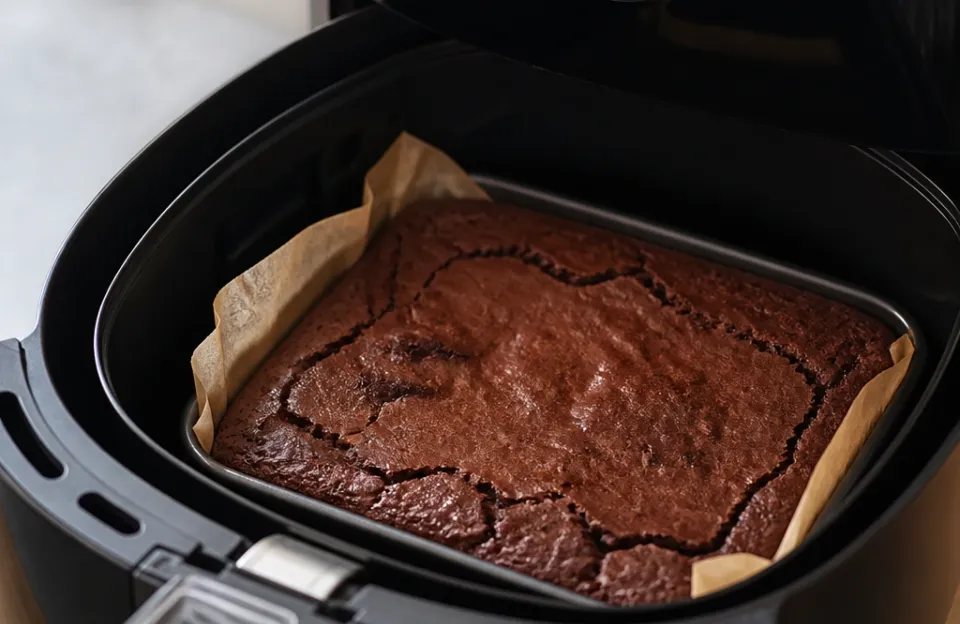
The shiny, crackly crust forms when sugar and egg proteins rise to the surface and dry out. Intense top-down airflow speeds that process, so the crust sets early and the expanding batter beneath it pushes the layer into fissures.
That crust is worth protecting. It helps hold steam inside the pan, which keeps the center moist. Opening the basket repeatedly releases that steam and interrupts crust formation, so leave the drawer closed until you are near the minimum bake time.
Adjusting Sugar Ratios for Convection Baking
Sugar does more than sweeten. It holds onto water, and in a high-airflow environment that moisture retention matters.
Brown sugar contains molasses, which is hygroscopic and pulls moisture from the air. If you adapt a family recipe, keep the sugar amount the same and expect a slightly less gooey result unless you shorten the bake. Cutting sugar significantly usually produces a dry, cakey square under rapid air circulation.
Picking the Right Pan Size for Your Basket
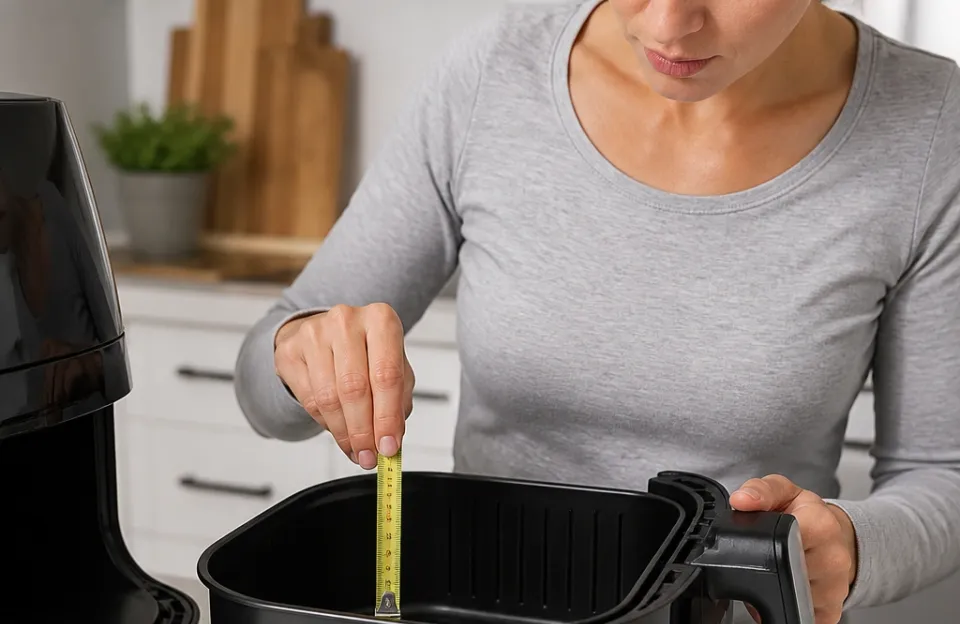
Do not pour batter directly into the air fryer basket. You need a vessel that fits inside with clearance on every side so air can move around it.
Measure the inside of your basket before mixing. Aim for at least half an inch of space between the pan and the basket walls on all sides. If the pan touches the sides, air cannot circulate, and the bottom will overbake while the middle stays liquid.
Silicone pans flex, which makes them easier to lower into a tight basket. Metal pans conduct heat faster and can produce thicker, harder edges. Glass dishes heat slowly and are generally harder to fit into smaller baskets.
| Pan Material | Heat Behavior | Best For | Drawback |
|---|---|---|---|
| Silicone | Slow, even heating | Fudgy centers, easy removal | Less crust development on edges |
| Aluminum | Fast, aggressive heating | Crisp edges, shorter bake times | Risk of burning if temperature is too high |
| Ceramic | Moderate, steady heat | Even baking across the whole pan | Heavy, harder to lift out safely |
Brownie texture is sensitive to pan behavior and batter depth, so changing pan material or size between attempts will change your results. Pick one pan and stick with it while you dial in timing.
Liner Safety: Parchment and Foil
Parchment and aluminum foil can both be used in an air fryer, but only with precautions: never run the appliance with an empty liner, and never let either material sit loose in the basket. Fast-moving air can pull lightweight parchment or foil up into the heating element.
Cut parchment to fit the base without covering the whole basket or blocking vents, and use only parchment rated for at least 425°F. Foil rules differ by brand: Philips advises against foil in its air fryers, while Frigidaire and Ninja permit it in specified positions. Check your own manual, because these brand-specific instructions take precedence over general advice.
If you skip liners, grease every corner of the pan. Cocoa-heavy batters are sticky, and the coating matters more in a small pan.
Adapting a Standard Recipe for the Air Fryer
Most boxed mixes and scratch recipes target a 9×13-inch or 8×8-inch pan, so you need to scale down to fit a 6-inch or 7-inch pan. Halving a recipe written for an 8×8 pan usually yields about the right volume for a 6-inch round pan.
Start by lowering the recipe’s oven temperature. A box that calls for 350°F typically works at 325°F or 320°F in an air fryer, with the timer set to roughly half the original suggested time. Check the center at that halfway mark.
Fat ratios matter more in a small pan. Butter brings flavor, while oil stays soft at room temperature and helps prevent brittle edges under fan force. If your recipe calls for all butter, swapping a tablespoon for a neutral oil is a reasonable adjustment for convection baking.
Eggs bind the structure, and a whole egg can add too much liquid to a halved recipe. Beat one egg in a separate bowl and measure out about two tablespoons to keep the hydration accurate.
No supplied source covers a specific brand’s air fryer instructions for boxed mix, so follow the package’s wet-ingredient directions and apply the pan-fill and temperature guidance here. Expect leftover batter if the box is sized for a 9×13 pan.
Mixing Method Changes for Smaller Batches
Small batches are less forgiving than large ones. Overmixing develops gluten, which produces tough, bread-like squares.
Whisk the wet ingredients first. Sift the cocoa powder to remove lumps, since small batches magnify clumps. Fold the dry ingredients into the wet and stop as soon as no streaks of flour remain. A few small lumps are fine; they hydrate during the short bake.
Managing Add-Ins Without Sinking
Chocolate chips and nuts sink quickly in thin batters, and a shallow pan gives them less distance to travel. Toss add-ins in a teaspoon of flour before folding them in; the coating adds enough friction to suspend them as the batter sets.
For nuts on top, press them gently into the surface after pouring rather than stirring them through. The airflow toasts the exposed nuts during the final minutes of baking.
Reading the Texture: Fudgy vs Cakey Results
Fudgy brownies rely on a high ratio of fat and chocolate to flour. Cakey versions use more flour and often a leavening agent such as baking powder.
For a dense, fudgy result, skip baking powder and use melted chocolate rather than cocoa powder alone. Melted chocolate adds fat and moisture that cocoa powder does not provide. Dark chocolate in the 60% to 70% cacao range works well; milk chocolate carries more sugar and dairy, which can scorch under direct convection heat.
Doneness Cues and Internal Temperature
Pull the pan when the center still looks slightly underdone. The toothpick should come out with moist crumbs attached, not wet batter, and not clean. A clean toothpick usually means you have gone too far.
Brownies keep cooking from residual pan heat after they leave the appliance, so removing them slightly early protects the center. Glass pans hold heat longer than metal, which extends that carryover effect.
Internal temperature guidance for brownies varies between sources and is best treated as a rough companion to visual cues. One source puts fudgy brownies near 165°F and cakey brownies near 185°F, another gives 160°F to 170°F for fudgy and 180°F to 185°F for cakey, and the same page elsewhere states 190°F to 200°F. Because those numbers conflict, use a range and your own recipe’s behavior rather than a single fixed target.
The USDA publishes minimum internal temperatures for meat, poultry, eggs, fish, leftovers and casseroles, but its chart does not list a temperature for brownies or baked chocolate batter, so it cannot settle this question.
For precision, a quick-read probe thermometer inserted into the exact center helps. A fast digital probe shortens the time the drawer stays open. If the center reads below the low end of your target range, give it another two minutes and retest.
High-Altitude Adjustments
Baking at altitude changes how batters set. High-altitude brownie guidance is aimed at home bakers around 3,000 feet and higher. It recommends checking doneness earlier, reducing leavening a little if brownies keep sinking, and adding a small liquid bump only after your timing is stable.
Make one change at a time. Brownies are highly sensitive to pan behavior and batter depth, so switching pan types between tests makes it harder to tell which adjustment helped.
Troubleshooting Common Baking Issues
Small-space baking leaves little margin for error. Match each symptom to a cause and a single corrective action before changing anything else.
Raw center, burnt edges. The temperature is likely too high, so the exterior sets before heat reaches the middle. Drop the temperature by 15°F and tent the pan loosely with foil for the first ten minutes, then uncover for the final five so the crust can form. Tuck the foil tightly under the rim so the fan cannot catch it.
Dry, crumbly texture. The bake ran long, or the batter lacks fat. Pull the pan a few minutes earlier next time and check whether your flour measurement is running heavy.
Batter overflowing the pan. The pan was overfilled or carried too much leavening. Never fill an air fryer pan more than two-thirds full; batter needs headroom to expand without reaching the heating element, which is also a fire risk.
Uneven baking. Some air fryers have uneven airflow, leaving one side darker. Rotate the pan 180 degrees halfway through and work quickly to limit heat loss.
Sticking to the pan. Line with parchment or grease every corner. Let brownies cool completely in the pan before removing them, because warm brownies fall apart.
If batter ever contacts the heating element or you see smoke from a loose liner, stop the appliance and let it cool before inspecting it.
Flavor Variations That Work in High Airflow
Once the base recipe is reliable, flavor changes are straightforward, though some additions behave differently under heavy convection.
Swirling peanut butter into the top works well. Drop spoonfuls of creamy peanut butter over the poured batter and drag a knife through to marble it. Avoid natural peanut butter that separates, since the excess oil pools and fries on the surface.
Espresso powder deepens chocolate flavor without making the brownies taste like coffee. Half a teaspoon mixed into the dry ingredients is plenty, and the rapid heat blooms the coffee compounds quickly.
Dried cherries or raisins hold up better than fresh berries. Fresh fruit releases water as it heats, and in a small pan under aggressive airflow that moisture can steam the surrounding batter, leaving soggy pockets. If you want raspberries, freeze them first and fold them in while solid so they thaw gradually during the bake.
Finish with flaky sea salt immediately after removing the pan. Residual heat melts the crystals slightly into the crust, contrasting with the sweetness.
Cooling and Storing Leftover Squares
Place the pan on a wire cooling rack as soon as it leaves the basket. Sitting flat on a solid counter traps heat underneath, which keeps the bottom layer cooking and turns it hard.
Let the brownies sit in the pan for at least 30 minutes. Starches firm up as they cool, and cutting while hot produces a smear rather than clean squares.
Once fully cool, lift them out using a parchment overhang or invert the pan if you greased it heavily. Cut with a sharp knife and wipe the blade between cuts for straight edges.
Store leftovers in an airtight container at room temperature and eat them within a few days. Refrigeration dries baked goods out and speeds staling. For longer storage, wrap individual squares tightly in plastic wrap, freeze them in a bag, and thaw at room temperature.
To reheat, warm a square at 300°F for about two minutes. Reheating runs much faster than the original bake, so stay nearby.
Before You Pull the Plug
Fudgy air fryer brownies come down to respecting a small, high-speed oven. Lower the temperature, check early, choose a pan that leaves room for air to move, and keep liners secured away from the heating element.
Once you know your machine’s timing, a small batch of dense brownies with a crackly top takes less time than preheating a full oven. Measure carefully, trust the toothpick and the jiggle test, and let the pan cool completely before you slice.