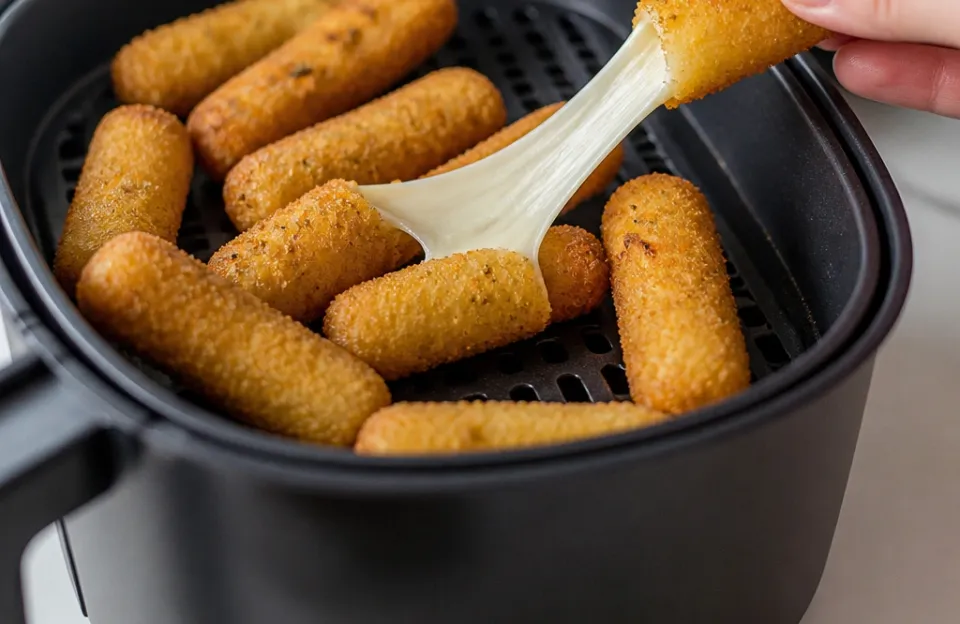
For standard frozen mozzarella sticks, set your air fryer to 400°F and cook for 6 to 8 minutes, checking them from about the 5-minute mark. Arrange them in a single layer without crowding, flip or shake at the midpoint, and pull them as soon as the coating is crisp and the cheese just begins to show. Exact timing shifts with your machine, the size of the sticks, and the breading, so treat those numbers as a starting point rather than a guarantee.
Air fryers are essentially countertop convection ovens that cook food faster and use less energy than a full-size oven, which is why frozen snacks work so well in them. Most air-fried foods fall somewhere between 350°F and 400°F for 5 to 25 minutes, so a 6-to-8-minute window for a small breaded cheese stick sits comfortably inside normal range.
What You Need Before You Start
You only need a few things: your air fryer, the frozen sticks straight from the freezer, and optionally a light oil spray. A pair of tongs helps with turning, and a sheet pan or plate is useful for resting the finished batch.
Check two things before you cook. First, read the package instructions, because a brand’s recommended time and temperature should take priority over any generic guide. Second, check your air fryer manual for maximum temperature and any rules about liners or parchment, since those restrictions vary by model.
Step-by-Step Method
- Decide on preheating. Many air fryers benefit from 2 to 3 minutes of preheating, but it is not mandatory. If your model or manual recommends it, do it; otherwise, add roughly a minute to the cook time below.
- Arrange in a single layer. Place the frozen sticks in one layer with a small gap between each one. Overcrowding prevents enough air circulation to cook the food properly, so cook larger amounts in batches rather than piling them up.
- Add oil only if you want it. A light spray on the breading can help browning, but most frozen sticks are already par-fried and will crisp without it. Spray the food rather than flooding the basket.
- Cook at 400°F for 6 to 8 minutes. Start checking at 5 minutes on the first batch, since your machine’s real temperature may run hotter or cooler than the dial suggests.
- Flip or shake at the midpoint. Around 3 to 4 minutes in, turn each stick over so both sides brown evenly.
- Pull at the first sign of readiness. Golden coating plus a hint of cheese at the ends means they are done. Remove the basket immediately if cheese is leaking heavily or the coating is darkening quickly.
- Rest for 1 to 2 minutes. This lets the molten center settle slightly so it does not scald your mouth on the first bite.
Why Frozen Mozzarella Sticks Work Better Than Thawed in an Air Fryer
Cooking from frozen is the standard approach for breaded cheese sticks, and freezing itself helps preserve quality by slowing chemical and enzymatic reactions and limiting microbial growth. The freezing and thawing process directly affects the quality of frozen foods, which is one practical reason to keep the sticks solid until they hit the basket. Thawed sticks tend to soften and lose their shape before cooking, so skip the counter thaw and cook them straight from the freezer.
Timing by Stick Size and Breading
Use this table as a starting guide, then adjust based on what you see in your own basket. All times assume a single layer and a preheated or fully hot air fryer.
| Stick Type | Typical Length | Recommended Temp | Cook Time Range | Notes |
|---|---|---|---|---|
| Snack size | 2–3 inches | 400°F | 5–6 min | Watch closely past 5 minutes |
| Standard grocery | 3–4 inches | 400°F | 6–8 min | Most common size |
| Pub or thick cut | 4–6 inches | 390°F | 8–10 min | Lower temp helps the center heat before the crust darkens |
| Panko breaded | Varies | 400°F | 6–8 min | Coarse crumbs brown faster than fine crumb |
| Gluten-free | Varies | 380°F | 7–9 min | Start lower and check early, since some coatings darken quickly |
Treat the gluten-free row as a cautious starting point, not a rule. Coating recipes differ by brand, so your first batch is the real test. If the crust darkens before the cheese softens, drop the temperature by 10 to 20 degrees and add a minute.
How to Tell They Are Done
Time is only one signal. Use all three of these cues together:
- Color: The coating should be an even golden brown with no pale, raw-looking patches.
- Cheese: A small amount of cheese visible at the ends or a slight bulge in the middle means the center has melted.
- Sound and feel: A gentle sizzle is normal. Tongs should meet slight resistance from a firm crust rather than a soft, limp surface.
Internal temperature targets for raw meat, poultry and seafood do not transfer to a fully cooked frozen breaded cheese product. Your goal is to heat the stick through and crisp the coating, not to hit a raw-food safety threshold. If your package gives specific heating instructions, follow those instead.
Troubleshooting: Leaks, Sogginess, and Burning
Cheese Leaks Out
Likely cause: The stick stayed in too long, the temperature was too high, or the coating had a crack before cooking.
Fix: Pull the batch 30 to 60 seconds earlier next time and check from the 5-minute mark. Keep sticks frozen until they go in, handle them gently so the breading stays intact, and avoid stacking them, which can crush the coating.
The Coating Is Soggy
Likely cause: Crowding trapped steam, the basket was lined in a way that blocked airflow, or the sticks sat for a long time after cooking.
Fix: Cook in a single layer and in batches if needed, since overcrowding prevents proper air circulation. Serve within a few minutes of cooking. If you used a liner, confirm with your manual that it is permitted and that it does not cover the entire basket floor.
The Coating Burns Before the Center Melts
Likely cause: Your air fryer runs hot, the sticks are thick, or the breading is a fast-browning type.
Fix: Lower the temperature to 380°F to 390°F and extend the time by 1 to 2 minutes, checking frequently. Do not push the temperature above your air fryer’s stated maximum to compensate for pale results, because that can damage the appliance or create a hazard. Instead, extend the cooking time at a safe setting.
The Coating Stays Pale
Likely cause: Under-preheating, no oil at all on a dry crumb coating, or a machine running cooler than the display suggests.
Fix: Preheat for 2 to 3 minutes, add a light spray of oil, and give the batch 1 to 2 extra minutes at the same temperature, checking every 30 seconds near the end.
Sticks Stick to the Basket
Likely cause: Cheese leaked through the coating and cooled on the grate, or the basket was not clean.
Fix: Let the basket cool, then soak it to loosen the residue. Next time, start with a clean basket, keep the sticks spaced apart, and lift them promptly when they are done rather than letting them cool in place.
Batch Size and Air Fryer Model Differences
No two air fryers behave identically. Cooking times vary because appliances differ in size and power, so a 6-minute result in one model may take 8 minutes in another. A small 2-quart basket also heats less evenly when loaded than a wide 6-quart basket.
Keep batches to one layer with visible gaps. If you need to feed a crowd, cook two or three batches rather than one crowded one, since overcrowding blocks air circulation and produces uneven results. On your first batch, note the actual time that worked and use it as your baseline for that machine and that brand.
Serving, Holding, and Reheating
Serve the sticks within 5 to 10 minutes of cooking, while the crust is still firm. A warm marinara, ranch, or garlic aioli works well on the side. If you are serving them alongside other finger foods, plate them last so they do not sit and soften.
For leftovers, refrigerate within 2 hours to keep food out of the danger zone between 40°F and 140°F. Leftover cooked food keeps in the refrigerator for 3 to 4 days or in the freezer for 3 to 4 months. It is safe to reheat frozen leftovers without thawing them first.
To reheat, use a lower temperature than the original cook: about 350°F for 3 to 4 minutes, checking at 2 minutes. The crust will not fully match a fresh batch, but a lower, shorter reheat reduces the risk of the cheese bursting out. Keep your refrigerator at 40°F or below and your freezer at 0°F for safe storage.
Safety and Stop Conditions
- Pull the basket immediately if cheese is leaking heavily or the coating is visibly blackening. Continuing to cook will not improve the result and increases the risk of a messy cleanup or a burnt-tasting batch.
- Never exceed your air fryer’s maximum temperature. Settings above the manufacturer’s limit can damage the appliance or create a safety hazard.
- Check your manual before using parchment or liners. Rules differ by manufacturer, and some advise against paper and foil because they can restrict airflow or shift toward the heating element. Do not add parchment to an empty preheating basket.
- Handle the hot basket with care. Use tongs and oven mitts, and let the basket cool on a heat-safe surface before cleaning.
Getting Consistent Results Regardless of Your Air Fryer Model
Once you know your machine, the process becomes repeatable. Pick a temperature at or below your appliance’s maximum, choose a time from the size table, and set a timer for 2 minutes before the earliest estimate. Check at that point, then every 30 seconds.
Two adjustments solve most problems. First, fix crowding before you touch the temperature, because a single layer is the biggest single factor in even browning. Second, log your results the first time you cook a new brand, since model and brand variation explains most of the gap between a recipe’s time and yours. With a baseline time and one or two tweaks, you can get crispy, properly melted sticks without guessing.
Frequently Asked Questions
Do I Need to Thaw Frozen Mozzarella Sticks First?
No. Cook them straight from the freezer. Freezing helps preserve quality, and thawing first softens the coating and makes the sticks harder to handle. Keep them frozen until they go into the basket.
Should I Preheat the Air Fryer?
Preheating helps, but it is not required. A 2-to-3 minute preheat gives more even browning on the first batch. If you skip it, add about a minute to the cook time and check earlier.
Can I Stack the Sticks in the Basket?
No. Stacking blocks air circulation and causes uneven cooking and sogginess. Use a single layer with small gaps, and cook in batches if you need more than one layer’s worth.
How Do I Know When They’re Done?
Look for an even golden coating and a little cheese showing at the ends. A slight sizzle is normal. Pull them at the first signs of readiness, and do not wait for a fixed timer if the coating is already dark.
Can I Use Parchment Paper or a Liner?
Only if your air fryer manual permits it. Some manufacturers allow fitted liners under specific conditions, while others advise against paper and foil because they can restrict airflow or move toward the heating element. Check your manual before using any liner, and never place parchment in an empty preheating basket.
Can I Cook Mozzarella Sticks and Chicken Wings at the Same Time?
It is better to cook them separately unless your air fryer manual and recipe times line up closely. Different foods need different temperatures and times, and mixing them crowds the basket, which reduces air circulation. Cook the wings first and reheat the sticks briefly if needed.
What Temperature Should the Inside of a Mozzarella Stick Reach?
There is no universal internal temperature requirement for a fully cooked frozen breaded cheese product. USDA internal temperature targets such as 145°F, 160°F, and 165°F apply to raw meat, poultry, and seafood. Follow the package heating instructions instead.
How Long Do Leftovers Keep?
Refrigerate leftovers within 2 hours, and store them in the refrigerator for 3 to 4 days or in the freezer for 3 to 4 months. You can reheat frozen leftovers without thawing them first.