An air fryer cooks too fast because it circulates superheated air directly around the food in a very small space. A standard oven has a large cavity that takes time to heat up and move air. An air fryer skips that delay entirely.
The heating element sits inches above the basket, and a powerful fan forces that heat into every gap. This concentrated airflow transfers energy to your food much quicker than traditional baking or roasting.
If you are wondering why does my air fryer cook too fast, the answer usually comes down to three things: the size of the cooking chamber, the speed of the fan, and the temperature settings you are using. Most recipes written for conventional ovens need a 25-degree Fahrenheit reduction and about 20 percent less time when moved to an air fryer. Skipping those adjustments is the most common reason dinner ends up charred on the outside and raw in the middle.
This article explains the mechanics behind that rapid cooking, breaks down the specific factors that speed up your machine, and gives you practical ways to slow things down so your food comes out exactly how you want it.
How Rapid Air Technology Heats Food Faster
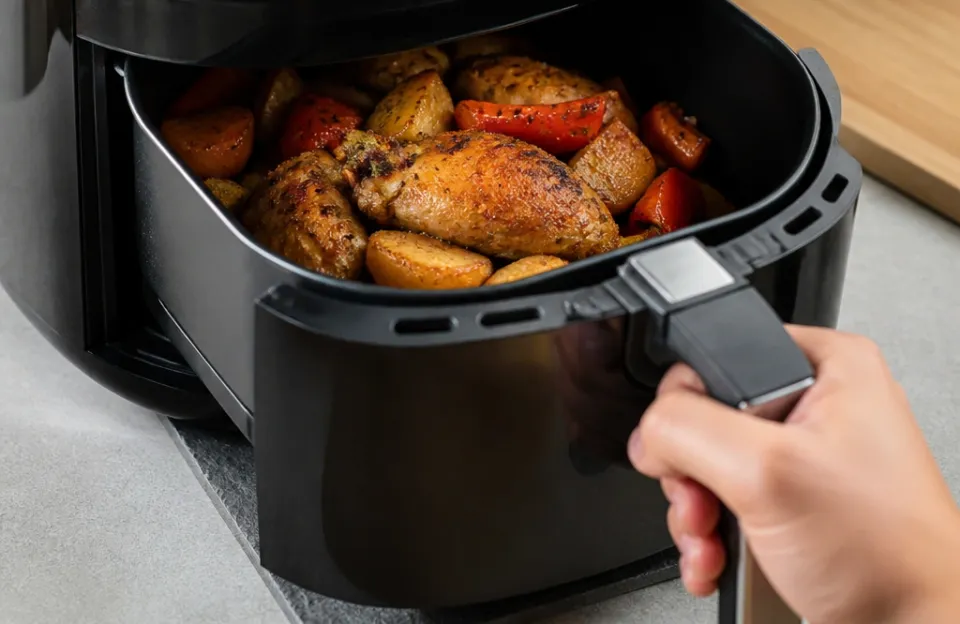
Air fryers use what manufacturers call rapid air technology. A metal coil near the top of the unit gets extremely hot. Directly above or beside that coil, a mechanical fan spins at high speed.
This fan pushes the heated air down and around the perforated basket, bouncing it off the bottom and back up through the food.
In a regular oven, heat radiates from elements at the top or bottom. The air moves slowly, mostly through natural convection. You might have a convection setting in your oven, which adds a fan, but the volume of air inside a full-sized oven is massive.
It takes time for that fan to create a consistent current.
An air fryer basket holds maybe four to eight quarts of space. The fan doesn't have to work hard to move all the air in that tiny box. Because the distance between the heating element and your chicken or potatoes is so short, the air hits the food before it loses any thermal energy.
This constant blast of high-velocity heat strips away the moisture layer on the surface of the food almost immediately, triggering the Maillard reaction (the browning process) much faster than a standard oven can.
The history of countertop convection shows these machines were originally designed for commercial kitchens specifically to cut down wait times. That same speed is what catches home cooks off guard.
The proximity of the heating element
The closer the heat source is to the food, the faster the exterior cooks. In many compact models, the top of your meal sits just two or three inches below the glowing coil. Even if the fan is moving the air, radiant heat travels in straight lines from that element directly downward.
Foods with uneven surfaces or tall profiles will brown rapidly on the peaks while the valleys stay undercooked.
Fan speed and air circulation rates
Most consumer air fryers run their fans at a single, fixed speed whenever the machine is on. You can't turn the fan down. This means the air circulation rate is always at maximum.
When you set the dial to 400 degrees, you are getting 400-degree air pushed aggressively against the food surface without pause. That continuous forced convection removes the boundary layer of cooler air that naturally forms around food in a still oven, allowing heat transfer to happen continuously and rapidly.
Why Your Specific Model Might Run Hotter Than Expected
Not all air fryers behave the same way. If you follow a recipe perfectly and still end up with burnt edges, your specific machine might run hotter than the average. Manufacturing tolerances vary.
A thermostat set to 375 degrees might actually hold the internal air at 390 or 400 degrees depending on the brand and build quality.
Larger units, like this multi-function eight-quart model, often have more powerful heating elements to compensate for the bigger basket. If you put a small amount of food in a large, powerful machine, that excess wattage concentrates on fewer items, cooking them drastically faster than intended.
Conversely, smaller personal-sized fryers have very little room for air to expand. The heat density in a two-quart basket is incredibly high. Dropping frozen fries into a tiny basket drops the ambient temperature for a second, but the element kicks into overdrive to recover, often overshooting the target temperature in the process.
| Machine Size | Typical Wattage | Heat Density | Cooking Speed vs. Recipe |
|---|---|---|---|
| 2 to 3 Quarts | 1000W to 1300W | Very High | 20% to 30% faster |
| 4 to 6 Quarts | 1400W to 1700W | Moderate | 10% to 20% faster |
| 7+ Quarts | 1700W to 1800W+ | Variable | Depends heavily on food volume |
Brand design also matters. Some popular basket-style designs place the fan directly above the element in a tight shroud, creating a highly focused downdraft. Other brands, including oven-style configurations, spread the element out or use multiple racks, which diffuses the heat slightly and slows down the cooking process compared to a dedicated basket unit.
Thermostat accuracy and calibration drift
Over months of use, the bimetallic strip or digital sensor that regulates temperature can drift. If your machine used to cook perfectly and suddenly started burning things, the thermostat might be reading lower than the actual chamber temperature. The machine thinks it needs to keep pumping heat to reach 350 degrees, even though the air inside is already pushing 380 degrees.
Voltage fluctuations in your kitchen
Appliances pulling high wattage can experience voltage variations depending on what else is running on the same circuit. While modern electronics regulate this better than old appliances, a slight bump in delivered power can cause the heating coil to run marginally hotter, shaving minutes off your expected cook time.
Converting Oven Recipes Without Burning Your Dinner
The biggest reason people ask why does my air fryer cook too fast is that they are following the instructions on the back of a frozen food bag or a traditional oven recipe without making adjustments. You cannot plug oven numbers directly into an air fryer.
The general rule for converting standard recipes is to drop the temperature by 25 degrees Fahrenheit and reduce the total time by 20 percent. If a recipe calls for 400 degrees for 30 minutes in an oven, set your air fryer to 375 degrees and check the food at the 24-minute mark.
However, that math is just a starting point. You need to account for the type of food you are cooking. Dense root vegetables hold onto cold longer, so they might need the full adjusted time.
Thin proteins or breaded items will likely finish even sooner than the 20 percent reduction suggests.
When working with raw poultry, safety is the priority. The USDA requires all poultry to reach an internal temperature of 165°F to prevent foodborne illness. Always verify this with a thermometer rather than relying solely on visual cues, since the aggressive browning in an air fryer can make meat look fully cooked long before the center reaches a safe temperature.
Checking proper poultry timing helps establish a baseline so you aren't guessing.
Adjusting for frozen versus fresh ingredients
Frozen foods release moisture as they thaw in the hot air stream. This steam temporarily cools the immediate area around the food, slowing down the browning process initially. Once that moisture evaporates, the cooking accelerates rapidly.
Fresh ingredients skip that steaming phase and start browning immediately. If you swap fresh chicken for frozen in a recipe, expect the first half of the cook time to do very little browning, followed by a sudden rush of color at the end.
Modifying baked goods and delicate batters
Cakes, muffins, and wet batters struggle in air fryers precisely because of the fan speed. The top crust forms in minutes, trapping uncooked batter underneath. Lowering the temperature by 50 degrees instead of 25, and covering the pan loosely with foil for the first half of the bake, prevents the top from setting before the middle cooks through.
Practical Ways to Slow Down the Cooking Process
You don't have to accept burnt exteriors as a permanent condition. Several physical adjustments can throttle the speed of your machine without requiring any technical modifications.
- Lower the temperature further. If dropping 25 degrees isn't enough, go down another 10 or 15. It is easier to add five extra minutes to a cook cycle than to undo a charred crust.
- Use a barrier. Placing a small piece of aluminum foil over the top of your food for the first half of the cooking time blocks direct radiant heat from the top element. Leave the sides open so the fan can still circulate air, or the food will just steam.
- Change the rack position. If you have a multi-level glass unit or an oven-style fryer, move the food to the lowest possible rack. Increasing the distance between the heating coil and the food reduces the intensity of the radiant heat significantly.
- Add thermal mass. Putting a few extra potato wedges or a small oven-safe dish of water in the corner of the basket absorbs some of the excess heat. The machine has to work harder to maintain the temperature, which evens out the spikes that cause rapid browning.
- Check early and often. Open the basket halfway through the estimated time. Opening the door vents the hot air instantly. While the machine recovers quickly, that brief pause interrupts the continuous bombardment of heat and gives the interior of the food a moment to catch up with the exterior.
Managing the timing for quick-cooking items, like figuring out when bacon finishes crisping, becomes much easier once you get used to pulling the basket out frequently to inspect progress.
Using oil sparingly to control browning
Oil conducts heat efficiently. A heavy coating of oil on vegetables or proteins will accelerate surface browning because the fat heats up faster than the water inside the food. If your meals are consistently getting too dark too fast, try cutting the oil in half.
Toss the food lightly so it has a micro-thin sheen rather than pooling droplets. Less oil means a slower path to deep browning.
Preheating habits that backfire
Many manuals tell you to preheat the empty basket for three to five minutes. If you are cooking something thin or delicate, putting it into a fully saturated 400-degree chamber guarantees a scorched bottom. For sensitive foods, skip the preheat entirely.
Put the food in cold and let the machine ramp up with the food inside. This gentler rise in temperature allows the center to warm up before the outside burns.
Foods That Are Especially Prone to Overcooking
Certain ingredients react poorly to forced convection simply due to their physical structure. Knowing which foods are vulnerable saves you from ruining dinner.
Leafy greens like kale or spinach will incinerate in minutes. The fan physically blows them around, pressing them against the heating element where they flash-burn. If you want crispy kale chips, you must weigh them down or use a very low temperature, around 300 degrees, and watch them constantly.
Foods coated in dry flour or loose breadcrumbs face a similar issue. The high-speed air strips the dry coating off the wet surface before it has time to adhere and set. This leaves bare spots that burn while the displaced flour pools at the bottom of the basket and smokes.
Pressing the breading firmly into the meat and letting it rest in the fridge for ten minutes before cooking helps the coating survive the initial blast of air.
Cheese is another problem ingredient. Exposed shredded cheese melts, then separates into oil and solids, and finally burns into a black crisp within a few minutes of hitting peak temperature. If a recipe calls for melted cheese on top, add it during the final sixty seconds of cooking, or turn the machine off completely and let the residual heat melt it gently.
Even dense items require attention. Getting root vegetables perfectly tender means cutting them uniformly so the smaller pieces don't turn to ash while the larger chunks finish cooking. Size consistency is one of the easiest ways to manage the aggressive heat output.
Sugary marinades and glazes
Sugar caramelizes around 320 degrees Fahrenheit and burns shortly after. Teriyaki sauce, honey mustard, or barbecue glazes applied at the beginning of a cook cycle will turn into bitter carbon before the protein is done. Always apply sugar-based sauces during the last two to three minutes of cooking.
Let the meat cook naked or with dry spices first, then brush on the glaze right at the end.
Troubleshooting Uneven Results From Fast Heating
Sometimes the complaint "why does my air fryer cook too fast" is really about uneven cooking. The outside looks burnt, leading you to pull the food out early, only to find the inside completely raw. The machine isn't necessarily broken; the heat is just penetrating unevenly.
Overcrowding the basket is the primary culprit. If you stack french fries or pile chicken thighs on top of each other, the air cannot flow between the pieces. The items on the outside and top take the full force of the fan and burn, while the items trapped in the center sit in a pocket of stagnant, cooler air.
Cook in single layers. If you have a lot of food, do it in batches.
Shaking the basket is mandatory for loose items. Fries, diced vegetables, and wings need to be tossed every five to seven minutes. This rotates which surfaces face the direct airstream, distributing the intense heat evenly across all sides.
If you leave them static, the top layer will overcook while the bottom layer steams in its own released moisture.
Using the wrong size basket for your portion also causes issues. Cooking a single chicken breast in a massive six-quart basket exposes it to an overwhelming volume of circulating hot air with no neighboring food to absorb the excess energy. Match your batch size to your machine's capacity, or artificially fill the empty space with crumpled foil to disrupt the airflow pattern.
Cleaning buildup that alters airflow
Grease and carbonized food particles stuck to the mesh basket or the heating element change how the machine operates. A clogged mesh restricts airflow from below, forcing all the air to hit the top of the food harder. Similarly, grease baked onto the heating coil acts as an insulator, causing the element to run hotter than the thermostat expects in order to push heat through the grime.
Wash the basket thoroughly after every use and wipe down the upper element periodically according to your manual.
Frequently asked questions
Does opening the air fryer basket ruin the cooking process?
Opening the basket causes a temporary drop in temperature, but the heating element recovers within seconds. For foods that are browning too quickly, pulling the basket out briefly acts as a manual pause button. It lets the interior heat equalize without adding more aggressive surface browning.
Should I always lower the temperature when using an air fryer?
Yes, if you are adapting a recipe meant for a conventional oven. Dropping the temperature by 25 to 50 degrees Fahrenheit compensates for the efficiency of the fan and the small cooking chamber. Without this adjustment, the exterior of the food will cook significantly faster than the interior.
Do air fryers with higher wattage always cook faster?
Higher wattage means the heating element can produce more heat and recover temperature drops faster. However, cooking speed also depends on the fan motor strength and the basket size. A 1700-watt machine with a large basket might cook slower than a 1400-watt machine with a tiny, cramped basket.
Can I put foil in the basket to block the heat?
You can place a small piece of foil over the top of the food to shield it from direct radiant heat. Never line the entire bottom of the basket with foil. Blocking the perforations stops the air from circulating underneath, which defeats the purpose of the appliance and can cause the machine to overheat.
Why does my food burn on the outside but stay raw inside?
This happens when the temperature is too high for the thickness of the food. The aggressive surface heat browns the exterior before thermal conduction can carry that warmth to the center. Lowering the temperature by 25 degrees and extending the time allows the heat to penetrate deeper without scorching the outside.
Is there a way to test if my air fryer runs hot?
Place an oven-safe standalone thermometer inside the basket and set the machine to 350 degrees. Let it run empty for five minutes, then read the thermometer. If it reads 375 or higher, your thermostat runs hot, and you should manually dial down your temperatures for every recipe you use.
Getting Consistent Results Every Time
Understanding why does my air fryer cook too fast comes down to respecting the physics of a small, high-powered convection chamber. The combination of close-proximity heating elements, restricted airspace, and aggressive fan speeds means energy transfers to your food much faster than you are used to.
Treat your air fryer as a distinct appliance rather than a miniature oven. Make the standard temperature and time reductions your default starting point. Keep an eye on sugary glazes, delicate batters, and thin cuts of meat, as they are the first to fall victim to the rapid airflow.
With a few minor adjustments to your habits, you can stop racing against the timer and start getting predictable, evenly cooked meals out of every batch.