Buy a single-zone air fryer if you cook for one or two people, usually prepare one food or one mixed batch at a time, and want the simplest appliance that fits a tight counter. Buy a dual-zone air fryer if you cook for three or more people, or if your recurring problem is getting a main and a side to finish together at different settings. The deciding factors are household size, whether two foods genuinely need separate temperatures and finish times, and how much measured counter space you have.
How Single Zone vs Dual Zone Air Fryers Actually Differ
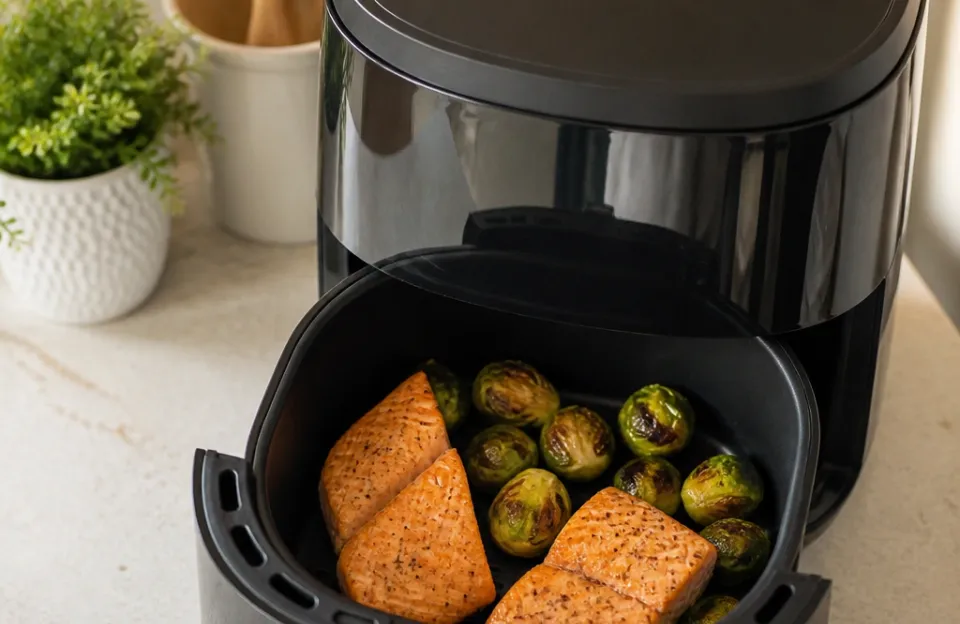
A single-zone air fryer has one cavity, one heating element, one fan and one control set. Everything inside cooks at the same temperature for the same duration, so a mixed batch works only when the ingredients share similar timing and heat needs.
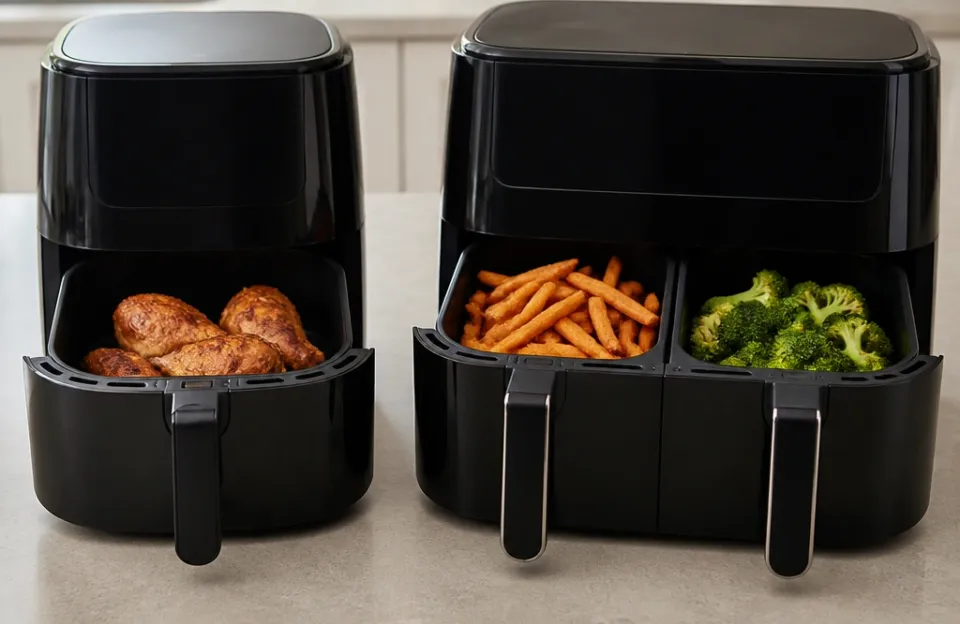
A dual-zone air fryer adds a second independently controlled compartment. The Ninja Foodi DZ401, for example, uses two independent 5-quart baskets with a 10-quart total, each with its own settings. Many dual-zone models include coordination features: Smart Finish is designed to finish foods cooked at different settings at the same time, while Match Cook copies one set of settings across both zones.
There is also a third layout worth knowing about. Some dual-zone models use a single basket with a removable divider rather than two separate drawers. The Emphsism 12QT switches between one 12QT chamber and two independent 6QT zones by removing or inserting its divider. The Ninja Foodi FlexBasket DZ071 works on the same principle at a smaller scale, offering a 7-quart MegaZone or two separate zones with six functions.
That distinction matters at serving time. Because the Emphsism uses one basket with a divider rather than two drawer-style baskets, you cannot pull out just one side to serve from directly.
Capacity: Total Quarts vs Usable Space per Side
The most common buying mistake is comparing total capacity figures directly. A dual-basket air fryer’s total capacity is divided between two zones, so a larger total does not automatically mean more room for one large item. A 10-quart dual-zone model with two 5-quart baskets gives you less room for a single wide item than a 6.5-quart single-basket model does.
For context on real single-zone capacity, the COSORI Iconic CAF-SE601S-CUS is a 6.5-quart single-basket model, while the Instant Vortex Plus 6QT ClearCook (140-3088-01) is a 6-quart single-basket unit with a viewing window and six functions. Those figures describe one uninterrupted cavity.
If you batch-cook proteins for the week, that uninterrupted cavity is the useful number, and the same principle applies when you prepare chicken wings in bulk. If your meals usually pair a protein with a vegetable or a starch at different temperatures, the per-zone figure is the one that constrains you.
Cooking Performance and Heat Distribution
Performance differences between the two designs are largely model-specific. No independent controlled test data comparing single-zone and dual-zone cooking speed or evenness was available for this comparison, so any claim that one design cooks faster or more evenly should be treated as unverified rather than settled.
What is documented is how the designs distribute their heat. Independent zones let you run two different temperatures and durations at once, which is exactly what coordination features such as Smart Finish are built to manage. A single zone cannot do that, so a main and a side at different settings usually means cooking them in sequence.
Maximum temperature is a separate, checkable specification. The COSORI Iconic lists a 90-450°F range, and the Emphsism 12QT is rated to 400°F, which is lower at the top end than the 450°F listed for the Ninja DZ401. If you rely on very high heat for browning, that ceiling is worth confirming on the specific model you are considering. Cooking-time references for foods such as potatoes and salmon can help you translate a recipe’s temperature into a plan for whichever layout you choose.
Counter Space, Storage and Outlet Access
Dual-zone bodies are generally wider than single-zone bodies because they house two compartments, two baskets and duplicate controls. Published dimensions still vary enough that measuring is not optional.
For reference points, the COSORI Iconic lists external dimensions of 14.8 × 11.8 × 11.6 inches including the handle, and its listed counter footprint is 14.8 × 11.8 inches. The Instant Vortex Plus 6QT ClearCook lists a counter footprint of 14.9 × 11.8 inches. Those are compact single-zone figures. Slim-profile countertop models show how narrow a single-zone footprint can get.
Dimension accuracy is not guaranteed across listings. Ninja’s current product page lists different external dimensions from its older product listing for the DZ401, so confirm the appliance dimensions and required clearance with Ninja before buying for a tight space.
Before ordering, measure four things: counter width, counter depth, height from the counter to the bottom of your upper cabinets, and the distance to a reachable outlet. Then compare those numbers against the manufacturer’s current specification page for the exact model, not against a retailer summary or an older listing.
Energy Draw and Circuit Load
Wattage is the specification that matters here, and it is available for several representative models. The COSORI Iconic is rated 1,725 W, the Instant Vortex Plus 6QT ClearCook is rated 1,700 W, and the Ninja DZ401 is rated 1,690 W. The Emphsism 12QT is listed at 1,600 W, though that figure comes from a third-party review site rather than a manufacturer specification.
Those numbers are closer to each other than the two-zone design might suggest, because wattage describes the appliance’s rated draw rather than a simple sum of two independent heaters. Treat wattage as the figure to check against your kitchen’s circuit capacity and against the manufacturer’s guidance. No verified data was retrieved on actual energy consumption in kWh or cost per use for either design, so claims about which layout saves electricity should be treated as unproven. Dual-zone models generally cost more upfront, and whether the convenience justifies that is a usage question, not an efficiency one.
Daily Cleanup and Maintenance
One basket and one tray versus two baskets or a basket plus a divider is the practical difference here, and it adds up over a week of cooking. More parts also means more surfaces that collect grease, including around the divider on models that use one.
The hard rule is the same for both designs: the main unit, which houses the heating element, fan and control panel, should never be submerged in water or placed in the dishwasher. Only removable parts go near water.
Baskets and pans are commonly listed as dishwasher safe, but harsh detergents and high dishwasher temperatures can degrade non-stick coatings over time, so the manual for your specific model should be the deciding reference. America’s Test Kitchen recommends skipping the dishwasher for air fryer baskets and trays, citing the dishwasher space they consume and how quickly nonstick surfaces wipe clean, while noting the dishwasher remains an option where parts are genuinely dishwasher safe. The Instant Vortex Plus 6QT ClearCook lists its basket and tray as dishwasher safe.
If you cook greasy foods such as bacon regularly, plan for the grease handling routine as part of the decision, because two compartments mean two grease cleanups on the nights both are used.
Food Safety When Using Two Zones
Dual zones create an obvious temptation to use one side for raw meat and the other for vegetables. The design does not remove the basic rules. USDA FSIS advises keeping raw meat and poultry separate from cooked or ready-to-eat foods and not reusing the same platter, cutting board or utensils for raw and cooked foods, because bacteria in raw juices can contaminate cooked food. The FDA similarly advises separating raw meat, poultry, seafood and eggs from other foods and using separate cutting boards for produce and for raw meat, poultry and seafood.
Use separate utensils and separate serving plates for each zone, and do not assume that separate compartments alone make cross-contact impossible. For doneness, the FDA states that a food thermometer is the only reliable way to ensure the safety of meat, poultry, seafood and egg products, because color and texture are unreliable indicators, with safe minimum internal temperatures including 165°F for poultry and 160°F for ground meat.
Who Benefits Most from Each Type
A single-zone air fryer fits you if: you cook for one or two people, you usually make one food or one mixed batch, you cook in sequence without it bothering you, and your counter is tight. A 6 to 6.5-quart single-basket model such as the COSORI Iconic or the Instant Vortex Plus 6QT ClearCook gives you one uninterrupted cavity, a simpler control set and fewer parts to clean.
A dual-zone air fryer with two fixed baskets fits you if: you cook for three or more people, or your recurring problem is timing two foods that need different settings. The Ninja Foodi DZ401 pairs two independent 5-quart baskets with Smart Finish and Match Cook, so you can coordinate finish times or copy one set of settings across both zones. The tradeoff is that the 10-quart total is split into two 5-quart baskets, so a wide single item cannot span both, and the body is wider.
A dual-zone air fryer with a removable divider fits you if: you want both a large single chamber and two independent zones in one appliance. The Ninja DZ071 FlexBasket offers a 7-quart MegaZone or two zones, and the Emphsism 12QT offers a 12QT mega zone or two 6QT zones, with the Emphsism described as fitting a whole chicken of roughly 5 to 6 pounds in that mode. Weigh the tradeoffs honestly: the Emphsism is a newer brand with only about 49 reviews and limited long-term durability data, and its divider can shift during shaking.
Two more species of the same idea appear in the broader market. Dual-basket models are sometimes sorted separately from dual-zone models, and understanding the difference between dual zone and dual basket layouts helps you read listings accurately. If neither basket layout appeals, comparing an air fryer toaster oven against a standard air fryer covers a different form factor entirely, and ceramic versus nonstick coatings is the relevant question if coating material drives your choice.
Price and Value
Verified current pricing was thin for this comparison, and prices move, so treat the following as dated reference points rather than shopping advice.
Food Network’s testing of more than 25 models named the Instant Vortex Plus Six-Quart as best overall at roughly $120 to $150, and highlighted dual-basket models such as the Instant Pot VersaZone at about $220 and the Ninja Foodi DualZone at roughly $160 to $200 as best for families. The Emphsism 12QT was listed at about $131, described as undercutting the Ninja DZ401 by roughly $50 to $100. No verified current price was retrieved for the Ninja DZ401, the COSORI Iconic or the Instant Vortex Plus, so confirm the price on the retailer page at the time you buy.
The value question is whether you will actually use two zones often enough. If you cook for one or two people and rarely need two different settings at once, the extra compartments, controls and cleaning add cost and effort without a matching benefit. If you cook for a family most nights, the ability to run a protein and a side simultaneously is the feature you are paying for.
Closing Decision Checklist
Work through these in order, and let the answers narrow the choice rather than forcing a preference.
- Household size. One or two people points toward single zone. Three or more points toward dual zone.
- Do two foods need different settings to finish together? If yes, dual zone is the direct fit. If you are content to cook in sequence, single zone is simpler.
- Usable capacity, not total. Decide the largest single item you need to cook in one layer, then check the per-zone figure on any dual-zone candidate rather than the total.
- Measure the counter. Record width, depth and the height to your upper cabinets, then confirm dimension and clearance figures on the manufacturer’s current page for that exact model.
- Check the outlet. Confirm the rated wattage against your kitchen circuit and the manufacturer’s guidance before buying.
- Decide on divider flexibility. If a removable divider appeals, verify in the official manual that the model supports it, and weigh the durability uncertainty of a newer brand against the flexibility.
- Confirm the cleaning routine. Check the manual for which parts are dishwasher safe, and expect non-stick coatings to last longer with hand washing.
If you are still torn after step two, the honest answer is that you probably cook in sequence often enough that a single-zone model will serve you well, and you can put the price difference toward a larger single basket instead.