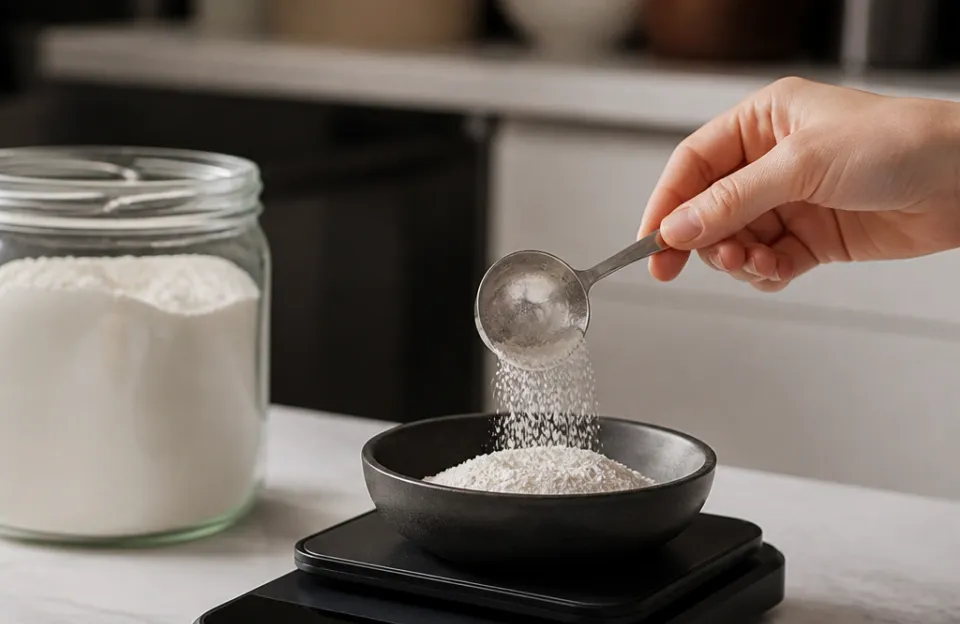
Using a food scale for weight loss and calorie counting means placing your plate or container on the device, pressing the tare button to zero it out, adding your food, and reading the exact gram weight. You then match that weight to a nutrition database to get precise calorie numbers. The whole process takes under a minute per meal once you build the habit.
You need three things before starting: a digital kitchen scale that measures in grams, a calorie tracking app on your phone, and your food. No special prep is required. Learning how to use a food scale for weight loss and calorie counting removes the guesswork from portion sizes.
Eyeballing a cup of rice often leads to eating 300 calories more than you planned. A scale gives you the exact number every time.
Why Grams Beat Cups and Spoons for Tracking Calories
Volume measurements change based on how you pack the food. Scoop flour straight from the bag, and you might get 150 grams in one cup. Spoon it gently, and that same cup holds 120 grams.
That difference adds up fast over a week of baking or cooking. Grams stay constant. Fifty grams of almonds is always fifty grams of almonds.
Calorie tracking apps calculate energy based on weight. When you log "one medium banana," the app guesses the size. A medium banana can weigh anywhere from 100 to 140 grams without the peel.
That gap represents roughly 35 extra calories. Weighing the peeled fruit at 118 grams tells the app exactly what you ate.
The USDA maintains standard reference weights for thousands of foods through their FoodData Central database. These entries list serving sizes in grams first. Volume equivalents are provided as secondary estimates.
Basing your tracking on the primary unit keeps your daily totals accurate.
Raw Weight Versus Cooked Weight Changes Everything
Water evaporates when you cook meat. Pasta absorbs water when you boil it. A chicken breast that weighs 200 grams raw might weigh 150 grams after grilling.
Those missing 50 grams are mostly water, not lost calories. The protein and fat content stays largely the same.
If you weigh your chicken after cooking but log it in your app as raw, you will underestimate your calories. The app thinks you ate 150 grams of raw chicken, which has fewer calories than 200 grams of raw chicken. Always check whether the database entry specifies "raw" or "cooked." Most entries default to raw weight unless stated otherwise.
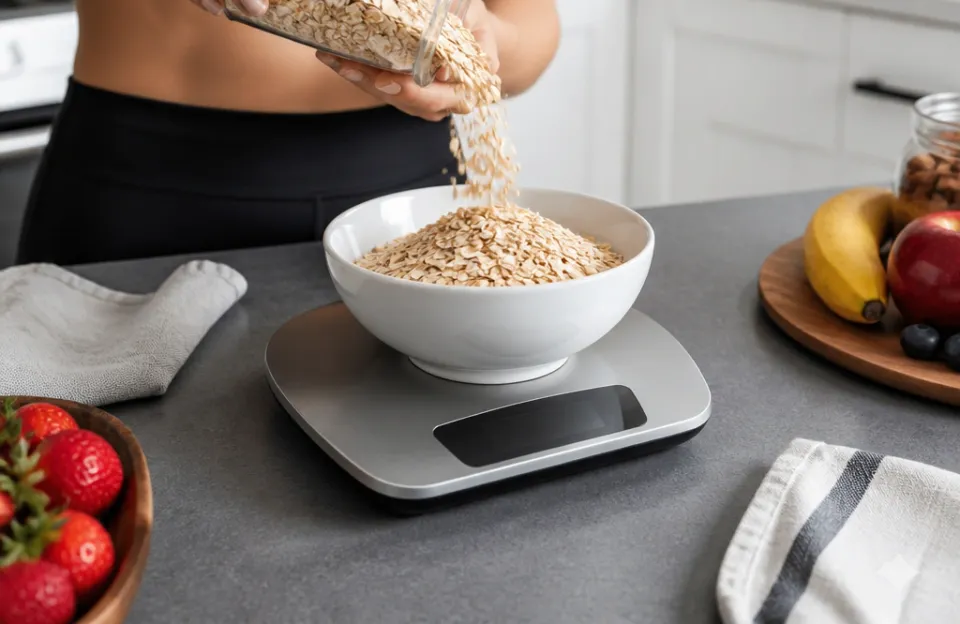
For grains and legumes, the opposite happens. Dry oats absorb liquid and gain weight. One hundred grams of dry oats turns into roughly 250 grams of cooked oatmeal.
The calories come from the dry weight. Log the dry measurement before adding water or milk to avoid inflating your intake numbers artificially.
Tare Is the Button You Will Press Most Often
The tare function resets the scale to zero while an object sits on it. This lets you weigh food inside a bowl without including the bowl's weight. Place your empty plate on the scale.
Press tare. The display reads zero. Add your food.
The number shown is only the food's weight.
You can tare multiple times during one session. Put a bowl down and tare. Add peanut butter and note the weight.
Press tare again so the display returns to zero. Pour honey directly on top of the peanut butter. The scale now shows only the honey's weight.
This method saves you from washing five separate measuring cups just to build a smoothie.
Setting Up Your Scale Before the First Meal
Place the scale on a hard, flat surface. Kitchen counters work perfectly. Avoid cutting boards with warped edges or silicone mats that compress.
Soft surfaces cause the load cell underneath the platform to read unevenly, leading to fluctuating numbers.
Turn the scale on and wait for the display to settle at zero. If it doesn't read zero, press the tare button. Select grams as your unit of measurement.
Some scales default to ounces. Switching to grams gives you smaller increments, usually down to one gram. Ounces often round to the nearest quarter or eighth, which hides small additions like cooking oil.
Keep the scale away from active stove burners or open windows. Heat rising from a pot can push against the weighing platform and alter the reading. Drafts from a fan or vent do the same thing.
Accuracy depends on a stable environment.
Weighing Individual Ingredients While Cooking
Cooking from scratch requires weighing each component as you add it to the pan or mixing bowl. Start by setting your prep bowls near the scale. Turn the scale on, place your cooking pot or skillet on it if it fits safely, and tare.
Pour olive oil directly into the pan until you hit your target grams. Oil is incredibly calorie dense. One tablespoon is roughly 14 grams and contains about 120 calories.
Pouring blindly from the bottle easily doubles or triples that amount. Weighing it prevents accidental surplus.
Add your chopped vegetables next. Press tare after each ingredient so the display isolates the new item. Log each weight into your tracking app immediately.
Waiting until the end of the meal to remember everything leads to forgotten items. Forgotten items mean untracked calories.
This approach pairs well with monitoring temperatures during cooking. Using a reliable instant read tool guarantees your proteins reach safe internal heat levels while you focus on the math of the ingredients. Getting both the weight and the temperature right keeps meals safe and aligned with your goals.
Handling Condiments, Sauces, and Liquid Additions
Liquids weigh exactly what they weigh. Water is one gram per milliliter. Other liquids vary slightly based on density, but a food scale measures mass directly, so density differences don't matter for calorie counting.
Fifty grams of soy sauce is fifty grams of soy sauce.
Squeeze bottles make this easy. Put your bowl on the scale, tare, and squeeze ketchup or mayo until you hit the desired number. For sticky items like honey or maple syrup, spray the measuring spoon with a light coat of cooking spray first if you prefer spoons.
Or skip the spoon entirely and pour straight from the jar onto the tared dish.
Sauces made from multiple ingredients should be weighed as a total batch. Weigh all components going into the saucepan. Add up the total calories for the entire batch using your app.
Once the sauce finishes cooking, weigh the final yield. Divide the total calories by the final weight in grams to find the calories per gram. When you serve yourself two tablespoons later, weigh that portion and multiply by your per-gram calculation.
Logging Pre-Packaged Foods Against Their Nutrition Labels
Packaged foods list serving sizes on the back. A bag of chips might state one serving is 28 grams. Open your scale, place a napkin or bowl on it, tare, and pour chips until the screen reads 28 grams.
Now you have exactly one serving.
Often, people eat more than the listed serving size without realizing it. Pouring chips directly from the bag into your hand makes it impossible to know if you grabbed 28 grams or 60 grams. Sixty grams is over two servings.
The calorie difference between those two amounts determines whether you stay within your daily limit.
Match the unit on the package to the unit on your scale. If the label uses grams, set your scale to grams. If it uses ounces, switch the scale to ounces temporarily, though converting to grams is generally more precise.
Enter the exact weight you measured into your app. The app will scale the macronutrients proportionally.
When dealing with larger cuts of packaged meat, checking the safe pork temperatures before eating is just as important as logging the raw weight. Proper cooking destroys pathogens, while proper weighing tracks the macros. Both habits belong in the same routine.
Building Complete Meals Without Dirtying Extra Dishes
Assembling a full plate involves layering ingredients on a single dish. Grab your dinner plate. Set it on the scale.
Press tare. Add your base carbohydrate, like brown rice. Note the weight and log it.
Press tare again.
Add your protein source. Note the weight. Press tare.
Add vegetables. Note the weight. Press tare.
Drizzle dressing. Note the weight. You now have a fully tracked meal sitting on one plate, ready to eat.
No measuring cups sit in the sink. No extra bowls need washing.
This stacking method works for lunches packed in containers too. Place the empty storage container on the scale first. Build the meal inside it layer by layer.
Seal the lid when finished. The food is weighed, logged, and stored simultaneously.
| Food Type | Common Visual Guess | Actual Scale Weight | Calorie Difference |
|---|---|---|---|
| Peanut Butter | 1 Tablespoon | 16g vs 32g (heaped) | ~95 vs ~190 kcal |
| Cheddar Cheese | 1 Slice | 20g vs 40g (thick cut) | ~80 vs ~160 kcal |
| Dry Pasta | 1 Cup | 100g vs 150g (packed) | ~350 vs ~525 kcal |
| Olive Oil | 1 Tablespoon | 14g vs 25g (heavy pour) | ~120 vs ~220 kcal |
Where Eyeballing Portions Fails the Hardest
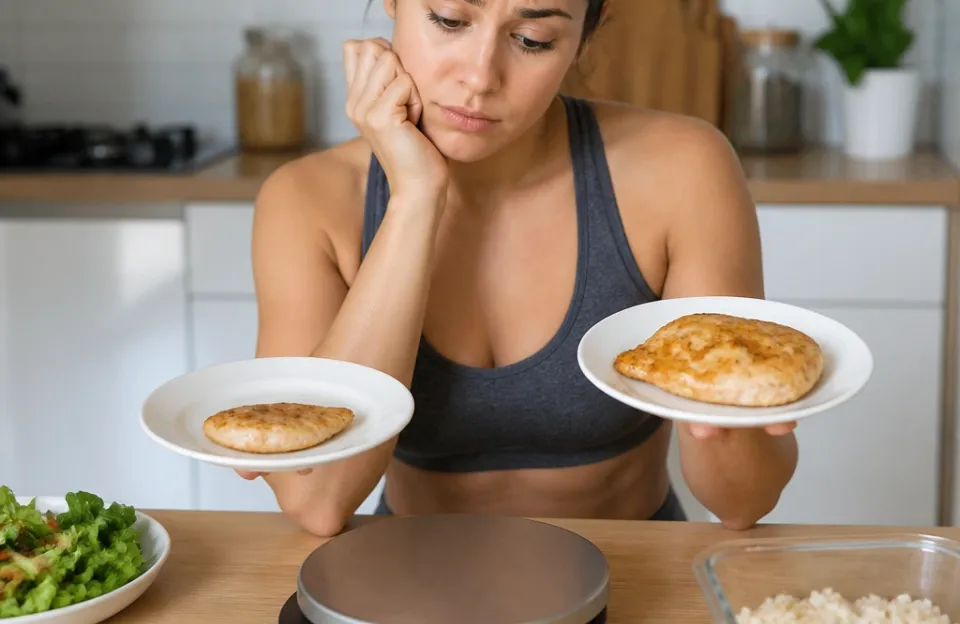
Certain foods trick the eye constantly. Shredded cheese settles differently depending on the shred size. Fine parmesan packs tightly into a measuring cup, yielding far more grams than large cheddar shreds in the same volume.
A cup measure cannot account for this variance.
Nuts are another frequent culprit. Almonds, walnuts, and cashews are high in fat and calories. A handful feels small, but hands vary in size.
What looks like a modest snack can easily exceed 300 calories when weighed. Granola behaves similarly. It clusters together, leaving air pockets in a measuring cup that hide the true density.
Cooking oils and butter top the list of mismeasured items. Recipes call for a tablespoon, but pouring from a bottle rarely yields exactly 14 grams. People tend to pour heavy.
Over a month, those extra grams of oil compound into thousands of untracked calories. Weighing fats directly on the pan or plate stops this accumulation.
Baking demands precision anyway. Following a recipe that relies on accurate oven readings ensures the cake rises properly. Weighing the flour and sugar ensures the calorie count matches the slice you eventually eat.
Baking by weight solves texture problems and tracking problems at the same time.
Eating Out and Managing Unweighable Restaurant Food
You cannot bring a scale to most restaurants without drawing stares. Dining out requires a shift in strategy. Track what you can control beforehand.
If you know you are eating out for dinner, weigh your breakfast and lunch strictly. Leave a calorie buffer for the restaurant meal.
Look up the restaurant's nutrition guide online if available. Many chains publish exact gram weights and calorie counts for their menu items. Use those published numbers instead of guessing.
Order simple dishes. A plain grilled steak with steamed broccoli is easier to estimate than a casserole with hidden sauces and mixed components.
For meals cooked at home but eaten later, prep them in advance. Weigh portions into individual containers on Sunday. Grab one container on Wednesday.
The tracking was done days ago. You simply scan the barcode or pull up the saved entry in your app. Batch cooking eliminates the friction of weighing every single night after a long workday.
If you smoke meats outdoors for meal prep, maintaining steady heat is critical. A solid wireless probe setup lets you monitor the pit temperature from inside while you handle other prep tasks. Once the brisket is done, slice it, weigh the portions, and store them for the week.
Mistakes That Skew Your Daily Totals
Weighing food after eating part of it ruins the data. Bite off a piece of toast, then put the rest on the scale. You now have no idea what the original slice weighed.
Always weigh before taking the first bite.
Forgetting to account for cooking spray is common. A quick spritz of the pan seems weightless. Five seconds of spraying adds several grams of oil.
Spray the pan while it sits on the tared scale if you want absolute accuracy. Or log a standard two-gram spray as a baseline.
Leaving the scale on a soft surface causes drifting numbers. Silicone baking mats compress under weight. The scale struggles to find a resting point.
Move it to the bare counter.
Another issue arises when people forget to subtract packaging weight. Leaving a plastic wrapper on the scale while weighing a candy bar adds a gram or two. It sounds minor, but consistency matters.
Remove all wrappers, peels, and bones before weighing the edible portion. If you must weigh something with a bone, like a ribeye, weigh it before cooking, eat it, and weigh the leftover bone. Subtract the bone weight from the initial weight to find out exactly how much meat you consumed.
Tracking hydration alongside food helps maintain context. Sometimes thirst masks itself as hunger. Having a fast digital thermometer nearby reminds you that kitchen tools serve specific functions.
Your scale handles mass; your tracker handles math. Keep them working together.
Does Constant Weighing Become Obsessive?
A food scale is a learning tool. Its purpose is teaching you what actual portion sizes look like. After four to six weeks of weighing everything, your eyes recalibrate.
You start recognizing what 150 grams of chicken looks like on a plate. You see what 30 grams of cereal fills in a bowl.
Once that visual calibration happens, you can relax. You don't need to weigh every blueberry forever. Transition to weighing calorie-dense foods like oils, nuts, cheese, and grains.
Let low-calorie vegetables remain visual estimates. A few extra grams of spinach won't derail a deficit.
People with a history of disordered eating should approach food scales cautiously. Counting every gram can trigger restrictive behaviors. If tracking causes anxiety, step away from the scale.
Work with a registered dietitian who can suggest alternative methods for managing intake without rigid measurement. The scale serves you. You don't serve the scale.
If you travel frequently, bringing your gear along protects your routine. Storing delicate instruments properly matters. A protective carrying case designed for similar-sized electronics keeps sensors safe from getting crushed in a suitcase.
Frequently Asked Questions
Do I really need a food scale if I use measuring cups?
Measuring cups work for liquids, but they fail with solids due to packing density. Flour, shredded cheese, and chopped vegetables compress differently every time you scoop them. A scale measures mass directly, removing the variation caused by how tightly you fill the cup.
For strict calorie counting, grams provide the consistency that volume measurements lack.
Should I weigh my meat before or after cooking?
Weigh meat before cooking whenever possible. Nutrition labels and database entries almost always list calories based on raw weight. Cooking drives out moisture, shrinking the meat and changing its weight without changing the total calories.
If you must weigh after cooking, search specifically for "cooked" entries in your tracking app to avoid underestimating your intake.
How do I track a homemade soup or stew with multiple ingredients?
Weigh every ingredient as you add it to the pot and log them individually in your app. Once the soup finishes cooking, weigh the entire pot minus the pot's tare weight. Divide the total recipe calories by the total cooked weight in grams.
This gives you a calorie-per-gram ratio. When you serve yourself a bowl, weigh the bowl's contents and multiply by that ratio.
Will using a food scale slow down my meal prep too much?
The first few days take longer because you are building the habit. Taring, pouring, and logging becomes automatic quickly. Most people find that weighing directly into the cooking vessel actually speeds up cleanup since fewer measuring spoons and cups get dirtied.
Within a week, the added time per meal drops to under sixty seconds.
Can I use a postage scale or jewelry scale for food?
Jewelry scales are highly accurate but usually max out at 100 or 200 grams. They cannot hold a dinner plate or weigh a large chicken breast. Postage scales handle heavier weights but often lack a tare function and measure in larger increments unsuitable for calorie tracking.
A dedicated digital kitchen scale with a capacity of at least 5 kilograms and one-gram increments is the correct tool.
Keeping Your Numbers Honest Long Term
How to use a food scale for weight loss and calorie counting comes down to repetition. You place the item, read the number, and log it. There is no shortcut around the physics of mass.
Calories are units of energy tied directly to the physical weight of macronutrients. Protein provides four calories per gram. Fat provides nine.
Carbohydrates provide four. Knowing these constants makes the scale's readout meaningful.
Start by weighing your highest calorie items first. Fats, grains, and proteins drive your daily totals. Vegetables and watery fruits matter less for strict math, though they matter greatly for nutrition.
Build confidence with the heavy hitters before worrying about the garnish.
Over time, the data reveals patterns. You might discover that your morning coffee habit contains 400 calories because you never measured the cream. Or you might find that your dinner portions were half the size you assumed.
That feedback loop is why people lose weight successfully with a scale. It replaces assumptions with evidence. Keep the batteries fresh, keep the surface flat, and let the numbers guide your choices.