Food scale batteries power the digital display and load cell sensor that give you accurate readings. Most kitchen scales run on either coin cells, standard AAA or AA alkaline batteries, or a built-in rechargeable lithium-ion pack. The type your scale uses determines how long it lasts, how much replacements cost, and whether you can swap them yourself in seconds.
Understanding food scale batteries helps you avoid a dead screen right when you need to weigh flour for a recipe. This guide covers the specific battery types used in digital kitchen scales, how long each one typically lasts, signs that power is dropping, and the exact steps to replace them safely. We will also look at situations where battery choice affects accuracy, which matters if you measure small quantities like yeast or spices.
Power Sources Inside Digital Kitchen Scales
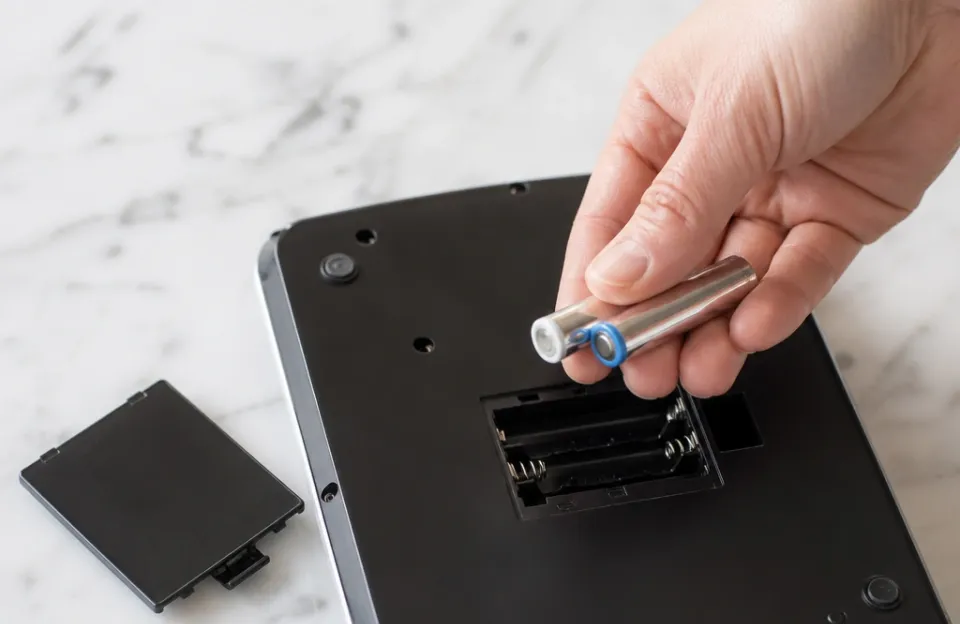
Digital food scales rely on a stable voltage to read the strain gauge inside the load cell. When voltage drops, the scale struggles to process weight changes correctly. Manufacturers choose different battery formats based on the scale's size, target price, and power draw.
A compact coffee scale needs far less physical space than a large 11-pound capacity baking scale, so they use entirely different power sources.
The three main categories are disposable coin cells, disposable cylindrical cells, and rechargeable packs. Each has distinct voltage outputs and discharge curves. Alkaline batteries start at 1.5 volts and slowly drop as they drain.
Lithium coin cells hold a steady 3 volts until they die almost instantly. Rechargeable lithium-ion cells operate around 3.7 volts and require a charging circuit built into the scale.
Knowing which category your scale falls into tells you what to buy when the screen fades. It also dictates how you store the device between uses. Leaving batteries inside a scale stored in a humid drawer accelerates corrosion, regardless of the chemistry.
Button Cells For Compact And Pocket Scales
Coin or button cells are flat, round batteries commonly found in smaller food scales designed for precision tasks. You might use one of these alongside a fast-reading probe thermometer when dialing in pour-over coffee ratios or weighing tiny amounts of saffron. The most frequent sizes are CR2032, CR2025, and CR2016.
The numbers refer to physical dimensions. A CR2032 is 20 millimeters wide and 3.2 millimeters thick.
These lithium cells provide a nominal 3 volts. That higher voltage compared to a single AA cell means the scale's microcontroller gets clean power without needing multiple batteries stacked together. They have low self-discharge rates, meaning they hold their charge well while sitting on a shelf.
The tradeoff is total capacity. A CR2032 holds roughly 220 milliamp-hours of energy. If your scale draws 10 milliamps while active, continuous use drains it in about 22 hours.
In practice, nobody leaves a pocket scale running nonstop. With normal daily use of a few minutes at a time, a coin cell easily lasts six months to over a year.
Standard Alkaline Cylindrical Cells For Everyday Models
Larger food scales meant for general cooking and baking usually take AAA or AA alkaline batteries. Some models require two, while others need three or four wired in series to reach the necessary operating voltage. Two AAA batteries provide 3 volts.
Three AA batteries provide 4.5 volts.
Alkaline cells have much higher capacity than button cells. A standard AA battery holds around 2,500 milliamp-hours. This makes them ideal for scales with larger LCD screens, backlighting, or higher-capacity load cells that draw more current.
You will find these in scales rated for 5 kilograms or 11 pounds, the standard size sitting next to your toaster oven air fryer on the counter.
The downside is the discharge curve. As alkaline batteries drain, their voltage steadily decreases. A fresh AA reads 1.5 volts.
Near the end of its life, it might drop to 1.1 volts under load. If a scale requires three batteries, that combined drop can cause erratic readings before the screen finally goes blank.
Built-In Rechargeable Packs For High-End Units
Rechargeable food scales contain an internal lithium-ion or lithium-polymer battery. These connect to a USB port, usually Micro-USB or USB-C, for charging. You cannot remove the battery without disassembling the scale and voiding the warranty.
These packs offer convenience. You plug the scale in like a phone. Many modern rechargeable scales last weeks on a single charge, even with heavy daily use.
Some high-end models share design philosophies with advanced wireless tools, prioritizing long life and stable connections similar to what you see in dual-probe wireless setups.
Lithium-ion cells maintain a very stable voltage throughout most of their discharge cycle. This provides consistent power to the load cell, which theoretically supports steady accuracy from a full charge down to the final few percent. Once depleted, they must be recharged immediately.
You cannot just swap in a spare from a drawer.
Typical Lifespan By Battery Chemistry
How long food scale batteries last depends heavily on usage frequency, screen brightness, auto-off timers, and ambient temperature. Manufacturers rarely publish exact hour counts because user habits vary wildly. However, we can establish reliable baselines based on battery chemistry and typical kitchen use.
| Battery Type | Common Sizes | Nominal Voltage | Average Lifespan (Normal Use) | Replacement Cost |
|---|---|---|---|---|
| Lithium Coin Cell | CR2032, CR2025 | 3V | 6 to 18 months | $1 to $3 per cell |
| Alkaline AAA | LR03 | 1.5V | 6 to 12 months | $1 to $2 per cell |
| Alkaline AA | LR6 | 1.5V | 1 to 2 years | $1 to $2 per cell |
| Lithium-Ion Pack | Internal custom | 3.7V | 2 to 5 years (total lifespan) | Full unit replacement |
"Normal use" here means turning the scale on for a few minutes daily to prep meals, perhaps weighing ingredients for dinner or measuring coffee beans. If you run a small home bakery and use the scale for four hours straight every day, expect those timelines to shrink by half or more.
Temperature plays a role too. Batteries drain faster in extreme heat and struggle to deliver current in freezing conditions. Storing a scale in a hot garage or near a stove reduces overall battery life.
Room temperature environments yield the longest runtimes.
Why Auto-Off Timers Matter So Much
Almost every digital food scale includes an automatic shutoff function. Typically, the scale turns itself off after 60 to 120 seconds of inactivity. This single function saves more battery life than any other design choice.
If you buy a scale and notice it lacks an auto-off timer, or if the timer is set to five minutes, your batteries will drain significantly faster. Always check the manual to confirm how quickly your specific model powers down. Some premium scales let you adjust this interval in the settings menu.
Backlights consume massive amounts of power relative to the rest of the circuit. A scale with a bright white LED backlight left on accidentally will drain a set of AAAs in days rather than months. Using the scale in a well-lit kitchen allows you to turn the backlight off if the model permits it.
Recognizing Low Power Symptoms On Your Scale
A dying battery does not always mean a completely black screen. Often, food scale batteries exhibit warning signs days or weeks before they fail completely. Catching these early prevents inaccurate measurements from ruining a recipe.
The most obvious sign is a dim or flickering display. If the numbers look faint even in good lighting, voltage is dropping. Some scales include a dedicated low-battery icon, usually shaped like a battery outline with one bar remaining.
Consult your manual to identify the specific symbol your manufacturer uses.
Erratic weight readings are a more deceptive symptom. If you place a 100-gram object on the scale and it bounces between 95g, 102g, and 98g, the load cell might not be receiving steady voltage. Before assuming the scale is broken or needs recalibration, swap the batteries.
Unstable power frequently mimics sensor failure.
Slow response times indicate struggling circuits. A healthy scale registers weight changes almost instantly. If you add flour to a bowl and the number takes two or three seconds to catch up, the processor is likely throttling due to insufficient power.
Delayed button responses happen too. Pressing the "tare" or "unit" button should trigger an immediate change. If you have to press hard or hold it down, the microcontroller is brown-out resetting or lagging.
Swapping Out Dead Cells Safely
Replacing food scale batteries is a simple task, but doing it wrong can damage the contacts or compromise the scale's water resistance. You only need a few moments and the correct replacement cells. Always match the exact size and chemistry printed on the old battery or listed in the user manual.
- Turn the scale off completely. Never change batteries while the unit is powered on.
- Flip the scale over and locate the battery compartment. It is usually on the bottom, sometimes recessed to keep the scale sitting flat on the counter.
- Open the cover. Some slide off with thumb pressure. Others require a small Phillips-head screwdriver or a coin to twist a slotted fastener.
- Note the orientation of the old batteries. Look for the plus (+) and minus (-) symbols stamped into the plastic housing. Taking a quick photo with your phone before removing them prevents confusion later.
- Remove the depleted batteries. If they are stuck, gently tap the edge of the scale against your palm. Do not pry them out with metal tools, which can scratch the contact springs.
- Inspect the metal contacts. Look for white or green crusty buildup. This is corrosion from leaking alkaline batteries.
- Insert the new batteries following the polarity markings exactly. Push them firmly into place so the springs compress slightly.
- Replace the cover and secure the screw if applicable.
- Turn the scale on and test it with a known weight. A sealed bag of sugar or a reliable instant-read tool with a verified weight works well for a quick sanity check.
Cleaning Corroded Contacts In The Battery Bay
Alkaline batteries occasionally leak potassium hydroxide when left inside devices for extended periods. This white, crystalline substance eats through metal and blocks electrical flow. If you open your scale and see this residue, do not just push new batteries in.
Put on disposable gloves. Dip a cotton swab in white vinegar. The mild acid neutralizes the alkaline corrosion.
Scrub the metal springs and flat plates gently until the crust dissolves. Wipe the area dry with a clean swab. Let it air out for ten minutes before inserting fresh cells.
Severe corrosion that pits the metal deeply might permanently ruin the compartment, requiring a new scale.
This is why removing batteries during long-term storage is highly recommended. If you only bake during the holidays, take the batteries out in January and put them back in November.
How Power Levels Affect Weighing Accuracy
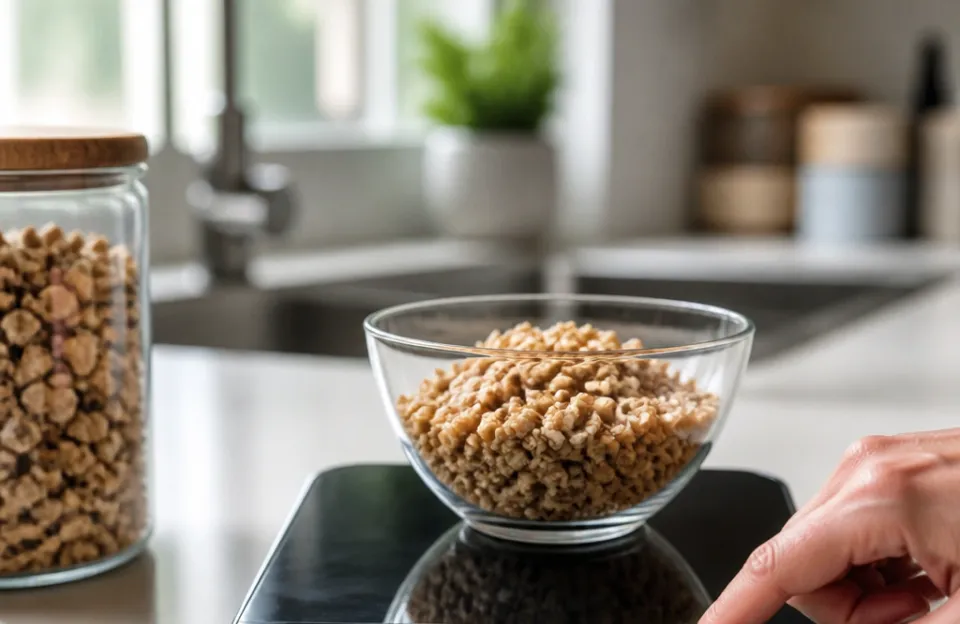
The relationship between food scale batteries and measurement precision comes down to the analog-to-digital converter inside the scale. The load cell generates a tiny electrical signal proportional to the weight applied. The converter translates that raw signal into the numbers you see on the screen.
This conversion process requires a stable reference voltage. When batteries weaken, the reference voltage fluctuates. The converter then misinterprets the load cell's signal.
A true 5-gram weight might register as 4 grams or 6 grams simply because the power supply dipped momentarily.
For everyday cooking, a gram or two of variance rarely matters. Adding salt to soup or portioning chicken breasts tolerates slight inaccuracies. Baking, however, demands precision.
Chemical reactions in bread dough or macaron shells rely on exact hydration percentages. A scale drifting due to weak batteries can cause dense loaves or cracked cookies.
If you regularly weigh items under 5 grams, such as espresso doses or nutritional supplements, keep fresh batteries installed at all times. Alternatively, invest in a rechargeable model or a scale that plugs directly into a wall outlet for lab-grade stability. Maintaining accuracy across all your kitchen instruments, whether you are checking safe pork temperatures or weighing flour, relies on proper equipment upkeep.
Choosing Between Disposable And Rechargeable Options
Deciding which food scale to buy often means choosing a battery philosophy. Both approaches have valid arguments depending on your kitchen workflow.
Disposable battery scales are cheaper upfront. When they die, you grab spares from a drawer and keep working within thirty seconds. There is no waiting for a charging cycle.
This suits infrequent users or people who travel with their scale, like campers using portable models.
The ongoing cost adds up over years, though. Buying quality name-brand alkaline or lithium coin cells repeatedly costs more than the electricity used to charge a lithium-ion pack. Disposing of dead batteries also carries environmental weight.
Check local regulations, as many municipalities require recycling rather than trashing lithium and alkaline cells.
Rechargeable scales appeal to daily users. Plugging in a USB cable every few weeks is effortless. You never run out of unexpected spares mid-recipe.
The initial purchase price is higher, and if the internal battery degrades after four or five years, the entire scale usually becomes e-waste since replacing soldered lithium cells is impractical for most consumers.
Some hybrid models exist. They feature a rechargeable internal battery but include a slot for standard AAAs as a backup. If the internal cell dies during a busy prep session, you pop in alkalines and finish cooking.
These offer the best of both worlds but tend to be bulkier and more expensive.
Storage Habits That Extend Battery Life
Where and how you store your scale directly impacts how long food scale batteries survive. Heat accelerates chemical reactions inside cells, draining them faster even when turned off. Moisture causes short circuits and rusts the contact points.
Keep the scale in a cool, dry cabinet away from the stove, dishwasher, or direct sunlight. Avoid leaving it on the counter where steam from boiling pots settles on the electronics. Steam infiltration ruins circuit boards and drains batteries rapidly through microscopic shorts.
Remove batteries if you plan to store the scale for more than a month. This applies especially to alkaline cells prone to leaking. Store the removed batteries in their original packaging or a dedicated plastic case, not loose in a junk drawer where they can roll against coins or keys and short out.
Do not mix old and new batteries in a multi-cell scale. The older, weaker battery acts as a resistor, forcing the new battery to work harder and drain unevenly. Always replace all cells simultaneously with identical brands and expiration dates.
Mixing chemistries, like pairing a lithium AA with an alkaline AA, causes unpredictable voltage delivery and potential leakage.
Frequently Asked Questions
Can I use rechargeable AA or AAA batteries in a scale designed for alkalines?
Yes, you can use NiMH rechargeable AA or AAA batteries in most scales. Keep in mind that standard alkalines output 1.5 volts, while NiMH rechargeables output 1.2 volts. A scale requiring four alkalines expects 6 volts.
Four NiMH cells only provide 4.8 volts. Some scales handle this lower starting voltage perfectly fine, while others might show a low battery warning immediately or refuse to turn on. Test them in your specific model to confirm compatibility.
Why did my brand new food scale batteries die after only a week?
Rapid drain on fresh batteries usually points to one of three issues. First, the scale was accidentally left on without triggering the auto-off function, perhaps because an item was resting on the platform keeping the sensor active. Second, moisture entered the battery compartment and created a short circuit.
Third, the batteries purchased were expired or counterfeit, lacking their stated capacity. Check the manufacturing date printed on the battery wrapper.
Are lithium coin cells better than alkaline ones for small scales?
Lithium coin cells like the CR2032 are the standard for small scales because they provide a steady 3 volts in a tiny package. You cannot substitute them with alkaline chemistry in that same physical size effectively. For scales taking AA or AAA sizes, lithium primary cells (non-rechargeable lithium AA) last significantly longer than alkalines and perform better in cold environments, though they cost considerably more per unit.
Does a low battery make my food scale read heavier or lighter?
A low battery does not consistently skew readings in one direction. Because the voltage drop destabilizes the analog-to-digital converter, the scale may read randomly heavier, lighter, or fluctuate between both while an object sits completely still. If you suspect accuracy issues, verify the reading against a known calibrated weight after installing fresh batteries.
How do I dispose of swollen food scale batteries?
Swollen batteries, particularly lithium coin cells or rechargeable packs, indicate gas buildup from internal failure. Do not puncture, crush, or throw them in regular household trash. Place them carefully in a non-conductive container, like a plastic tub.
Tape over the terminals to prevent accidental shorts. Take them to a designated battery recycling drop-off point, often found at electronics retailers or municipal waste centers.
Can I leave my rechargeable scale plugged in all the time?
Most modern rechargeable scales include overcharge protection circuits that stop drawing current once the battery reaches 100 percent. Leaving it plugged in constantly is generally safe. However, keeping a lithium-ion battery perpetually at maximum charge slightly accelerates long-term chemical degradation.
Unplugging it once fully charged, or using it cordlessly until it drops to 20 percent before recharging, maximizes the total lifespan of the internal cell.
Keeping Your Scale Ready For Daily Prep
Paying attention to food scale batteries prevents frustrating interruptions during meal preparation. Matching the right battery chemistry to your usage habits ensures the load cell receives steady power, which directly translates to accurate measurements on the display. Whether your scale runs on CR2032 coin cells, standard AA alkalines, or an internal USB-charged pack, swapping them promptly when symptoms appear protects both your recipes and the device's internal circuits.
Store the scale properly, clean the contacts if corrosion appears, and always replace cells in complete sets to get the longest possible life from every power source you install.