Most home cooks never need a scale that reads down to 0.1g or 0.01g. A standard kitchen scale measuring in 1g increments handles nearly everything from baking bread to portioning chicken breasts. You only need precision food scales with 0.1g or 0.01g resolution when working with ingredients so potent or expensive that a single extra gram ruins the recipe or wastes money.
This article breaks down exactly which cooking and prep tasks demand high-resolution weighing, which ones do fine with a basic model, and what happens if you use the wrong tool for the job. We will also cover how environmental factors affect tiny measurements and why buying a highly sensitive scale creates new problems you did not expect.
How Gram Resolution Changes Your Kitchen Results
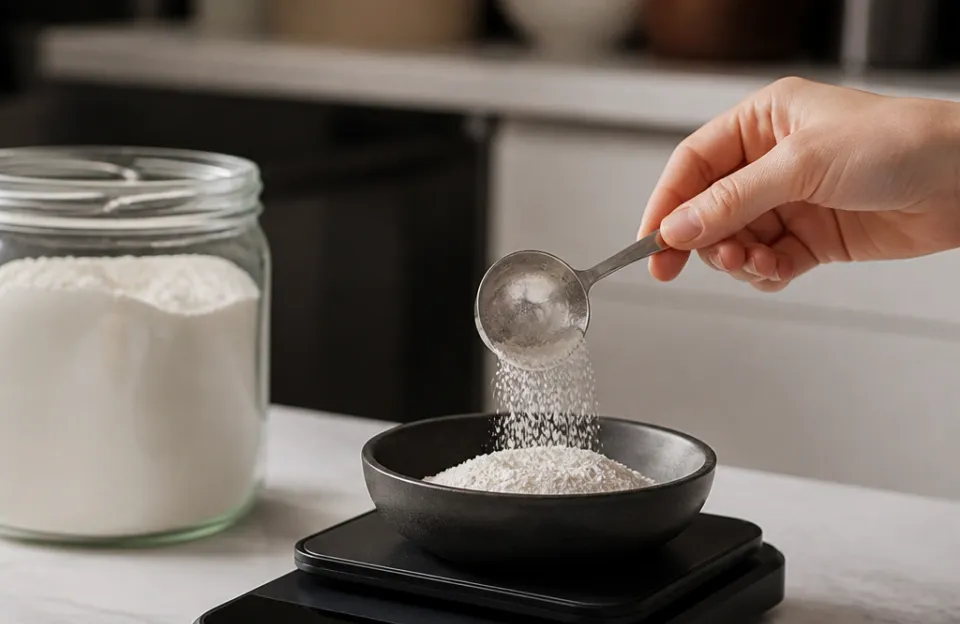
Resolution refers to the smallest weight change a scale can detect and display. A standard digital kitchen scale usually has a 1g resolution. If you add half a gram of flour, the screen stays at zero until you cross the full gram threshold.
A 0.1g scale detects ten times smaller changes. A 0.01g scale detects one hundred times smaller changes than your basic countertop model.
Why does this matter? It matters because some recipes rely on chemical reactions triggered by exact ratios. Baking soda, yeast, salt, and certain hydrocolloids react based on their mass relative to the other ingredients.
When you work with large batches, a 1g error gets diluted. When you work with small batches, concentrated flavors, or pure extracts, a 1g error overwhelms the entire dish.
The National Institute of Standards and Technology maintains strict definitions for weights and measures in commercial settings, but home kitchens operate without oversight. You are responsible for matching your tools to your recipes. Using a scale with the wrong resolution is a common reason people struggle with advanced techniques they see online.
The difference between 1g, 0.1g, and 0.01g readings
A 1g scale works perfectly for flour, sugar, butter, water, vegetables, and whole cuts of meat. These ingredients have enough volume that a one-gram variance falls well within the acceptable margin of error for taste and texture.
A 0.1g scale enters the territory of spices, fine salts, active dry yeast, and powdered gelatin. If a sourdough recipe calls for 2.5g of salt in a small test batch, a 1g scale forces you to guess between 2g and 3g. That is a massive percentage swing.
A 0.1g scale lets you hit 2.5g exactly.
A 0.01g scale is reserved for ultra-potent additives. Saffron threads, pure capsaicin extract, MSG in micro-doses, food-grade essential oils, and molecular gastronomy chemicals like sodium alginate or transglutaminase fall into this category. At this level, you are weighing fractions of a single gram.
| Resolution | Best Used For | Common Ingredients | Margin of Error Impact |
|---|---|---|---|
| 1g | Everyday cooking, standard baking | Flour, sugar, butter, water, meat | Very low for standard recipes |
| 0.1g | Small-batch baking, spice blending, coffee | Yeast, salt, ground spices, coffee beans | Moderate; affects rising and flavor balance |
| 0.01g | Molecular gastronomy, supplements, extracts | Saffron, pure extracts, hydrocolloids, caffeine | Extremely high; ruins dishes or causes safety issues |
When 0.1g Accuracy Actually Matters in Food Prep
You need 0.1g precision whenever you scale a recipe down to a single serving or work with leavening agents in small quantities. Professional bakers often formulate recipes in baker's percentages. When they test a new formula, they mix a tiny batch first to avoid wasting expensive ingredients like vanilla bean paste or high-fat European butter.
In a 100g test dough, 1g of yeast is 1%. If your scale only reads in 1g increments, you cannot measure out 0.8g or 1.2g to test how the dough behaves.
Coffee brewing is another area where 0.1g precision makes a noticeable difference. Specialty coffee enthusiasts weigh both the dry grounds and the liquid yield. A standard pour-over might use 15.0g of coffee to 250.0g of water.
Shifting to 15.4g of beans changes the extraction rate. If you dial in espresso, being off by two-tenths of a gram alters the shot time by several seconds. Pairing accurate weighing with reliable temperature tracking, such as checking water heat using a fast-reading digital probe, gives you total control over the brew variables.
Spice blending requires the same attention. Creating a custom garam masala or a curing rub means balancing strong aromatics like clove, star anise, or cinnamon against milder bases. Clove easily dominates a blend.
Measuring it in 0.1g increments prevents a ruined batch. This applies equally to making homemade sausages where cure #1 (pink salt) must be measured precisely for food safety. Guessing the amount of nitrite in a small batch of salami is dangerous.
Fermentation projects also benefit from finer scales. Making hot sauce or miso at home involves calculating salt percentages based on the total weight of the vegetables or soybeans. A 2% salt brine behaves very differently from a 3% brine.
When fermenting small jars, a 1g error shifts the percentage significantly. Getting the salt right keeps bad bacteria out while letting lactobacillus thrive.
Why 0.01g Scales Exist for Culinary Use
Moving from 0.1g to 0.01g takes you out of standard cooking and into laboratory-level formulation. You rarely need this for a Tuesday night dinner. You need it when handling ingredients that cost hundreds of dollars per ounce or possess intense chemical activity.
Saffron is the classic example. High-quality saffron costs more per gram than gold. Recipes call for tiny amounts, sometimes just a few threads.
Weighing those threads on a 1g scale registers nothing. On a 0.01g scale, you can measure exactly 0.15g to infuse a risotto without overspending or overpowering the dish with a metallic, hay-like bitterness.
Molecular gastronomy relies heavily on 0.01g scales. Techniques like spherification use sodium alginate and calcium chloride. These hydrocolloids form gels at specific concentrations.
Too much calcium chloride makes a bitter, chalky sphere that shatters. Too little leaves you with a puddle. Formulators measure these powders in hundredths of a gram to get consistent textures.
Pure extracts and essential oils used in confectionery require extreme care. Peppermint oil, lemon oil, or floral waters are incredibly concentrated. One drop can weigh around 0.05g.
If you are making artisanal chocolates or hard candies, adding 0.10g versus 0.15g of peppermint oil changes the candy from refreshing to tasting like toothpaste.
Some home cooks also use 0.01g scales for dietary supplements, nootropics, or precise caffeine dosing added to foods or drinks. Handling pure powdered caffeine demands absolute accuracy due to toxicity risks at high doses. Never guess with pure alkaloids.
Always use a calibrated 0.01g scale.
Standard Kitchen Tasks That Only Need 1g Precision
Do not buy a high-resolution scale thinking it will improve your everyday cooking. For most tasks, it just slows you down. A 1g scale is faster, sturdier, and cheaper.
Roasting vegetables, searing steaks, or boiling pasta requires no fine weighing. Even if you weigh your potatoes to ensure even cooking, a 1g variance changes nothing about the final texture. Portioning meal prep containers for macros works perfectly fine at 1g resolution.
Tracking 150g of cooked chicken breast does not require knowing if it is 150.04g.
Standard baking recipes for cakes, cookies, and breads written for home cooks assume you are using a 1g scale. If a cookie recipe asks for 250g of all-purpose flour, 150g of granulated sugar, and 115g of butter, rounding to the nearest gram is already baked into the author's testing process. Trying to weigh 115.3g of butter adds stress without improving the cookie.
If you are monitoring oven performance while baking these standard items, keeping an eye on ambient heat helps. An easy-to-read dial thermometer placed on the rack shows you if your oven runs hot or cold, which matters far more to a cake's rise than weighing the flour to the tenth of a gram.
Liquid ingredients measured by weight also fall into the 1g category. Water weighs exactly 1g per milliliter. Milk is close enough that the difference is negligible for home cooking.
Pouring 200g of milk onto a 0.01g scale is pointless because the liquid sloshes and evaporates faster than the sensor can stabilize.
Practical Limitations of Ultra-Sensitive Food Scales
High-resolution scales introduce physical problems you do not face with heavier-duty models. Understanding these limitations saves you from returning a scale you thought was broken.
Air currents are the biggest enemy of a 0.01g scale. The draft from your HVAC vent, someone walking past the counter, or even your own breath hitting the weighing pan causes the numbers to jump wildly. To get a stable reading at 0.01g, you often need to place the scale inside a draft shield or a makeshift enclosure.
Many lab-style scales come with glass windshields for this exact reason.
Vibration transfers through countertops. If your washing machine is running in the next room, or if you bump the table slightly, a 0.01g scale registers the movement as weight. You need a heavy, solid surface to use one effectively.
Granite counters work better than thin laminate over hollow cabinets.
Static electricity messes with light powders. Spices, cocoa powder, and hydrocolloids build up static charge, especially in dry winter air. The powder clings to the sides of the weighing boat or repels itself, causing the scale reading to drift continuously.
Anti-static brushes or working in slightly higher humidity helps, but it remains a constant annoyance.
Capacity trades off directly against resolution. A scale that reads 0.01g usually maxes out at 50g, 100g, or maybe 200g total weight. You cannot put a mixing bowl on it.
You have to tare a tiny plastic weighing boat, spoon the ingredient in, record the number, move it to your actual mixing bowl, and repeat for every micro-ingredient. It is a slow, deliberate process.
If you are doing serious baking that requires both large capacity for flour and high precision for yeast, you actually need two separate scales. Keep your heavy-duty 5kg scale for the main ingredients, and pull out the pocket-sized 0.1g or 0.01g scale just for the additives. And when you need to verify the internal doneness of whatever you baked or roasted, having a reliable wireless setup nearby removes the guesswork from proteins.
Matching Scale Resolution to Specific Ingredients
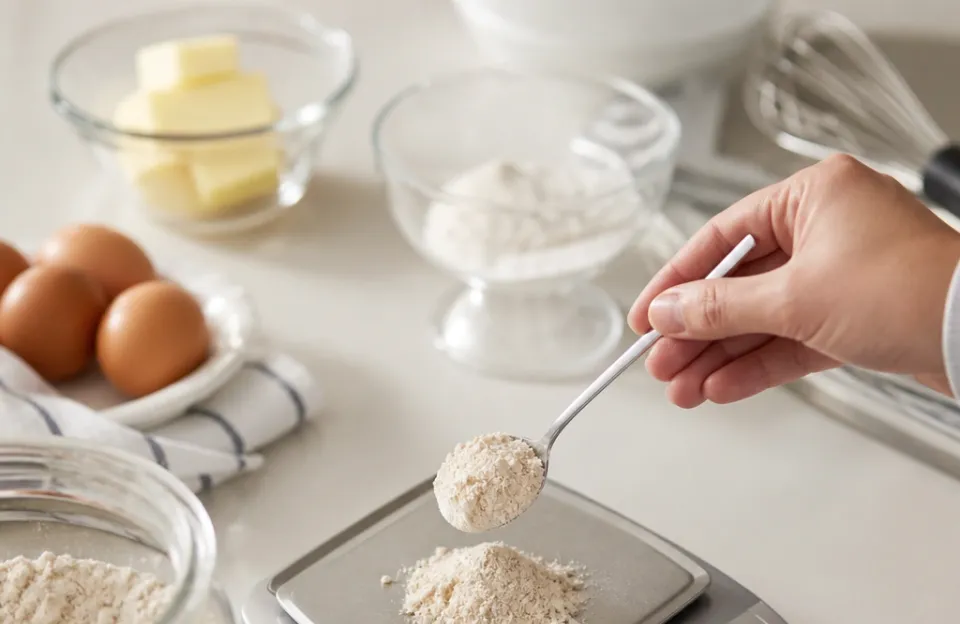
Knowing which resolution fits which ingredient prevents both frustration and wasted food. Here is a practical breakdown to guide your setup.
Use 1g resolution for:
- All-purpose, bread, and cake flours
- Granulated, brown, and powdered sugars
- Butter, shortening, and cooking oils
- Whole vegetables, fruits, and nuts
- Raw and cooked meats (if you want exact portions, pairing your scale work with a quick dual-probe reader verifies safe temperatures instantly)
- Liquids like water, stock, and milk
Use 0.1g resolution for:
- Active dry and instant yeast
- Fine sea salt and kosher salt in small batches
- Ground spices (cinnamon, cumin, black pepper)
- Baking powder and baking soda in scaled-down recipes
- Coffee beans for single-cup brewing methods
- Powdered gelatin and agar agar for standard desserts
- Citric acid or malic acid for candy making
Use 0.01g resolution for:
- Saffron threads
- Pure food-grade essential oils (peppermint, orange, lavender)
- Sodium alginate, calcium lactate, and xanthan gum in micro-doses
- Transglutaminase (meat glue)
- Pure capsaicin or chili extracts
- Powdered caffeine or other dietary additives mixed into food
- Natural food colorants in highly concentrated paste or powder form
If you frequently switch between these categories, store your high-resolution scale in a protective case. Dust settling on the load cell of a 0.01g scale over a few weeks can alter its baseline calibration. Keeping your workspace organized goes beyond just the counters; even planning your storage layout and surfaces affects how clean your environment stays during detailed prep work.
Calibration and Drift Issues With Fine Measurements
All digital scales experience drift. Temperature changes, battery voltage dropping, and repeated heavy loads cause the sensor to lose its zero point. On a 1g scale, a 0.3g drift is invisible.
The screen still reads zero. On a 0.01g scale, a 0.3g drift means your measurement is off by thirty increments before you even start.
You must calulate a precision scale regularly using certified calibration weights. A 0.1g scale typically needs a 50g or 100g calibration weight. A 0.01g scale needs specific small weights, often 10g, 20g, or 50g depending on the model's maximum capacity.
Do not use random coins or objects you assume weigh a certain amount. Buy the calibration weights recommended by the manufacturer.
Temperature acclimation matters too. If you keep your precision scale in a cool drawer and bring it out into a warm, steamy kitchen, condensation forms on the internal components. The readings will bounce.
Let the scale sit powered on for ten to fifteen minutes to reach room temperature before attempting to weigh anything under a gram.
Battery levels affect sensor sensitivity. As batteries drain, the voltage supplied to the strain gauge load cell drops. The scale struggles to differentiate between tiny weight changes and electrical noise.
Change the batteries the moment the display dims or the readings become sluggish. Rechargeable models should be topped off before a session requiring 0.01g accuracy.
Common Mistakes When Buying Precision Food Scales
People often buy the wrong scale because they confuse capacity with resolution, or they ignore the physical realities of using sensitive equipment.
- Buying a 0.01g scale for general baking. You will spend twenty minutes trying to weigh 500g of flour because the scale maxes out at 100g. You end up needing a second scale anyway, doubling your cost and cluttering your drawers.
- Ignoring the weighing platform size. Some 0.01g scales have platforms the size of a postage stamp. You cannot fit a standard measuring cup or bowl on them. You are forced to buy specialized micro-weighing boats and transfer ingredients constantly.
- Placing the scale near heat sources. Setting a precision scale next to a running toaster oven or above a heating vent warps the metal strain gauge inside. Heat expansion changes the resistance, giving false readings. Keep sensitive scales away from appliances that generate radiant heat. If you are working with sugar syrups or deep frying, track the heat safely with a dedicated stainless steel probe rather than hovering your delicate scale near the stove.
- Assuming higher resolution means higher quality. A cheap 0.01g scale often uses poor sensors that fluctuate randomly. A well-built 0.1g scale from a reputable brand provides more trustworthy data than a poorly manufactured 0.01g scale. Read reviews specifically looking for mentions of "drift" or "unstable readings."
- Tapping the scale during use. Resting your hand on the counter next to the scale transfers pressure. Even leaning against the cabinet can flex the countertop enough to register on a 0.01g display. Stand back and let the numbers settle before recording them.
Frequently asked questions
Can I use a jewelry scale for measuring food ingredients?
Jewelry scales offer 0.01g or 0.001g resolution and work mechanically the same way as culinary precision scales. However, they are rarely made with food-safe materials. The weighing pans may contain metals or coatings not intended for direct food contact.
If you use one, always place ingredients inside a food-safe container or parchment paper, and never place raw food directly on the platform.
Does a 0.01g scale make my baking noticeably better?
For standard home baking like cookies, muffins, or sandwich loaves, no. The hydration levels and ingredient ratios have enough tolerance that 1g precision is perfectly adequate. A 0.01g scale only improves baking when you are scaling recipes down to single servings, working with potent chemical leaveners, or formulating professional-level pastry components where exact hydrocolloid ratios dictate the texture.
Why does my 0.1g scale keep changing numbers when nothing is on it?
This is caused by air drafts, vibrations, or static electricity. High-resolution load cells are incredibly sensitive. A ceiling fan blowing across the platform, footsteps vibrating through the floorboards, or dust settling on the sensor will cause the display to fluctuate.
Move the scale to a solid, sheltered surface away from vents and foot traffic.
Is 0.1g precision necessary for pour-over coffee?
It is highly recommended if you are trying to replicate specific recipes or dial in a particular roast. Coffee extraction relies on strict ratios of water to dry grounds. A difference of 0.3g of coffee changes the strength and extraction yield of a single cup.
While you can brew coffee without it, a 0.1g scale removes a major variable when troubleshooting a bitter or sour cup.
What is the maximum weight a 0.01g food scale can handle?
Most consumer 0.01g scales max out between 50g and 200g total capacity. The sensor required to detect hundredths of a gram physically cannot support heavy loads without breaking or losing its calibration. If you try to weigh 300g on a 200g capacity scale, it will either display an error code or permanently damage the load cell.
How often should I calibrate a precision kitchen scale?
Calibrate it whenever you move it to a new location, if the room temperature changes drastically, or if you notice the zero point drifting. For frequent users working at 0.01g resolution, checking calibration once a week with the appropriate certified weight is good practice. For occasional 0.1g use, calibrating once a month or before a major project is sufficient.
Deciding Which Resolution Fits Your Cooking Style
Choosing between 1g, 0.1g, and 0.01g comes down to what you actually cook. If your kitchen revolves around family dinners, standard baking, and meal prep, a sturdy 1g scale covers everything you need. Spending extra money on higher resolution only introduces fragility and slower workflows without changing how your food tastes.
If you roast your own coffee, bake sourdough in small test batches, or blend custom spice rubs, a 0.1g scale pays for itself quickly. It eliminates the guessing game with yeast and salt, giving you repeatable results every time you cook.
Reserve 0.01g scales for true edge cases. If you are experimenting with molecular gastronomy, handling saffron, or dosing pure extracts, you need that level of control. Just remember that operating at that resolution requires patience, a draft-free environment, and regular calibration.
Match the tool to the task, and your time in the kitchen stays focused on the food rather than fighting the equipment.