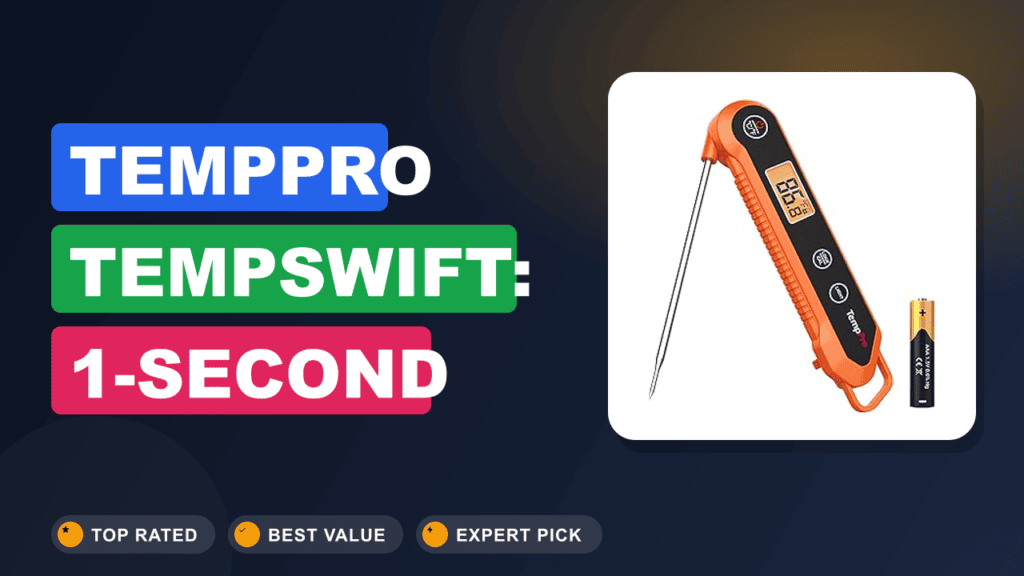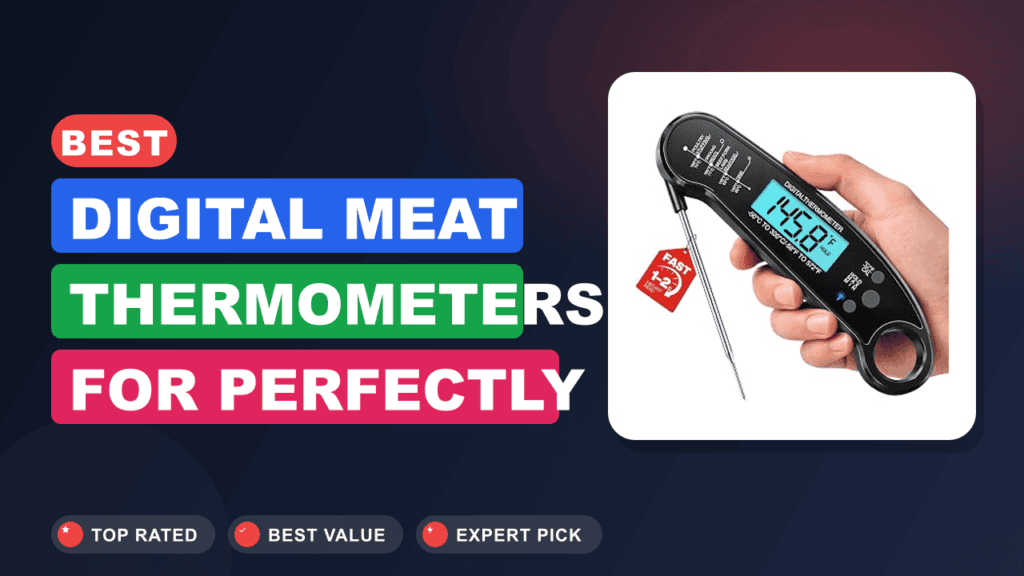
The ThermoWorks DOT is a well-loved kitchen tool, celebrated for its reliable accuracy and sturdy build. It’s a “set-it-and-forget-it” probe thermometer that helps home cooks and pitmasters hit perfect temperatures every time. But quality often comes with a higher price tag.
If you appreciate the DOT’s features but your budget calls for something more affordable, you’re not alone. Many people want dependable temperature readings without the premium cost.
This guide lists five cheaper alternatives to the ThermoWorks DOT that still deliver solid performance in the kitchen and on the grill. We’ll explore what makes a good thermometer, then break down each alternative, looking at its strengths, what it’s best for, and any drawbacks. The goal is to help you find a thermometer that keeps your cooking precise without stretching your wallet.
How to Choose a Reliable Meat Thermometer Without Breaking the Bank
Finding a quality meat thermometer that doesn’t cost a fortune means knowing what features truly matter. You want a tool that performs its main job, measuring temperature accurately, without unnecessary frills. Here’s what to keep in mind when looking for a budget-friendly alternative to the ThermoWorks DOT.
Accuracy and Response Time
These are the most important factors. A thermometer isn’t useful if it gives you wrong readings or takes too long to get them. For meat, you generally want an accuracy of +/- 1°F (or +/- 0.5°C).
Instant-read thermometers typically give a reading in 2-5 seconds. Probe thermometers, like the DOT, monitor temperature over time, so while the initial reading speed isn’t as critical, consistent accuracy is key. Make sure the thermometer has a good reputation for consistent results; you don’t want a device that offers inconsistent readings.
Many cheaper thermometers claim high accuracy, but checking user reviews for consistency can give a more realistic picture.
Temperature Range
Consider the temperatures you’ll be dealing with. Most cooking involves temperatures between 32°F (0°C) and 300°F (150°C), but if you’re deep-frying or smoking at high heat, you might need a thermometer that goes up to 500°F (260°C) or higher. Standard digital thermometers usually cover a wide enough range for most home cooking needs.
Make sure the thermometer’s range fits your specific cooking habits.
Probe Design and Durability
The probe is the part that goes into your food. Look for probes made from food-grade stainless steel. The length of the probe matters, especially for larger cuts of meat; you want to make sure the tip reaches the center of the thickest part without touching bone.
A longer probe can also help keep your hand away from hot surfaces. You might also want to understand what thermometer stems are typically made of for better insight into their robustness. Some cheaper models might have thinner probes that are more prone to bending or damage.
A good cord for the probe, if it’s a wired model, should be heat-resistant and long enough to reach from your food to the display unit without strain. Issues with the probe not going deep enough can be frustrating.
Ease of Use and Readability
A simple design is often better for budget thermometers. Look for large, clear displays that are easy to read, even in low light or from a distance. Backlights are a big plus.
Buttons should be intuitive, and settings shouldn’t be overly complicated. A magnetic back for attaching to an oven or grill can be surprisingly useful. Alarms should be loud enough to hear when you’re not right next to the kitchen.
Additional Features
While you’re looking for cheaper alternatives, some extra features can still be found at a lower price point.
- Programmable alarms: Essential for “set-and-forget” cooking, letting you know when your target temperature is reached.
- Timers: Some thermometers include basic timers.
- Water resistance: Handy for quick cleanups and protecting against splashes, though full waterproofing is usually found on higher-end models.
- Temperature hold: Freezes the reading on the display once the probe is removed.
Price Point Considerations
The goal here is affordability. While the ThermoWorks DOT costs a certain amount, these alternatives aim to provide good value at a lower cost. Expect to find solid options in the $20-$40 range, with some even below that.
Remember that a lower price doesn’t always mean low quality; many brands focus on essential features to keep costs down while maintaining performance. Just be wary of options that seem too good to be true, as they might compromise on accuracy or build quality.
The List: 5 Budget-Friendly Alternatives to the ThermoWorks DOT
Here are five alternatives that stand out for their blend of affordability and reliable performance, giving you a solid choice without the premium price tag of a ThermoWorks DOT. We’ve chosen a mix of instant-read and probe-style options to cover various cooking needs.
1. ThermoPro TP03 Digital Instant Read Meat Thermometer
The ThermoPro TP03 is a highly popular and affordable instant-read thermometer that often makes “best budget” lists. It’s known for its quick response time and straightforward operation, making it a great alternative for cooks who need fast temperature checks rather than continuous monitoring.
What it is: The TP03 is a compact, folding instant-read thermometer. You unfold the probe, insert it into your food, and get a reading typically within 3-5 seconds. It has a simple digital display and usually comes with a magnetic back for easy storage on a fridge or grill.
It operates on a single AAA battery, which is common and easy to replace.
Who it’s genuinely good for: This thermometer is excellent for everyday cooking, grilling, and barbecuing where you need to quickly check the internal temperature of meats, poultry, fish, or even baked goods. It’s perfect for testing doneness on a steak, chicken breast, or roast at various points during cooking. Its speed helps prevent overcooking by giving you real-time feedback.
If you’re often wondering about your meat thermometer’s accuracy, a quick, reliable tool like this can set your mind at ease.
One real strength: Its speed and simplicity. For its price, the TP03 delivers very fast and accurate readings, usually within ±0.9°F (±0.5°C). The folding probe makes it safe to store and easy to carry.
The magnetic back is a surprisingly useful feature that many users appreciate for keeping it handy. It’s a workhorse for quick temperature checks. Many users find it to be one of the best budget meat thermometers available.
One real limitation: The TP03 is an instant-read thermometer, not a leave-in probe thermometer. This means you can’t insert it into your food and close the oven door or grill lid to monitor the temperature over an extended period. If continuous monitoring is your primary need, this isn’t the direct replacement for a ThermoWorks DOT.
Also, while splash-resistant, it’s not fully waterproof, so submerging it is not recommended.
2. Kizen Instant Read Meat Thermometer
The Kizen Instant Read Meat Thermometer is another strong contender in the budget category, often praised for its rapid readings and overall value. It offers many features typically found in more expensive models at a fraction of the cost.
What it is: Like the ThermoPro TP03, the Kizen is a folding probe instant-read thermometer. It features a large, backlit LCD display, a magnetic back, and a meat temperature guide printed right on the body of the thermometer. It also boasts an auto-off function to save battery life.
It’s designed for quick, precise temperature measurements across a wide range of foods.
Who it’s genuinely good for: This thermometer suits home cooks who want a fast, accurate, and easy-to-read tool for checking doneness on a variety of foods. It’s particularly useful for grilling, pan-frying, and roasting, where quick temperature checks are essential to hit the perfect level of doneness. The built-in temperature guide is helpful for beginners or anyone needing a quick reference.
If you’re troubleshooting inconsistent readings, a straightforward tool like the Kizen can help confirm temperatures.
One real strength: Its exceptional combination of speed, accuracy, and additional features for the price. It typically provides readings in 2-3 seconds with an accuracy of ±1°F (±0.5°C). The bright backlight and large display make it very easy to read in any lighting condition, and the magnetic back adds to its convenience.
It also has an IP67 waterproof rating, meaning it can withstand splashes and even brief submersion, making cleanup simpler.
One real limitation: As with any instant-read thermometer, its primary limitation is the lack of continuous monitoring. You can’t leave the probe in the food during cooking, which might be a deal-breaker if you’re looking for a direct replacement for the DOT’s set-and-forget functionality. While durable, the folding mechanism could wear over time with very heavy use, though this is a common trait for this design type.
3. Inkbird IHT-1P Waterproof Instant Read Thermometer
Inkbird is a brand well-known for its range of temperature controllers and thermometers, often providing solid performance at competitive prices. The IHT-1P is their entry into the instant-read market, focusing on durability and quick readings.
What it is: The Inkbird IHT-1P is a robust instant-read thermometer with a foldable probe. Its key differentiating factor is its strong focus on water resistance, holding an IPX5 rating. It features a large, rotatable backlit LCD screen, which is handy for reading from different angles, and it charges via a USB-C port, rather than relying on disposable batteries.
Who it’s genuinely good for: This thermometer is ideal for cooks who work in busy, potentially messy kitchen environments or for those who prioritize easy cleaning. Its water-resistant design makes it suitable for outdoor grilling, deep-frying, or any situation where splashes are common. The rechargeable battery is a plus for eco-conscious users or those who prefer not to deal with battery replacements.
It’s a reliable choice for quickly checking the internal temperature of a wide range of foods, from meats to bread.
One real strength: Its excellent waterproof design and rechargeable battery. The IPX5 rating means it can withstand sprays and splashes, making it easy to rinse under a tap without worry. The USB-C rechargeable battery is convenient and eliminates the need to constantly buy new batteries.
It also provides very fast readings (2-3 seconds) with high accuracy (±1°F/±0.5°C), comparable to higher-priced models. The rotatable display is a thoughtful touch for readability.
One real limitation: While rechargeable, the battery does eventually need to be recharged, which means it might not be ready if you forget to plug it in. Like other instant-read models, it does not offer continuous temperature monitoring, which is the main function of the ThermoWorks DOT. So, if your primary need is for a leave-in probe, this won’t fit that specific role.
4. Lavatools Javelin PRO Duo
The Lavatools Javelin PRO Duo sits at the higher end of the “budget alternative” spectrum, often costing a bit more than the other instant-read options mentioned but still significantly less than a ThermoWorks DOT. It’s revered for its precision and speed, often compared favorably to more expensive brands.
What it is: The Javelin PRO Duo is a high-performance instant-read thermometer with a super-thin, folding probe. It’s known for its incredibly fast response time and accuracy. It has an auto-rotating display, a magnetic back, and an IP65 splash-proof rating.
It also includes an internal magnet for easy storage.
Who it’s genuinely good for: This thermometer is perfect for serious home cooks, bakers, or grillers who demand near-professional speed and accuracy without the professional price tag. If you’re particular about hitting exact temperatures quickly for anything from tempering chocolate to searing a perfect steak, the Javelin PRO Duo is an excellent choice. It’s also very good for those who have experienced issues with meat thermometers being off by 10 degrees and want a tool they can trust.
One real strength: Its unparalleled speed and accuracy in its price bracket. It often provides readings in 1-3 seconds with a tested accuracy of ±0.9°F (±0.5°C), competing with much more expensive instant-read thermometers. The thin probe leaves smaller puncture marks in food, reducing juice loss.
The auto-rotating display is incredibly practical, allowing you to read the temperature clearly no matter how you hold the thermometer.
One real limitation: Its primary limitation, like the others in the instant-read category, is the absence of continuous monitoring. This means it can’t directly replace the set-and-forget functionality of a ThermoWorks DOT for long cooks. While splash-proof, it’s not fully waterproof, so care is still needed during cleaning.
It’s also usually the priciest option on this “cheaper alternatives” list, though still a substantial saving over the DOT.
5. Taylor Precision Products Classic Large Dial Oven Thermometer (as a secondary check or for ambient temp)
While not a direct digital replacement for the DOT, a reliable analog oven thermometer from a brand like Taylor can be an invaluable, extremely cheap alternative for monitoring ambient oven or grill temperatures, or as a quick verification tool. It’s a different category but serves a critical function often overseen.
What it is: This is a classic, large-dial analog oven thermometer designed to sit or hang inside your oven or grill. It continuously displays the ambient temperature, giving you a general idea of your cooking environment. It’s a simple, mechanical device that requires no batteries.
Taylor is a well-known brand for various thermometers, including meat thermometers. If you’re looking for how to use a Taylor meat thermometer, an oven thermometer works differently but complements digital tools.
Who it’s genuinely good for: This thermometer is excellent for anyone who wants a cheap, always-on way to verify their oven’s or grill’s internal temperature. Oven thermostats can be notoriously inaccurate, and having a separate, reliable ambient thermometer helps you ensure your food is cooking at the temperature you set. It’s a great companion to an instant-read meat thermometer.
It’s especially useful if you find your oven is not cooking evenly or consistently.
One real strength: Its simplicity, reliability, and extremely low cost. It never needs batteries, and it provides a constant, easy-to-read display of your cooking environment’s temperature. It’s a fundamental tool for accurate baking, roasting, and grilling, ensuring your oven isn’t lying to you.
Many experienced cooks use these alongside their digital probes for a complete picture. This helps avoid situations where a meat thermometer is off by 10 degrees due to an inaccurate oven setting.
One real limitation: This is an ambient thermometer, not a probe thermometer. It measures the air temperature inside your oven or grill, not the internal temperature of your food. So, it cannot tell you when your steak is done.
It’s purely a supplementary tool and doesn’t offer the precision or alarm functions of a digital probe like the DOT. It also isn’t “instant-read” for food, taking time to adjust to temperature changes.
Quick-Reference Comparison Table
Here’s a side-by-side look at the key features and distinctions of these five budget-friendly alternatives to the ThermoWorks DOT:
| Feature | ThermoPro TP03 | Kizen Instant Read | Inkbird IHT-1P | Lavatools Javelin PRO Duo | Taylor Large Dial Oven Thermometer |
|---|---|---|---|---|---|
| Type | Instant-Read | Instant-Read | Instant-Read | Instant-Read | Ambient Oven/Grill |
| Response Time | 3-5 seconds | 2-3 seconds | 2-3 seconds | 1-3 seconds | Continuous (Ambient) |
| Accuracy | ±0.9°F (±0.5°C) | ±1°F (±0.5°C) | ±1°F (±0.5°C) | ±0.9°F (±0.5°C) | Varies, generally ±10-20°F |
| Water Resistance | Splash-resistant | IP67 Waterproof | IPX5 Splash-proof | IP65 Splash-proof | No (Mechanical) |
| Power Source | 1x AAA Battery | 1x CR2032 Battery | USB-C Rechargeable | 1x CR2032 Battery | Mechanical (No Battery) |
| Display | Backlit LCD | Backlit LCD (large) | Rotatable Backlit LCD | Auto-rotating Backlit LCD | Analog Dial |
| Key Strength | Fast, simple, magnetic back | Fast, accurate, fully waterproof | Rechargeable, very durable | Fastest, most precise instant-read | Always-on, verifies oven temp |
| Key Limitation | Not fully waterproof, no continuous monitor | No continuous monitor | No continuous monitor | Pricier than other instant-reads, no continuous monitor | No food probe, less precise |
| Best For | Everyday quick checks | All-around home kitchen/grill | Outdoor/messy cooking | High-precision cooks/bakers | Verifying oven/grill temperature |
Making Your Choice: Which Alternative is Right for You?
Choosing the right thermometer among these alternatives depends on your specific cooking habits, priorities, and how you intend to use it. The ThermoWorks DOT is a probe thermometer designed for leave-in monitoring, so if that’s your absolute main requirement, you’ll need to look for a budget-friendly wired probe thermometer, which isn’t explicitly on this instant-read focused list (though the general advice about accuracy still applies). However, if “cheaper alternative” means a reliable thermometer for general cooking tasks, these instant-read options are excellent.
- If you primarily need quick checks for doneness: Any of the instant-read options (ThermoPro TP03, Kizen, Inkbird, Javelin PRO Duo) will serve you well. They are fast, accurate, and easy to use.
- For ultimate speed and precision in an instant-read: The Lavatools Javelin PRO Duo is likely your best bet, offering near-professional performance.
- If durability and easy cleanup are top priorities: The Kizen Instant Read Meat Thermometer (with its IP67 rating) or the Inkbird IHT-1P (with its IPX5 rating and rechargeable battery) are excellent choices for splashy environments or outdoor cooking.
- For the absolute basic, reliable instant-read with great value: The ThermoPro TP03 is a solid entry-level choice that performs consistently for general tasks.
- If you need to verify your oven or grill temperature: The Taylor Large Dial Oven Thermometer is an inexpensive, essential tool that complements any digital meat thermometer. It’s critical for baking accuracy and understanding if your oven’s thermostat is truly calibrated.
Consider your budget as well. The ThermoPro TP03 and Kizen are often the most affordable digital options, while the Javelin PRO Duo is a bit more but offers superior speed. The Taylor oven thermometer is the cheapest option and serves a different, but equally important, role.
No single thermometer is perfect for every situation, and sometimes having two tools, an instant-read and an ambient oven thermometer, gives you the most complete picture for less than the cost of a high-end single-purpose unit.
Frequently asked questions
Do cheaper thermometers last as long as premium brands?
It varies. Premium brands often use higher-grade components and offer better warranties, which can contribute to a longer lifespan. Cheaper thermometers can still last a long time with proper care, but they might be more susceptible to damage from drops, moisture, or extreme heat.
Regular calibration checks can help ensure accuracy over time, regardless of the price point.
What temperature range should a good meat thermometer have?
A good meat thermometer should cover the range from around 0°F (-18°C) to at least 300°F (150°C), which handles most meats and general cooking. For specialty tasks like deep frying or candymaking, you might need a thermometer that reaches 400°F (200°C) or even 500°F (260°C). Always check the product specifications to match your cooking needs.
Can I use these alternatives for candy or deep frying?
Most digital instant-read thermometers can be used for candy or deep frying, provided their temperature range extends high enough (typically up to 400°F/200°C or more). However, remember they are “instant-read,” meaning you shouldn’t leave them in hot oil or sugar for extended periods. A dedicated candy thermometer or a leave-in probe designed for high temperatures might be better if those are your primary uses.
Some people incorrectly believe they can interchange a candy thermometer with a meat thermometer, but their design and purpose differ.
How often should I calibrate my thermometer?
It’s a good practice to calibrate your thermometer periodically, especially if you notice inconsistent readings. A common method is the ice bath test, which should read 32°F (0°C). Another method is the boiling water test, which should read 212°F (100°C) at sea level.
If your thermometer is consistently off, it might need to be recalibrated or replaced. Learning how to calibrate a thermometer can save you from inaccurate results.
What is the most important feature in a budget thermometer?
For a budget thermometer, the most important feature is consistent accuracy. A cheap thermometer that gives unreliable readings is useless. After accuracy, focus on response time for instant-read models, and a clear, easy-to-read display.
Durability and water resistance are also significant benefits that extend the life of your investment.
Getting Great Readings, Regardless of Your Thermometer
Choosing a cheaper alternative to the ThermoWorks DOT doesn’t mean sacrificing accurate cooking. Plenty of reliable thermometers are available that deliver great performance for less money. The key is to understand your needs, do you need quick spot checks, or continuous monitoring?
No matter which thermometer you pick, remember that proper use is crucial for getting accurate readings. Always insert the probe into the thickest part of the meat, avoiding bones and fat pockets. And don’t forget to keep an eye on your oven’s true temperature, not just the dial setting, to ensure an even cook.
With the right tool and a bit of care, you’ll be hitting perfect temperatures every time.