Cottage cheese chips typically take about 10 to 12 minutes in an air fryer at 375°F, according to recipe sources. No official or tested source establishes a single recommended time, so treat that range as a starting point and judge doneness by how the chips look and feel rather than by the clock alone. For a two-stage approach, an initial cook at a lower temperature followed by a final crisping blast adds up to a similar total, and the numbers should be reconciled before you start.
Foods cooked in an air fryer generally require 5 to 25 minutes at 350°F to 400°F, which puts cottage cheese chips comfortably inside the normal range for this appliance. The variable that matters most is moisture: cottage cheese is a soft, high-moisture cheese, and the finished food is allowed up to 80 percent moisture under the federal standard of identity. Driving off enough of that water is what turns a wet spread into a crisp chip.
If you are looking for a high-protein alternative to traditional potato or tortilla chips, air frying mozzarella sticks shows how the same appliance handles another cheese-based snack. Cottage cheese is a straightforward base to work with, but the result depends on how thin you spread it, how much whey you leave in the mixture, and how your particular air fryer distributes heat.
Before You Cook: Preparing the Mixture for Even Crisping
The preparation stage decides most of the outcome. A smooth, evenly spread base dehydrates predictably; a lumpy or watery one produces chips that are soft in the middle and dark at the edges.
- Drain excess whey. If the container looks watery, spoon the curds into a fine-mesh sieve and let them drip for a few minutes. Extra liquid adds cooking time and promotes uneven drying.
- Blend until smooth. Process the cottage cheese until it looks like thick yogurt or heavy cream. Whole curds create pockets of moisture that stay soft while the rest of the chip over-browns.
- Spread thin and even. Aim for a thin, uniform layer, roughly ¼ inch thick, on a lined basket or tray. Thick patches will not dry through in the same time as thin ones.
- Keep it to one layer. Overcrowding the basket prevents enough air circulation to cook the food properly, so cook large amounts in batches rather than stacking.
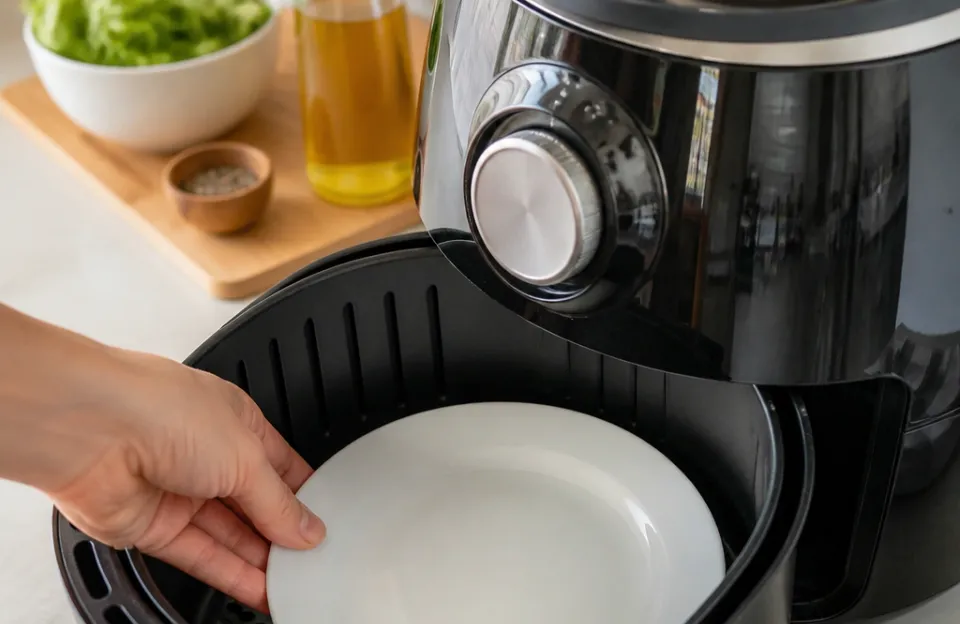
On the liner question, parchment paper or a silicone liner made for air fryers gives the wet, sticky mixture a non-stick surface. Whether a specific liner is safe in your appliance depends on the manufacturer’s instructions, which vary by model, so check the manual before using one at high heat.
Step-by-Step Air Frying Instructions
These steps follow the recipe-source method of a single 375°F cook, with doneness judged visually. If your appliance runs hot, the two-stage variation below gives you more control.
- Preheat the air fryer to 375°F (190°C).
- Spread the blended mixture into a thin, even layer on the lined basket, roughly ¼ inch thick.
- Cook for 10 to 12 minutes, checking from about the 8-minute mark onward.
- Judge doneness by three cues: the surface feels dry to the touch, the sheet is firm, and the edges are deep golden and beginning to lift.
- Stop before burning. If the edges darken quickly while the center stays pale and soft, pull the batch, lower the temperature, and finish more gently.
- Cool for at least 5 minutes before eating. The chips firm up as they lose residual heat, and this rest is part of the texture, not an optional extra.
Two-stage variation: cook at 350°F for 8 to 10 minutes, then raise the temperature to 375°F for the final 2 to 4 minutes. The combined time lands in the same 10 to 14 minute window, so the two methods are consistent rather than contradictory.
What Affects Cooking Time
No two air fryers behave identically, and the same recipe can need different timing from one kitchen to the next.
Appliance style and wattage. Small pod-style air fryers concentrate heat close to the food, while larger oven-style models with more interior space can take a few extra minutes. Exact performance varies by model and is not standardized, so your first batch is always a calibration run.
Batch size and crowding. A single even layer crisps fastest. Overcrowding blocks air circulation and is a leading cause of pale, chewy results, which is why the USDA recommends batching large amounts.
Thickness of the spread. A ¼-inch layer is a useful reference point because it dries through in roughly the stated time. Thicker spreads need longer and are more prone to burnt edges with a soft center.
Moisture in the cottage cheese. Brands differ in how much whey they carry, and cottage cheese may contain up to 80 percent moisture under the standard of identity. Draining before blending is the simplest way to make timing more predictable.
Fat content. Full-fat cottage cheese has a minimum milkfat of 4 percent by weight under the federal standard. Higher-fat mixtures brown and firm differently from lean ones, so expect some variation in color and texture between brands.
Troubleshooting: Rubbery Chips, Uneven Crisping and Sticking
Most failures trace back to moisture, thickness, or temperature. Work through cause, check, and fix for each.
| Problem | Likely Cause | Diagnostic Check | Corrective Action |
|---|---|---|---|
| Rubbery or chewy chips | Pulled too early or spread too thick | Surface feels tacky and the center gives when pressed | Return to the air fryer in 2-minute increments until dry and firm; spread thinner next time |
| Burnt edges, soft center | Temperature too high for the thickness | Edges dark brown while the middle stays pale and pliable | Lower the temperature and extend the time so heat reaches the center before the rim chars |
| Sticking to the liner | Under-cooked base or a worn liner | Chips tear and leave a film behind when lifted | Cook slightly longer so the surface sets; use a liner rated for air fryer use |
A few related points are worth knowing:
- Do not stack parchment layers. A sandwich of parchment and cheese blocks airflow to the middle layers and produces a semi-cooked result. Cook in single layers only.
- Respect the cool-down. Eating a chip straight from the basket gives you soft fats and a fragile structure. Five minutes of resting lets it set into an actual crunch.
- Watch the last two minutes. Thin chips can go from golden to burnt quickly, so stay nearby once the surface looks dry.
Flavoring Your Chips Without Ruining the Texture
Cottage cheese is mild and slightly tangy, so it takes seasoning well. The main risk is adding moisture or burn-prone ingredients before cooking.
- Dry seasonings go on before cooking. Garlic powder, onion powder, paprika, and dried herbs such as oregano or thyme hold up to the heat.
- Fresh herbs and fresh garlic go on after. They are likely to burn or turn bitter over a 10 to 12 minute cook, so scatter them over the cooled chips instead.
- Season lightly at first. Flavors concentrate as water evaporates, so a mixture that tastes right wet can taste over-salted once crisp. Commercial cottage cheese is often already salted, so taste the base before adding more.
- Watch the salt if it matters to you. Look for no-salt-added varieties if you are managing sodium intake, since dehydrating concentrates whatever salt is already there.
As a hypothetical example, stirring a spoonful of finely grated Parmesan into the base would add a dry, savory note. Because Parmesan carries less moisture than cottage cheese, a mixture like that may brown faster, so check earlier than usual. That is an illustration of how added ingredients can shift timing, not a tested recipe with a fixed time adjustment.
Storing and Re-Crisping Leftovers Safely
This is where many cottage cheese chip recipes go wrong. A short air-fryer cook does not make a dairy-based snack shelf stable, and homemade chips should be treated as a perishable food.
To be shelf stable, perishable food must be treated by heat, drying, or both to destroy foodborne microorganisms that can cause illness or spoil food. A 10 to 12 minute air-fryer cook does not meet that bar, so room-temperature storage for days is not supported.
Follow these storage rules instead:
- Refrigerate within 2 hours. Leftover cooked food should go into the refrigerator within 2 hours to avoid the temperature danger zone between 40°F and 140°F. Perishable food left out longer than 2 hours, or 1 hour above 90°F, should be thrown away.
- Keep for 3 to 4 days refrigerated, or freeze for 3 to 4 months. These are the standard limits for perishable leftovers.
- Cool completely before packaging. Warm food causes sweating, which can provide enough moisture for mold to grow.
- Use clean, dry, airtight containers and store them in a cool, dry, dark place.
- Check for moisture regularly. Food affected by moisture but not spoiled should be used immediately or redried and repackaged, and moldy food should be discarded.
Expect the refrigerator to soften the chips, since moisture migrates in a humid environment. To re-crisp, spread the chilled chips in a single layer and return them to the air fryer at 350°F for 2 to 3 minutes, then let them cool again before eating. Reheating restores some crunch; it does not extend the storage window beyond the 3 to 4 day refrigerator limit.
How the Air Fryer Compares with Other Methods
The air fryer is essentially a countertop convection oven that cooks food faster than a larger oven and uses less energy. That efficiency is why it suits a thin, moisture-heavy spread: concentrated moving air dries the surface quickly.
Published recipes put cottage cheese chips at about 10 to 12 minutes in the air fryer at 375°F. Oven-baked versions of the same snack exist, but the specific times and textures for oven and microwave preparation are not established by the sources behind this guide, so no reliable comparison figures are offered here. What can be said is general: the air fryer’s faster airflow makes it a practical choice for small batches, while an oven is better suited to making a large tray at once.
Quick Doneness Decision Guide
Use this sequence at the end of cooking:
- Surface dry to the touch? If not, cook 2 more minutes.
- Sheet firm when pressed gently? If it still gives, it needs more time.
- Edges deep golden and lifting? That is your cue to stop.
- Edges dark but center soft? Lower the temperature and finish gently rather than pushing the heat.
- Cooled for 5 minutes and still chewy? Return to the air fryer briefly, and spread thinner next batch.
The Bottom Line
Cottage cheese chips take roughly 10 to 12 minutes at 375°F in an air fryer according to recipe sources, and a two-stage cook at 350°F then 375°F lands in the same total window. Blend the mixture smooth, drain excess whey, spread it thin in a single layer, and cook in batches rather than crowding the basket. Judge doneness by dryness, firmness, and golden lifting edges rather than the timer alone.
Then treat the results as what they are: a perishable dairy snack. Refrigerate within 2 hours, keep for 3 to 4 days, and re-crisp in the air fryer just before eating. That approach gives you the crunch you want without overstating how long a homemade cheese chip can safely sit on the counter.