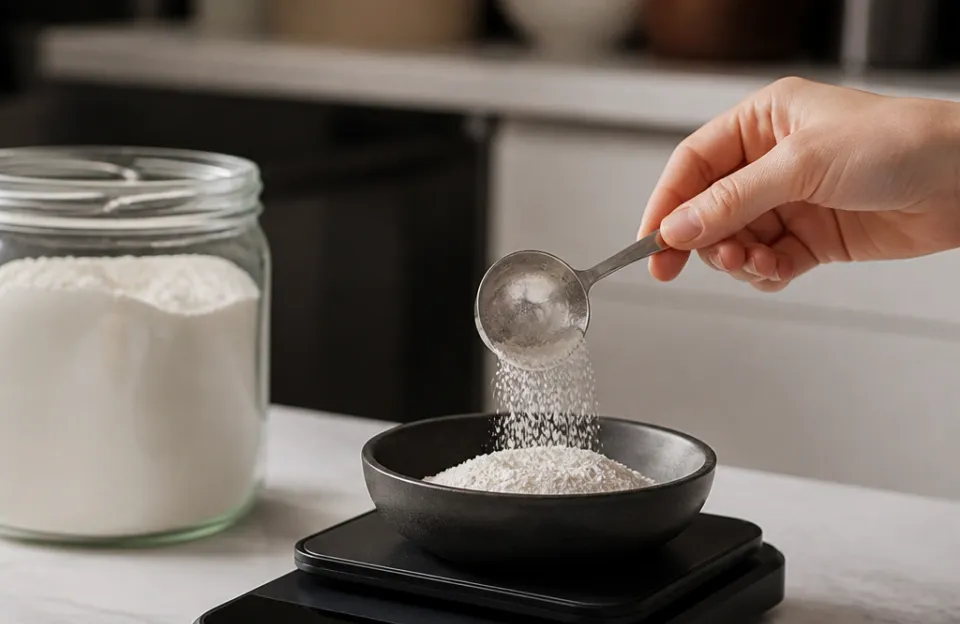
Using a food scale in grams, ounces, pounds, and other units takes about two minutes to learn. You place your container on the platform, press a button to zero it out, pick your preferred measurement unit, and add ingredients until the display shows the target number. That's the entire process.
Learning how to use a food scale in grams, ounces, pounds & other units removes the guesswork from cooking and baking. Volume measurements like cups vary wildly depending on how tightly you pack flour or sugar. Weight stays constant every single time.
Once you get comfortable switching between metric and imperial readings, recipes from any country become easy to follow.
Setting Up Your Kitchen Scale for Accurate Weighing
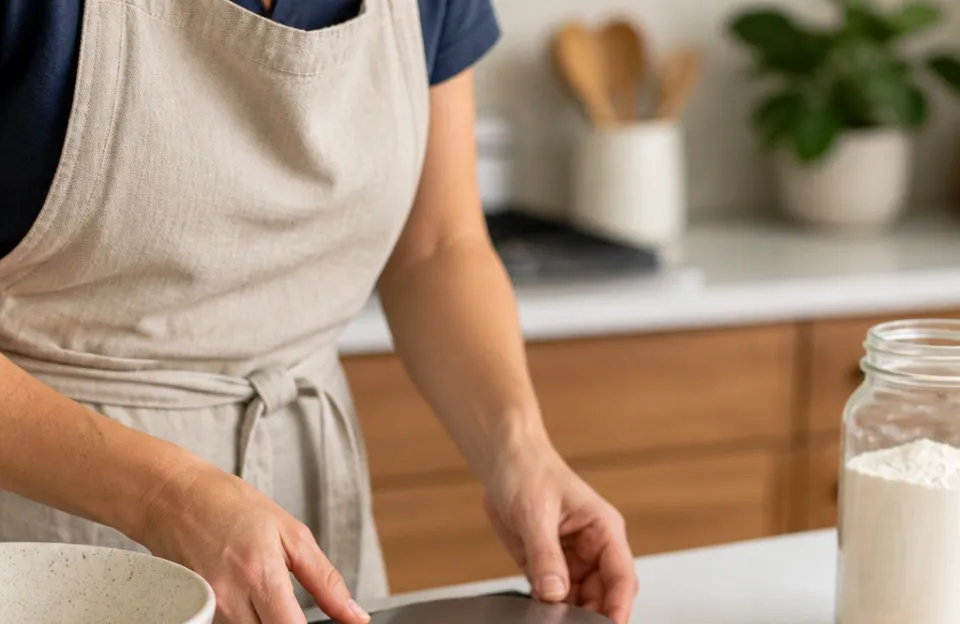
Every digital food scale needs a flat, stable surface to work correctly. Place it on a hard countertop. Avoid cutting boards that rock or silicone mats that compress, because an uneven base throws off the load cell underneath the platform.
The load cell is the small sensor that translates physical pressure into a digital number.
Turn the scale on using the power button. Most models take one or two seconds to boot up and display "0" or "0.0". If the screen shows a number other than zero before you put anything on it, press the tare or zero button once.
This resets the sensor so your starting point is completely clean.
Check the battery indicator if your model has one. A low battery causes the numbers to jump around or freeze entirely. Scales powered by an AC adapter don't have this problem, though they limit where you can stand in the kitchen.
If you notice erratic readings while portioning meals, fresh batteries usually fix it. For tasks requiring strict precision, pairing your weighing routine with a reliable temperature probe helps you track both weight and heat without guessing.
Switching Between Grams, Ounces, Pounds, and Milliliters
Digital scales include a dedicated button to cycle through different units of measurement. It is usually labeled "Unit," "Mode," or marked with a symbol showing multiple abbreviations. Pressing it once changes the display from grams (g) to ounces (oz).
Pressing it again might switch to pounds and ounces (lb:oz), then milliliters (ml), and finally fluid ounces (fl oz). The exact sequence depends on your specific model.
Grams are the standard for baking. Professional bakers and recipe developers write formulas in grams because the metric system divides cleanly. One hundred grams of flour is always exactly one hundred grams.
Ounces are common in American cooking, especially for proteins and produce. A chicken breast might weigh six or eight ounces. Pounds handle larger quantities, like a whole roast or a bulk bag of rice.
Milliliters and fluid ounces on a food scale estimate volume based on the density of water. One milliliter of water weighs exactly one gram. So the scale assumes whatever you pour has the same density as water.
This works fine for broth, milk, or water. It fails completely for honey, oil, or heavy syrups. Honey is much denser than water, so 100 milliliters of honey will register as roughly 140 grams on the display.
Always weigh thick liquids in grams rather than relying on the milliliter setting.
| Unit | Abbreviation | Best Used For | Accuracy Note |
|---|---|---|---|
| Grams | g | Baking, spices, coffee | Exact metric standard |
| Ounces | oz | US recipes, meat portions | 1 oz equals 28.35 g |
| Pounds/Ounces | lb:oz | Large cuts of meat, bulk items | Shows mixed fractions |
| Milliliters | ml | Water-thin liquids only | Assumes water density |
| Fluid Ounces | fl oz | US liquid recipes | Assumes water density |
If you need official conversion standards, the National Institute of Standards and Technology publishes exact weights and measures data. Knowing these conversions matters when you adapt international recipes.
Using the Tare Button to Weigh Multiple Ingredients in One Bowl
The tare function is the most useful tool on the device. Taring subtracts the weight of whatever is already sitting on the platform, resetting the display back to zero. This lets you build a recipe inside a single mixing bowl without dirtying extra dishes.
Place your empty bowl on the scale. The screen will show the bowl's weight. Maybe it reads 300 grams.
Press the tare button. The screen drops to zero. Now add your first ingredient, say flour, until the display reads 250 grams.
Press tare again. The screen returns to zero, holding the flour's weight in its memory. Add sugar until the screen hits 100 grams.
Press tare. Add butter until you see 50 grams. You just measured three separate ingredients perfectly using one container.
You can keep taring as many times as you want until you hit the scale's maximum capacity. Just remember that the total combined weight of the bowl plus all the ingredients cannot exceed that limit. If your scale maxes out at 5 kilograms, and your heavy glass bowl weighs 1 kilogram, you only have 4 kilograms of actual food capacity left.
Taring also applies when you switch units. If you tare a bowl in ounces, then switch the unit button to grams, the scale recalculates the zeroed state automatically. You don't need to tare again after changing units.
When measuring dry goods, keeping your workspace organized goes hand in hand with knowing how to maintain your prep area so crumbs don't interfere with the sensor pad.
Measuring Dry Ingredients Without Messing Up the Reading
Dry ingredients behave differently than solid blocks of cheese or whole vegetables. Flour compacts easily. Sugar pours fast.
Spices are incredibly light. Each requires a slightly different approach to get an accurate reading.
For flour, spoon it gently into the bowl sitting on the scale. Don't scoop directly with the measuring bowl, because scooping packs air out and adds too much weight. Since you are using a scale, packing doesn't matter as much as it does with measuring cups, but dumping a massive pile all at once can overshoot your target.
Add it slowly near the end. If you need exactly 125 grams, pour steadily until you hit 115 grams, then add small pinches until the display settles on 125.
Sugar is heavier and flows faster. Pour it from the bag carefully. Granulated sugar rarely clumps, so it falls evenly onto the platform.
Brown sugar contains molasses and tends to stick together. Break up large chunks before adding them to the bowl so the scale registers the true weight rather than a hollow lump.
Spices and salt require a scale with high resolution. Resolution refers to the smallest increment the display can show. A standard kitchen scale reads in 1-gram increments.
That works for flour. It fails for saffron or yeast, where you might need 0.5 grams. If you bake bread frequently, a scale that reads down to 0.1 grams prevents over-salting or killing your dough with too much yeast.
Precision here pairs well with checking your dough temperatures accurately during fermentation.
Weighing Liquids and Sticky Foods Like Honey or Oil
Liquids slosh. When you pour water or milk into a bowl on the scale, the number will bounce up and down for a second or two before settling. Wait for the display to stabilize before you stop pouring.
If you pull the jug away while the number is still jumping, you will likely overshoot your target.
Sticky foods present a different challenge. Peanut butter, honey, and molasses cling to spoons and spatulas. If you measure honey by scooping it onto the platform, some of that weight stays stuck to your spoon, meaning less honey actually ends up in your recipe.
To fix this, place your mixing bowl on the scale, tare it, and pour the sticky ingredient directly from its jar into the bowl. Watch the number climb and stop pouring when you hit the target weight.
Oils are slippery and pour quickly. Tip the bottle very slowly as you approach the final few grams. Olive oil weighs slightly less than water per milliliter, which is why using the gram setting is far more reliable than the fluid ounce setting for fats.
If you are tracking macros or calories, weighing oils in grams gives you the exact amount needed for nutrition apps.
Understanding Scale Capacity and Why It Matters for Big Cuts of Meat
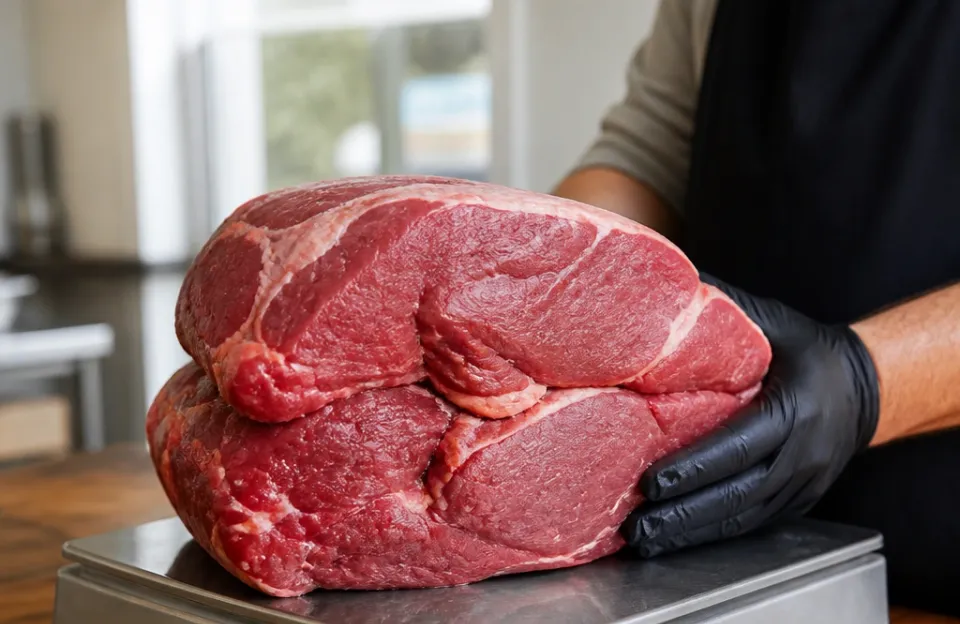
Every food scale has a maximum weight limit. Common capacities are 3 kilograms, 5 kilograms, or 11 pounds. Exceeding this limit damages the internal load cell permanently.
The screen might flash an error code like "EEEE" or "OUT", or it might just go blank. Once a load cell is crushed by excess weight, the scale will never read accurately again.
If you cook large roasts, whole turkeys, or buy meat in bulk, check the capacity before purchasing a scale. A 3-kilogram scale handles daily baking and dinner prep. It cannot hold a 6-kilogram bone-in pork shoulder.
For those larger jobs, you need a higher-capacity model. Some scales offer a 10-kilogram limit, though they often sacrifice fine resolution, reading in 2-gram or 5-gram jumps instead of 1-gram increments.
When you are portioning a large piece of meat, place the cutting board on the scale first, tare it, and then set the protein down. This keeps raw juices off the scale's electronics. After portioning, verify your cooked results using a fast wireless thermometer to confirm the center reaches safe temperatures.
Converting Recipe Units Manually When Your Scale Lacks a Specific Setting
Sometimes a recipe calls for a unit your scale doesn't support natively, or you prefer working strictly in grams. Basic math handles this instantly.
One ounce equals 28.35 grams. If a recipe asks for 4 ounces of cream cheese, multiply 4 by 28.35. You need 113.4 grams.
Round to 113 grams; no home recipe requires sub-gram accuracy for dairy.
One pound equals 16 ounces, or 453.6 grams. If you need 2 pounds of ground beef, set the scale to grams and aim for 907 grams. Alternatively, switch the scale to the "lb:oz" mode if it has one.
In that mode, 2 pounds displays as "2:00" or "2 lb 0 oz".
Fluid ounces confuse people because they measure volume, not weight. Eight fluid ounces of water weighs about 236 grams. Eight fluid ounces of vegetable oil weighs roughly 218 grams.
Because densities change, converting fluid ounces to grams requires knowing what liquid you are pouring. Stick to weight-based recipes whenever possible to avoid doing density math in your head.
Troubleshooting Jumping Numbers and Drifting Readings
A scale that won't settle on a number is frustrating. Several common issues cause drifting or jumping digits.
Airflow is a frequent culprit. A ceiling fan blowing directly down, an open window, or even an air conditioning vent hitting the platform creates downward pressure. The load cell interprets this moving air as fluctuating weight.
Move the scale away from drafts.
Vibrations cause similar problems. If your scale sits next to a running dishwasher or a washing machine, the micro-vibrations travel through the counter and shake the sensor. Relocate the scale to a quieter part of the kitchen.
Debris trapped under the weighing platform prevents it from resting flat against the sensor. Crumbs, spilled sugar, or a piece of plastic wrap wedged underneath will make the numbers drift upward slowly. Flip the scale over and clear the gap between the platform and the base.
Low batteries cause the processor to lag. The display might freeze, jump in large increments, or shut off randomly. Replace them with fresh ones.
Rechargeable scales should be topped off before a long baking session. If you rely heavily on rechargeable tools in the kitchen, keeping your probes fully charged alongside your scale prevents mid-recipe failures.
Cleaning the Platform Without Damaging the Load Cell
Food scales get dirty. Flour dust coats the buttons, and meat juices drip onto the platform. Cleaning them requires care because water and electronics don't mix.
Never submerge a food scale in the sink. Water seeps through the seams around the buttons and destroys the circuit board. Instead, wipe the surface with a damp cloth.
Use mild dish soap if grease is present. Wring the cloth out thoroughly so it is barely wet, not dripping.
For stubborn dried dough or sticky syrup, lay a warm, damp cloth over the spot for a minute to soften it. Then wipe it away gently. Do not scrape the platform with a knife or metal spatula.
Scratching the surface creates grooves where bacteria hide, and pressing down hard while scraping can bend the load cell beneath.
If your scale has a removable stainless steel platform, take it off and wash it in the sink separately. Dry it completely before snapping it back onto the base. Plastic platforms usually stay attached, making the damp-cloth method your only option.
Frequently Asked Questions
Can I use a food scale to weigh letters or packages for postage?
Yes, provided the item falls within the scale's maximum capacity and fits on the platform. Switch the unit to ounces or pounds, place the envelope on the scale, and read the weight. However, postal services require certified scales for official commercial shipping.
For personal letter mail, a kitchen scale works fine.
Why does my scale show a negative number after I remove my bowl?
This happens if you turn the scale on while the bowl is already sitting on it, or if you press tare without anything on the platform and then add weight later. When you remove the bowl, the scale subtracts that weight from its current zero point, resulting in a negative number. Turn the scale off and back on with an empty platform to reset it.
Is there a difference between a food scale and a nutrition scale?
Nutrition scales include built-in databases of foods. You type in a code for an apple, weigh it, and the screen calculates calories, carbohydrates, and fats automatically. A standard food scale only displays weight.
Both use identical load cells and measure in the same units, but nutrition scales cost more due to the software.
Does altitude affect how a food scale reads weight?
No. Digital food scales measure mass pressing down on a load cell, not atmospheric pressure. Unlike boiling points, which drop at higher elevations, gravity remains consistent enough across everyday altitudes that a kitchen scale reads the exact same in Denver as it does in Miami.
How often should I calibrate my food scale?
Home cooks rarely need to calibrate their scales unless they drop them or suspect inaccurate readings. If you want to test it, place a known weight on the platform. A brand-new, unopened roll of US nickels works well.
Each nickel weighs exactly 5 grams. Ten nickels should read 50 grams. If the display is off by several grams, consult your manual for the calibration button sequence.
Can I weigh hot pans directly on the scale?
Avoid placing extremely hot cookware directly on a plastic platform. High heat warps the plastic and can damage the load cell adhesive. Stainless steel platforms handle moderate heat better, but transferring a pan straight from a 400-degree oven risks melting internal components.
Let the pan cool slightly, or transfer the food to a room-temperature bowl placed on the scale.
Getting Consistent Results Every Time You Cook
Mastering how to use a food scale in grams, ounces, pounds & other units comes down to three habits: always start on a flat surface, use the tare button relentlessly, and wait for the display to stop moving before you record the number. Once those steps become automatic, you'll stop worrying about packed flour or overflowing measuring cups. Your recipes will yield the same result on Tuesday as they did last month.
That consistency is the entire reason professional kitchens abandoned volume measurements decades ago, and it is the fastest way to improve your own cooking at home.